Compounded bioidentical regimens commonly cost about $80 to $150 per month in medication alone. FDA-approved generics cost far less at the pharmacy, and your real total still depends on labs and follow-up visits.
The monthly medication price is usually the smallest line on the bill. A 2016 peer-reviewed analysis estimated that U.S. pharmacies dispensed about 26 to 33 million compounded bioidentical hormone therapy prescriptions a year. At an estimated average of $49 out of pocket, that spending landed near $1.3 to $1.6 billion, and medication alone at that price was about $588 a year before any consult or lab, according to the 2016 analysis in PubMed Central.
Bioidentical names a molecule, not a bill. Estradiol that matches the hormone your body makes can be an FDA-approved generic or a custom compound, and those routes don't share a price, a payer, or a quality review. Every figure below is an estimate from published market reports, not a clinic quote.
Table of Contents
- Hormone Therapy Costs at a Glance
- Why Compounded and FDA-Approved Costs Differ
- The Cost Drivers Beyond the Medication Price
- What a Full Year Really Costs
- How ProMD Structures Hormone Program Pricing
- Insurance, Financing and Your Written Quote
Hormone Therapy Costs at a Glance
Read the table left to right. The monthly medication figure comes first, then the annual medication figure. Nothing in the grid includes a consultation, bloodwork, or a follow-up.
| Option | Typical cost per month | Typical cost per year | Notes |
|---|---|---|---|
| FDA-approved oral estradiol, 90-day generic supply | about $3 to $10 | about $40 to $120 | Discount pricing for a 90-day supply of $10 to $30 |
| FDA-approved estradiol patch, generic | $30 to $65 | about $360 to $780 | Discount pricing; coverage depends on the plan |
| Compounded cream or oral troche | $80 to $150 (reports up to $300) | about $960 to $1,800, or up to $3,600 | Often cash-pay and usually not reimbursed |
| Compounded topical combination, early menopause | $80 to $120 | about $960 to $1,440 | Several hormones such as Bi-est, progesterone, testosterone, and DHEA |
| Compounded topical combination, three years in | $160 to $220 | $1,920 to $2,640 | Medication only; excludes visits and testing |
| Pellet insertion | $400 to $800 per insertion, every 3 to 5 months | about $960 to $3,200 | Market estimate; pellets are not on ProMD's confirmed service list |
Pharmacy-counter generics
A 90-day supply of generic oral estradiol has been listed around $10 to $30 on discount pricing, which is roughly $3 to $10 a month, or about $40 to $120 a year. Generic patches in the same pricing examples run about $30 to $65 a month, or about $360 to $780 a year. Compounded creams and oral troches in those examples commonly run $80 to $150 a month, with some reports at $250 or more, as summarized by The HRT Index pricing examples. At the $300 ceiling used in wider market writeups, cream or troche medication alone is about $3,600 a year.
Multi-hormone topicals and pellets
A topical compound that combines several hormones, such as Bi-est or Tri-est, progesterone, testosterone, and DHEA, was estimated at about $40 to $60 per prescription, and at $80 to $120 a month when more than one preparation was used. By three years into menopause that stack was estimated at $160 to $220 a month, or about $1,920 to $2,640 a year in medication, before visits and testing, in the National Academies review of menopausal hormone therapy. Pellet rows are a different billing cycle. At $400 to $800 an insertion, every three months is four insertions a year ($1,600 to $3,200). Every five months is about $960 to $1,920. Those pellet cells are market estimates only.
Practical rule: Find your row, multiply the monthly medication figure by twelve, then add consults, labs, and follow-ups before you compare any two providers.
Why Compounded and FDA-Approved Costs Differ
Calling a hormone bioidentical doesn't make it cheaper, and it doesn't make it safer. The word only means the molecule matches one the body makes.
FDA-approved estradiol and micronized progesterone are that kind of molecule, sold as finished drugs with standardized strength and quality controls. Many products marketed as "bioidentical hormones" are something else. The FDA's consumer update on bioidentical hormones states that many of those products are compounded drugs and are not FDA-approved. Compounded drugs aren't reviewed for safety, effectiveness, or quality before marketing. The same update says the FDA has no evidence that compounded bioidentical hormones are safer or more effective than FDA-approved hormone therapy.
The premium on the receipt
A 2017 survey put the average out-of-pocket price at about $49 for FDA-approved postmenopausal hormone therapy and about $88 for compounded bioidentical hormone therapy, roughly 80% higher for the compounded option. Conventional FDA-approved therapy in that review ran about $430 to $830 a year, as reported in a 2024 clinical review of menopausal hormone therapy costs. If the active hormone is already sold as a generic, the extra dollars are a compounding premium, not a different hormone.
That premium can grow after the first fill. Compounded menopausal formulations can lack rigorous quality control, which can mean variable absorption and potency, levels that run too high or too low, and differences in purity. The FDA's overview of compounded-drug risks is clear that these products aren't evaluated for safety, effectiveness, or quality before marketing. A low first quote can turn into extra visits, repeat labs, and a new prescription.
If the symptom is vaginal dryness rather than a need for several systemic hormones, start by comparing simpler local options. A plain guide to compare menopausal dryness treatments is a useful checkpoint before you pay for a custom cream.
Ask one question before you accept a compound: is this active hormone already available as an FDA-approved generic, and what is the compounding premium buying? Our HRT medication page is the place to see how prescribed hormone therapy is framed before you price a custom recipe against a finished drug.
The Cost Drivers Beyond the Medication Price
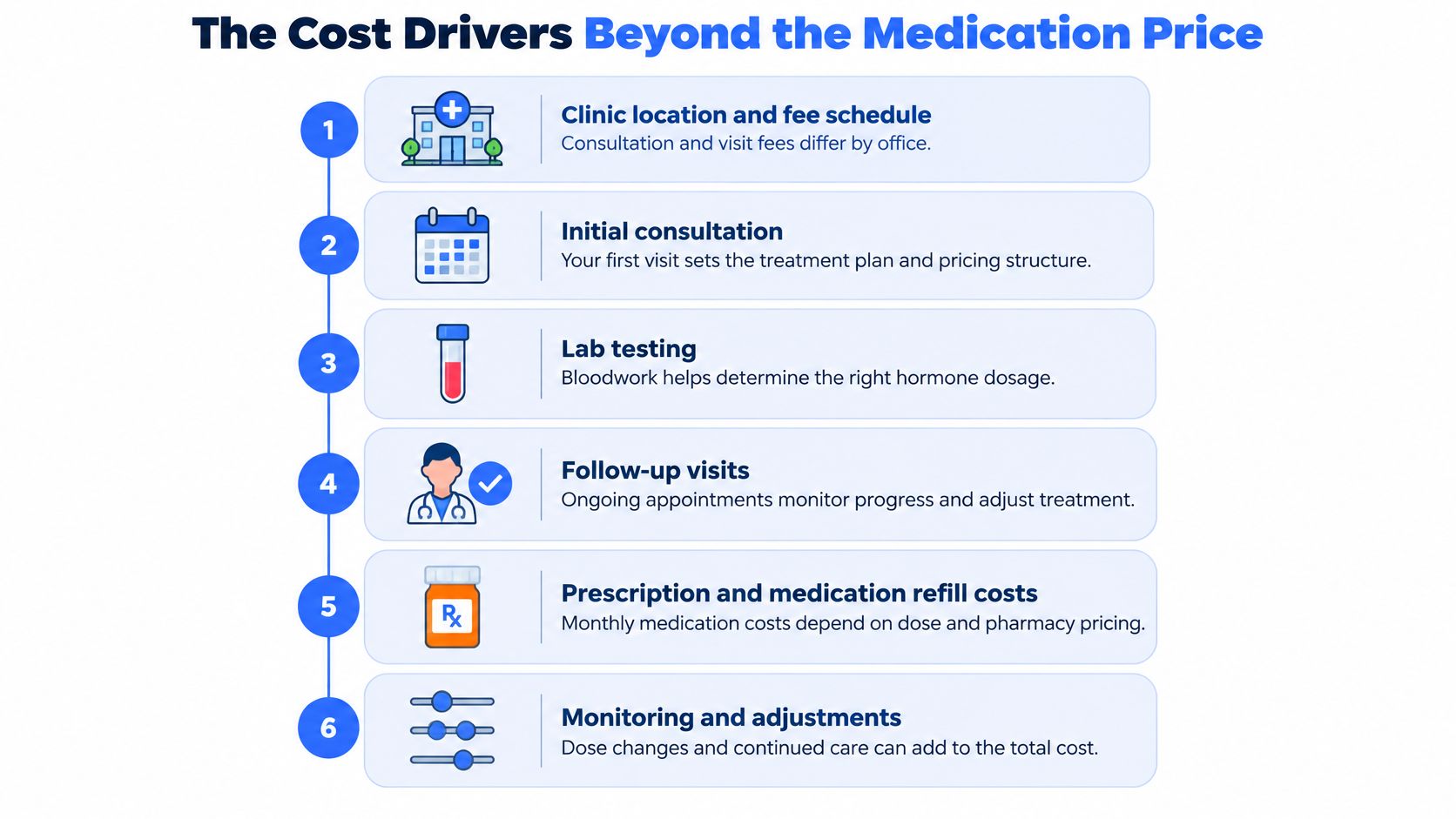
Medication is one layer. The rest of the bill shows up in the order you meet it, and each layer can dwarf a cheap monthly fill.
Where the first dollars go
Clinic location and fee schedule. Consultation and visit fees differ by office and market. Compare the same visit type, not a new-patient visit at one office against a short refill visit at another.
Initial consultation and labs. The first visit sets the plan. For hormone imbalance, our providers order thorough lab work to identify specific imbalances and build a targeted treatment plan. Hormone testing has been reported at about $285 to $360, with ancillary tests adding about $180 out of pocket, in that same 2024 review of therapy costs. A panel in that range already equals several months of generic oral estradiol.
Formulation. One hormone costs less than a combination. A multi-hormone topical costs far more across a year than a single FDA-approved oral product, because you are paying for several ingredients, a custom base, and a cash price.
Delivery method and the visits after
Delivery and billing cycle. Creams and troches are usually monthly. Patches follow a pharmacy refill. Pellets are a procedure fee on a multi-month clock.
Follow-up and monitoring. Retesting, dose changes, and product switches add visits. A low monthly price can hide a higher annual total once those visits are on the calendar.
Published estimates put compounded creams or oral troches at about $80 to $300 a month. Separate pellet reviews put insertion near $350 to $600, with a median near $375, and replacement generally every three to six months. Another commonly cited band is about $400 to $800 every three to five months. Those are market estimates, not universal prices, and the Clear Hormones cost review tells patients to check whether insertion, consult, labs, medication, and follow-up are included. Compounded products and pellets are often left off insurance formularies, so the cash price is the price that matters. Pellet figures here are market context only. They aren't a confirmed service on this article's offer list. Readers comparing that model can read a separate note on pellet hormone therapy and still verify what any clinic provides.
Say a compounded cream is $120 a month. Medication alone is about $1,440 before the first visit. Add an initial panel in the $285 to $360 range, ancillary tests near $180, and two follow-ups, and the first-year total sits well above the number in the ad.
What a Full Year Really Costs
Three sketches show how the medication line grows once visits and labs are added. Each one is an estimate, not a quote.
Profile A, generic oral estradiol
Medication is a 90-day generic supply at $10 to $30, about $40 to $120 a year. One initial lab panel, using the reported $285 to $360 band plus about $180 in ancillary tests, is already larger than the entire year of pills. Two follow-up visits sit on top of that. The drug is the cheap line. The year is mostly clinical time.
Profile B, compounded cream or troche
At $80 to $150 a month, medication is $960 to $1,800 a year before any visit. At a reported $300 ceiling, medication alone is about $3,600. The same first panel and two follow-ups still get added. A clinic that advertises "about $100 a month" has described the cream, not the year.
Profile C, a combination three years in
At $160 to $220 a month, medication alone is $1,920 to $2,640 a year. Labs and follow-ups are extra again. This is the profile where a monthly ad and a 12-month total look like different treatments.
Use the same four steps on any of them.
- Take the annual medication figure.
- Add the initial consultation and lab work at the reported levels.
- Add follow-ups and any retest or dose-change visit.
- Compare that total with the monthly figure the clinic advertised.
Pellets don't follow a monthly copay. Insertions every three to five months at $400 to $800 each add about $960 to $3,200 a year before labs. That pattern is market context, not a price we are quoting.
Every number on this page stays an estimate until a written quote replaces it.
How ProMD Structures Hormone Program Pricing
Hormone pricing here is a sequence, not a single monthly fee. The table compares in-clinic care with virtual care. Blank-looking fees are items you confirm in writing. They aren't hidden rates.
| Pricing element | In-clinic program | ProMD Connect |
|---|---|---|
| Initial consultation | Complimentary aesthetic consultation, booked online | Virtual consultation through ProMD Connect |
| Lab work | Ordered by the provider to identify specific imbalances | Confirm lab fees for remote care before you start |
| Medication | Prescribed by the provider after labs | Prescription options shipped to the patient's door |
| Follow-up visits | Confirm in your written quote whether visits are included | Confirm in your written quote whether visits are included |
What the first visit is, and isn't
The first step you can book on the website is a complimentary aesthetic consultation. That visit is not a promise that hormone care, lab fees, or medication are included. Hormone services aren't confirmed at every office, so the booking step includes a location check. Ask whether that office offers hormone optimization before you hold a time.
When hormone care begins, a provider orders detailed lab work to identify specific imbalances and develops a targeted treatment plan. You shouldn't expect a prescription price before those results, because the plan is based on the panel, not from a package menu.
Virtual care still has a lab line
ProMD Connect is a virtual wellness platform with guided hormone optimization, along with weight loss and peptide therapy, and prescription options shipped to your door. Shipping can cut travel. It doesn't remove labs or follow-up. Confirm lab fees and shipping terms for remote care before you treat a shipped prescription as the whole cost.
Each office that offers wellness services is staffed by providers trained in functional medicine, hormone optimization, and weight management. The quote is for that oversight plus the medication, not for a jar alone.
Per-program prices aren't listed in the research behind this article. Get a written quote that separates medication, labs, and follow-ups before you commit. No payment plan is verified here, so don't assume financing is available. Availability differs by office. Confirm hormone services at your location before you book.
Insurance, Financing and Your Written Quote
ProMD Health operates on a cash-pay model. Don't assume a health plan will pay for a hormone visit, a lab, or a prescription here. A low copay at some other pharmacy is not a ProMD benefit.
Coverage in the wider market isn't a yes-or-no question either. It changes with the product, the formulary, the deductible, the indication, and whether the prescription is compounded. A 2025 U.S. survey reported that 26% of women had menopause prescriptions fully covered, 60% paid a copay, and 8% reported no coverage. Another 2025 survey found that nearly 60% paid out of pocket and 45% had a full or partial denial, as compiled by The HRT Index on U.S. menopause costs. A small pharmacy copay can still leave a separate consult, a lab bill, and a telehealth fee. An independent clinician plus an FDA-approved generic on a pharmacy benefit can cost less than an advertised clinic bundle. That comparison is about the outside market, not a claim that our services bill to insurance.
The ACOG clinical consensus on compounded bioidentical menopausal hormone therapy notes that cost and access lead some patients to consider compounded vaginal estrogen or progesterone, and it recommends asking the pharmacy about quality control, potency, and the delivery vehicle. FDA-approved formulations have established pharmacokinetic data and are the products most often handled through standard prescription benefits. Ask whether a quoted price already nets out insurance, whether the pharmacy is in network, and whether the consult, labs, shipping, and follow-ups are billed separately.
No payment plan or third-party financing is confirmed for these programs. Treat any financing language as unverified until someone puts it in writing, and review the financing offers page only as a place to check what is posted.
Written quote checklist
- Ask for the 3-month total and the 12-month total.
- Confirm whether each product is FDA-approved or compounded, and which pharmacy fills it.
- Confirm whether the consultation, labs, retesting, dose-change visits, and shipping are included.
- Ask how many follow-ups are included and what an extra visit costs.
- If anyone offers a pellet, ask the insertion fee, the replacement interval, and whether insertion is included. Don't treat pellets as part of our confirmed menu.
- Ask whether any outside pharmacy or lab would bill insurance, whether that lab is in network, and whether prior authorization applies. That question is not a statement that our fee is covered.
- Ask for refill terms and cancellation terms in writing.
This week, book the complimentary consultation, bring recent lab results if you have them, and request a written 12-month total before you start therapy.
ProMD Health offers hormone optimization and menopause management with lab-based planning, in clinic or through ProMD Connect, and the medication is only one part of what you are pricing. If you want a cash-pay quote that separates the prescription from labs and follow-ups, book a complimentary consultation and ask for the 12-month total before you start. Visit ProMD Health to check your office and book that visit.