A liquid facelift is a non-surgical facial-rejuvenation approach that typically combines dermal fillers to restore volume with botulinum toxin to relax dynamic wrinkles, producing a refreshed look without incisions or general anesthesia. In 2024, 5,331,426 hyaluronic-acid filler procedures were recorded in the United States, reflecting how established injectable facial rejuvenation has become.
You may notice the change gradually. Your forehead looks more lined in photographs, your cheeks seem flatter, or your jawline no longer appears as defined as it once did. Yet the mirror may not show one isolated problem. Facial aging usually involves movement-related lines, changing volume, softer contours, and shifts in skin texture at the same time.
A liquid facelift addresses some of these changes with a coordinated plan rather than one universal injection. The right approach depends on whether your primary concern comes from muscle activity, volume loss, skin quality, or laxity. The sections below explain what the treatment involves, what it can't do, and how a qualified medical professional can help you decide whether injectables are enough.
Table of Contents
- Recognizing Facial Aging and Treatment Options
- How a Liquid Facelift Works by Design
- What Results to Expect and How Long They Last
- Liquid Facelift vs Surgical Facelift Explained
- Who Is an Ideal Candidate for This Approach
- Safety Considerations and Risk Awareness
- Choosing a Provider and Planning Next Steps
Recognizing Facial Aging and Treatment Options
A person might first notice facial aging while checking a phone photograph or applying makeup. The forehead lines that appear during concentration may remain visible at rest. The midface can look flatter, the lower face less defined, and the skin less even in texture. These changes don't necessarily arrive together, which is why a treatment that helps one area may not address another.
Aging changes have different causes
Dynamic expression lines come from repeated muscle movement. Volume loss can create hollow cheeks, under-eye depressions, or deeper folds around the nose and mouth. Softer jawline definition may reflect changes in facial volume and tissue support, while texture concerns involve the skin itself rather than the deeper structures.
That distinction matters. A product that relaxes a muscle won't replace volume, and a filler that adds support won't directly stop muscle contraction. Patients often seek a non-surgical option because they want visible refinement without the incisions, general anesthesia, and recovery associated with a traditional facelift.

Why combination treatment can make sense
The term liquid facelift describes a multi-injectable facial-rejuvenation strategy, not a single standardized medical procedure. A clinician may combine a neuromodulator with filler, use filler in selected facial regions, or recommend a different plan when skin quality or significant laxity drives the concern.
Practical rule: Identify the dominant cause of aging in each area before choosing a product.
ProMD Health provides medically supervised aesthetic services across its approved clinic markets, including injectable facial rejuvenation. A consultation should help you understand which concerns are realistically treatable, which products may be appropriate, and whether a surgical opinion would better match your goals.
How a Liquid Facelift Works by Design
A liquid facelift works by addressing two different mechanisms of facial aging. Botulinum toxin temporarily reduces selected muscle activity, while dermal fillers add volume or support beneath the skin. The clinician may use these tools separately or together, depending on facial anatomy and the desired degree of correction.
Botulinum toxin is suited to expression lines caused by repeated contraction, including selected frown lines, forehead lines, and crow's feet. Fillers are used for structural concerns such as reduced fullness in the cheeks, lips, chin, jawline, under-eye hollows, and nasolabial folds. The FDA's guidance on dermal fillers explains that fillers are gel-like substances injected beneath the skin to create a smoother or fuller appearance, and that common short-term effects include swelling and bruising.
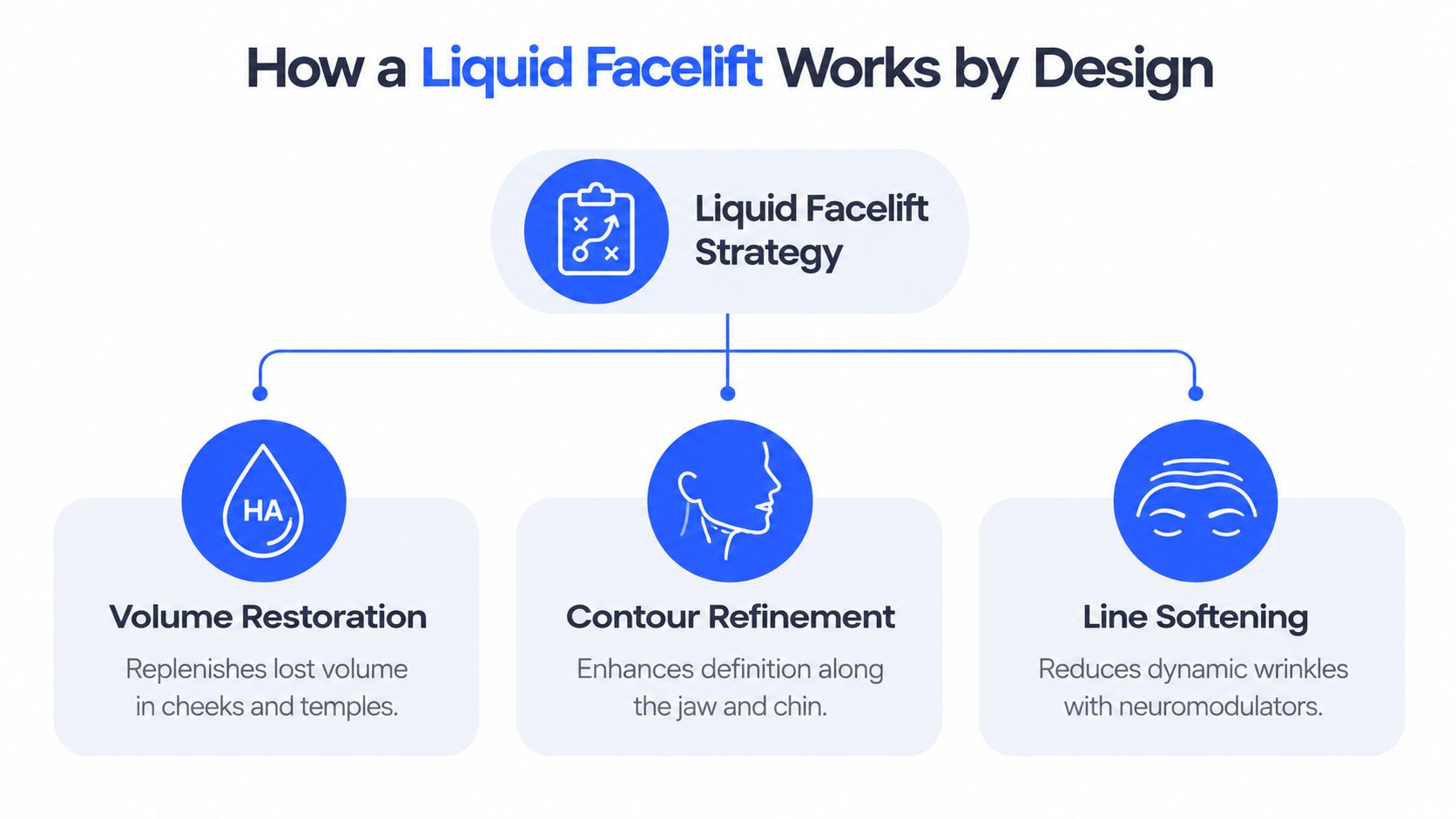
The two components aren't interchangeable
Think of facial muscles as moving hinges and lost volume as missing support beneath a cushion. Relaxing a hinge can soften a crease created by motion, but it won't refill a hollow area. Adding support beneath the cushion can improve contour, but it won't prevent the hinge from moving.
Hyaluronic-acid fillers provide immediate volumization and may be reversible with hyaluronidase when clinically appropriate. Other products, including calcium hydroxylapatite or poly-L-lactic acid, can create a more gradual effect by supporting collagen-related remodeling. Product choice should account for tissue thickness, vascular anatomy, facial asymmetry, the treatment area, and the patient's preferred degree of correction.
For a patient researching filler options, the educational overview of dermal fillers from ProMD Health can provide useful background before a consultation. Another helpful resource is this explanation of Beverly Hills med spa injectables, which illustrates how practices may discuss injectable planning in relation to facial concerns.
Customization matters more than syringe count
A qualified injector shouldn't plan treatment around a fixed amount of product for every face. The plan should consider:
- Facial region: Cheeks, lips, chin, jawline, and under-eye hollows have different structural and vascular considerations.
- Skin and tissue characteristics: Thin skin, baseline asymmetry, and existing laxity affect how much correction looks balanced.
- Treatment goal: A patient seeking line softening needs a different strategy from someone seeking contour refinement.
- Staging: Conservative treatment and follow-up assessment can help prevent unnecessary heaviness.
The result is modular rather than universal. A liquid facelift can refine selected contours and soften certain lines, but it doesn't reproduce the structural lifting of surgery.
What Results to Expect and How Long They Last
Results depend on the product, injection sites, facial movement, tissue characteristics, and the treatment plan. Hyaluronic-acid filler can create visible volume soon after placement, although swelling may temporarily make the result look fuller than the intended outcome. Botulinum toxin works by temporarily reducing muscle activity, so its effect develops rather than appearing as a permanent change at the moment of injection.
Biostimulatory injectables follow a different timeline. Products such as poly-L-lactic acid or calcium hydroxylapatite are selected for a more gradual collagen-related effect, which means the final appearance may evolve over time. Your clinician should explain what you may notice immediately, what may change as swelling settles, and when an assessment makes sense.
Results are temporary by design
Most FDA-approved fillers are eventually broken down and absorbed by the body, while botulinum toxin activity also declines. That means a liquid facelift doesn't permanently reshape facial structures. Maintenance isn't a sign that the original treatment failed. It reflects the temporary nature of injectable products and the continuing process of facial aging.
The scale of filler use helps explain why many patients are familiar with this category. The American Society of Plastic Surgeons data reported to the FDA lists 5,331,426 hyaluronic-acid filler procedures in 2023 and the same number in 2024. The report places hyaluronic-acid fillers among the five most common minimally invasive cosmetic procedures, within a total exceeding 28.5 million minimally invasive procedures in 2024.
Plan for follow-up, not a single event
A thoughtful treatment plan may involve an initial assessment, conservative correction, and later review. The purpose is to evaluate balance and response rather than add product automatically. Repeated treatment can also increase cumulative exposure to swelling, asymmetry, nodules, and delayed inflammatory reactions, so each maintenance visit deserves a fresh clinical assessment.
You can review general expectations in ProMD Health's guide to dermal filler results, then bring specific questions to a qualified provider. Ask which changes should appear quickly, which may evolve gradually, and what signs would indicate that another approach is more suitable.
Liquid Facelift vs Surgical Facelift Explained
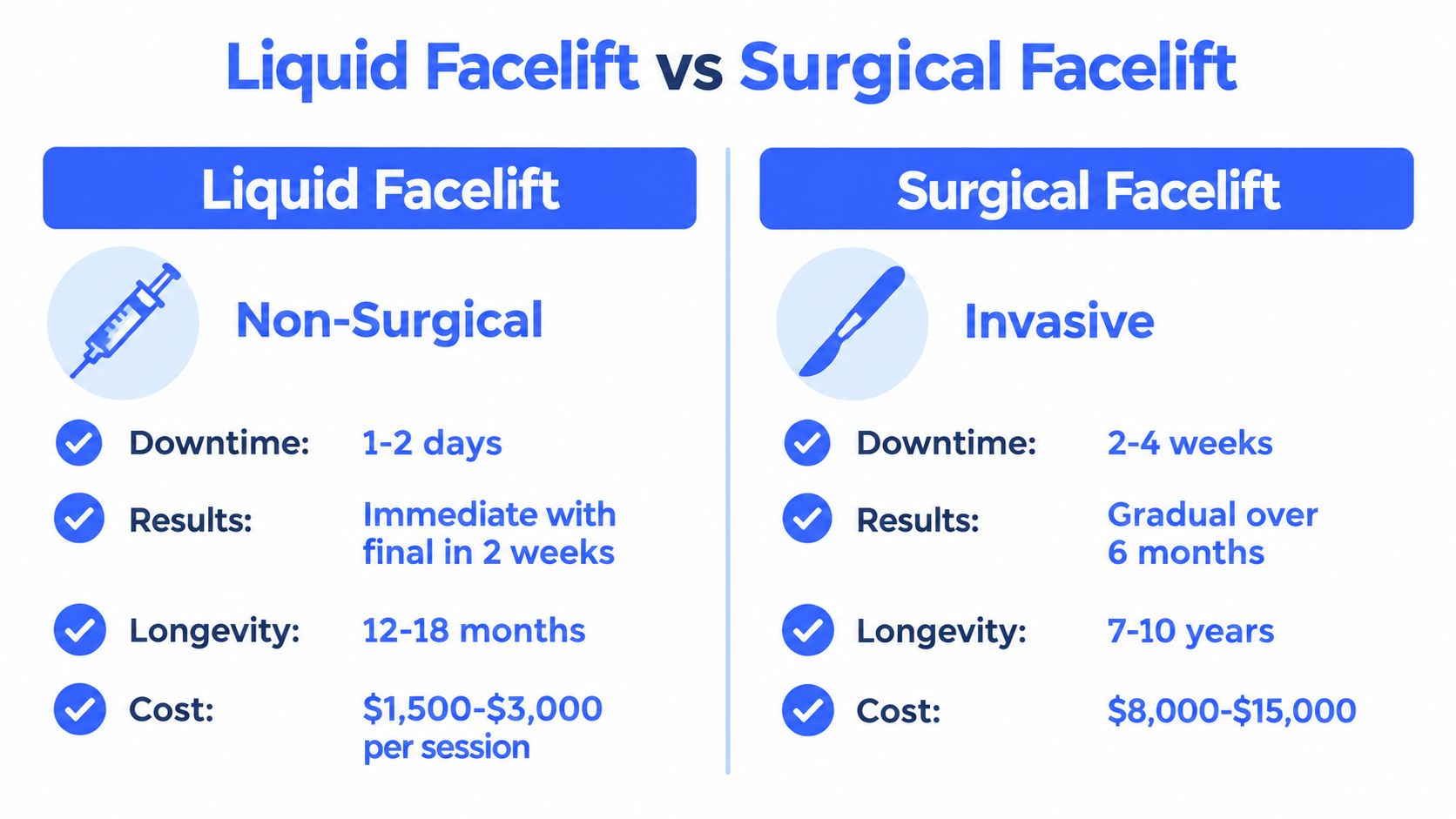
A liquid facelift and a surgical facelift address different anatomical problems. Injectables can redistribute volume, refine selected contours, and soften dynamic lines. Surgery can reposition descended tissues and remove substantial excess skin, which injectables can't accomplish.
Compare the treatment paths
| Consideration | Liquid facelift | Surgical facelift |
|---|---|---|
| How it works | Uses injectable products to address volume and selected lines | Repositions facial tissues and removes excess skin |
| Incisions and anesthesia | No surgical incisions or general anesthesia | Requires surgery, incisions, and anesthesia |
| Best suited to | Moderate volume loss, dynamic lines, and selected contour concerns | More advanced laxity, jowling, and excess skin |
| Longevity | Temporary, with maintenance as product effects decline | Generally more durable structural correction |
| Main limitation | Can't fully correct pronounced tissue descent | Requires greater recovery and procedural commitment |
The table is a decision aid, not a substitute for examination. Someone with cheek flattening and expressive lines may receive meaningful improvement from an injectable plan. Someone with marked jowling, loose lower-face skin, or advanced gravitational descent may need a surgical consultation because adding more filler could create fullness without solving the underlying laxity.
Choose based on the problem, not the label
Patients sometimes view a liquid facelift as a facelift without surgery. That description is incomplete. The injectable approach is better understood as targeted volume management and line softening, while surgical lifting changes the position of tissues that have descended.
A consultation can clarify where you fall on that spectrum. The educational discussion of which type of facelift may suit different concerns can help you prepare, but an in-person evaluation remains important because photographs and descriptions can't fully show tissue mobility, skin excess, or vascular anatomy.
Who Is an Ideal Candidate for This Approach
An appropriate candidate usually has concerns that respond to volume restoration, contour refinement, or reduced muscle activity. Common examples include flattened cheeks, under-eye hollows, softer jawline definition, marionette lines, and expressive forehead or glabellar lines. The person may want a refreshed appearance without surgery and should understand that the result will be temporary.
The better question isn't, “How much filler can I receive?” It's, “Which visible change comes from a problem injectables can address?” More product doesn't necessarily produce a younger appearance. Excessive volume can create heaviness or alter facial balance, especially when the main issue is lax skin rather than deflation.
Signs the approach may fit
A clinician may consider an injectable plan when the patient has:
- Moderate volume loss: Hollowing in the cheeks, lips, chin, jawline, or under-eye area may respond to carefully selected filler.
- Dynamic expression lines: Muscle-related forehead, frown, or eye-area lines may respond to a neuromodulator.
- Defined expectations: The patient wants refinement, not a permanent structural lift.
- Willingness to follow up: Temporary products require ongoing evaluation and possible maintenance.
A liquid facelift may be less appropriate when substantial jowling or marked excess skin dominates the concern. Untreated dental or inflammatory conditions, unrealistic expectations, or an inability to return for follow-up also deserve attention before treatment.
Consider the personal outcome
A systematic review found that facial aesthetic injectables were generally associated with improvements in psychological well-being, social functioning, self-perception, appearance-related distress, and quality of life in selected adults. The strongest evidence involved single-modality botulinum toxin A, while evidence for hyaluronic-acid fillers and mixed injectable protocols was more heterogeneous, as described in this systematic review of psychosocial outcomes.
That evidence supports a balanced view. Patients may feel more comfortable with their appearance, but outcomes vary, and injections can't resolve every source of dissatisfaction. A provider should assess both anatomy and expectations before recommending treatment.
Safety Considerations and Risk Awareness
Injectable facial rejuvenation is a medical procedure, not just a cosmetic service. The most serious technical concern is inadvertent injection of filler into a blood vessel. An occlusion can restrict blood flow and, in rare cases, cause tissue death, stroke, or vision loss.
FDA educational material estimates vascular occlusion at approximately one in 5,000 injections, while another FDA panel summary cites approximately one in 6,000 syringes. These figures refer to injections or syringes rather than individual patients or complete liquid-facelift sessions, and risk varies with the product, location, technique, and anatomy. FDA guidance also reports that about 85% of vascular-occlusion cases resolved without lasting sequelae, while emphasizing that vision loss is the most concerning complication.
Know the warning signs
Contact the treating medical team immediately if you notice:
- Severe or unusual pain: Pain that seems disproportionate requires prompt assessment.
- Blanching or unusual skin color: Pale areas may indicate reduced perfusion.
- Livedo patterns: Mottled or netlike discoloration can signal vascular compromise.
- Delayed capillary refill: Skin that doesn't regain color normally needs evaluation.
- Visual symptoms: Any new visual disturbance after filler injection is an emergency.
The FDA material on dermal-filler risks and management emphasizes urgent treatment when vascular occlusion is suspected. Hyaluronidase may be considered for appropriate complications involving hyaluronic-acid filler, but patients shouldn't attempt to manage a suspected occlusion at home.
Ask how the practice prepares
A responsible provider should understand facial vascular anatomy, use conservative aliquots and low injection pressure, observe skin color and perfusion, and have a documented emergency pathway. The practice should also record product lot numbers and provide consistent follow-up.
Safety question: Ask who will evaluate you if severe pain, skin discoloration, or a visual change develops after treatment, and how quickly that person can respond.
Qualified medical oversight doesn't eliminate risk, but it supports better assessment, technique, recognition, and escalation when a complication occurs.
Choosing a Provider and Planning Next Steps
Start with the provider, not the product name. Look for a licensed medical professional who examines your facial anatomy, explains product selection, discusses limitations, and provides clear follow-up instructions. You should also receive understandable information about expected swelling, bruising, temporary results, and emergency contact procedures.
Ask whether the practice documents product details and maintains a protocol for suspected vascular complications. Some modern aesthetic practices also use pre-treatment visualization tools to help patients discuss possible changes before injections. These tools can support communication, but they can't replace clinical judgment or guarantee a particular result.
ProMD Health offers multi-location aesthetic care that includes dermal fillers, neurotoxin injections, biostimulatory approaches, and related medspa services. Its care model also includes ProMD Connect telehealth support for ongoing program management, while treatment availability and provider expertise should be verified with the specific office.

Bring questions to your consultation: Which facial changes come from muscle movement, volume loss, skin quality, or laxity? Which product, if any, fits each area? What would make injectables insufficient? A good plan may involve staged treatment, careful reassessment, or referral for surgical evaluation rather than immediate use of more product.
ProMD Health offers medically supervised dermal fillers, neurotoxin injections, and individualized facial-rejuvenation planning across its approved locations. Visit ProMD Health to explore available services and request a consultation about whether a liquid facelift fits your anatomy and goals.