Electrolysis is the only FDA-approved method for permanent hair removal, while laser treatment provides permanent hair reduction. Men commonly need 6 to 8 facial sessions and 8 to 12 trunk sessions, depending on hair density, skin type, and hormonal influences.
You may be dealing with a familiar problem: shaving your neck leaves irritation, waxing your chest becomes a recurring chore, or dense back hair makes you avoid certain clothes. Search results promise “permanent hair removal for men,” but that phrase hides an important distinction. Laser can substantially reduce regrowth over time, while electrolysis is the recognized permanent-removal method.
The right choice depends on your goal, treatment area, hair color, skin tone, and tolerance for maintenance. A beard line that needs careful shaping requires a different strategy from a dense back, and darker skin calls for a different wavelength assessment than fair skin.
Table of Contents
- Understanding Permanent Hair Removal Options for Men
- Laser Hair Removal vs Electrolysis for Men
- Choosing the Right Laser Wavelength for Your Skin Type
- Male Treatment Areas and What to Expect
- Why Clinic Treatment Beats At-Home Devices for Men
- Making Your Decision – A Decision Framework for Men
- Taking the Next Step Toward Lasting Results
Understanding Permanent Hair Removal Options for Men
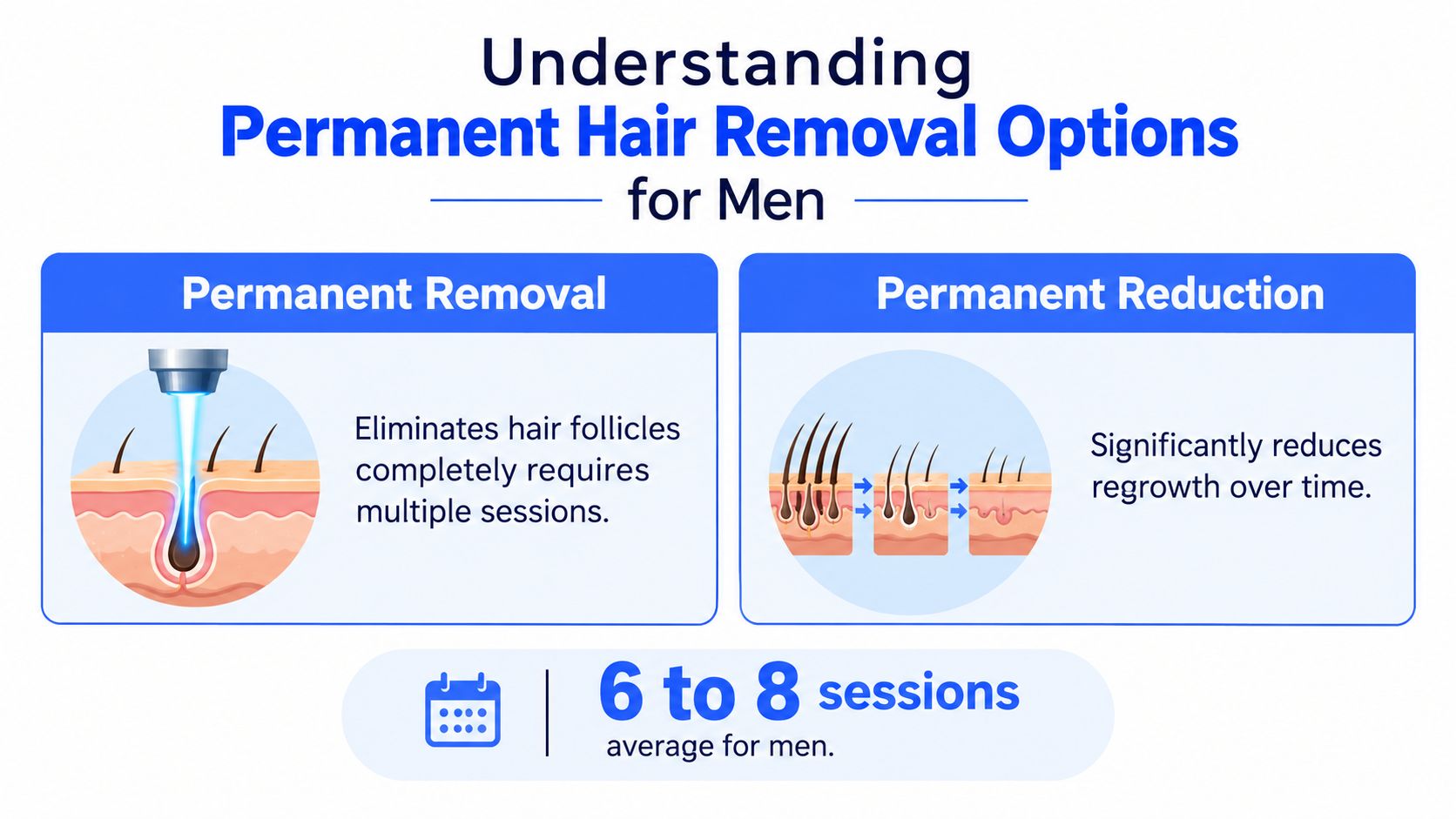
A man may want a sharper beard outline, less irritation on the neck, or a smoother chest and back without shaving every few days. Those goals require different treatment decisions. Start by separating permanent removal from long-term reduction.
Electrolysis destroys growth cells in individual follicles with a fine probe. The Cleveland Clinic's explanation of electrolysis identifies it as the only FDA-approved method for permanent hair removal. Laser hair removal uses pigment in actively growing follicles to reduce future regrowth. Its FDA-approved claim is permanent hair reduction, rather than guaranteed permanent removal.
What permanence means in practice
Laser treatment does not make every treated follicle disappear permanently. Effective treatment may produce fewer hairs, finer regrowth, and slower growth over time. The technical definition of permanent hair reduction refers to a long-term, stable decrease in regrowing hairs, assessed after treatment is complete rather than immediately after an appointment, as described in FDA-cleared diode system specifications.
Electrolysis provides follicle-level precision, but each follicle must be treated individually. That makes it suitable for a beard outline, isolated chin hairs, or a small area where complete removal matters. Laser treats larger surfaces more efficiently, particularly when hair is dark and coarse. For dense trunk hair, reduction is often the practical goal. For beard shaping, excessive reduction can alter the intended outline, so conservative planning matters.
| Permanence Levels Compared | FDA Status | Best For |
|---|---|---|
| Electrolysis | FDA-approved for permanent hair removal | Individual follicles, small areas, final cleanup |
| Laser hair removal | FDA-approved for permanent hair reduction | Dense body hair, larger areas, long-term reduction |
Why male hair requires a specific plan
Male hair is commonly denser and coarser across the chest, back, shoulders, abdomen, and beard area. Hormonal activity can influence future growth, so a provider should assess density, treatment goals, skin tone, and area rather than promise one universal result. Darker skin also requires careful wavelength and setting choices to reduce the risk of unwanted pigment changes.
Men have represented a measurable share of laser hair removal patients. A U.S. analysis reported male shares of 14.8% of procedures in 2005, 11.3% in 2006, 13.1% in 2007, and 12.9% in 2014. Summarized 2013 data from 10 countries placed male participation at 15.1%, according to the medical-aesthetic analysis of male laser hair removal participation.
Practical rule: Choose laser for efficient reduction across a large area. Choose electrolysis for follicle-by-follicle permanence or exact beard shaping.
Laser Hair Removal vs Electrolysis for Men
Laser and electrolysis solve different problems. Laser is generally the more efficient option for a broad chest, back, or shoulder treatment because one appointment can cover many follicles. Electrolysis is slower across large surfaces, but it gives the provider direct control over individual hairs.
The difference also affects comfort and scheduling. Laser commonly feels like brief heat or snapping sensations, while electrolysis involves repeated insertion of a fine probe. Neither experience is identical for every patient, and sensitivity varies by area, settings, hair density, and skin condition.
The American Academy of Dermatology's laser hair removal guidance explains that treatment is timed around the active growth phase, with many patients treated once every 4 to 6 weeks. The UCSF hair-removal guidance also distinguishes laser's follicle-targeting approach from electrolysis, which destroys individual roots with a probe.
Method Comparison Chart
| Factor | Laser | Electrolysis |
|---|---|---|
| Main result | Long-term reduction in regrowth | Permanent removal of treated follicles |
| Best treatment scale | Large areas such as chest and back | Small areas and individual hairs |
| Precision | Useful for reducing or shaping a zone | Highly precise follicle by follicle |
| Hair pigment | Works best when hair contains sufficient pigment | Can treat individual hairs regardless of pigment |
| Appointment pattern | Repeated sessions aligned with growth cycles | Repeated appointments until targeted follicles are treated |
| Maintenance | Some patients need future touch-ups | Treated follicles don't need laser-style reduction maintenance |
| Main limitation | Doesn't guarantee complete permanent removal | Time-intensive for dense body hair |
Matching the method to your goal
If you want to reduce heavy trunk hair so you can shave less often, laser usually offers the more practical starting point. If you want to remove a few stubborn hairs along a carefully designed neckline, electrolysis may be more appropriate.
A combination approach can also make sense. Laser can reduce the bulk of dark, coarse hair across a broad area, followed by electrolysis for selected hairs that remain. Men interested in how light-based methods differ should review IPL versus laser treatment before choosing a service.
Hormonal changes can make facial and torso regrowth less predictable. That doesn't mean treatment has failed, but it does mean a responsible plan should allow for monitoring and possible maintenance rather than promising that one course will prevent every future hair.
Choosing the Right Laser Wavelength for Your Skin Type
The safest laser isn't selected by body area alone. Skin tone, hair pigment, hair thickness, and the provider's device settings all matter. A wavelength that works well for lighter skin may carry more risk when the skin contains more melanin, because the laser can interact with pigment in the skin as well as pigment in the follicle.
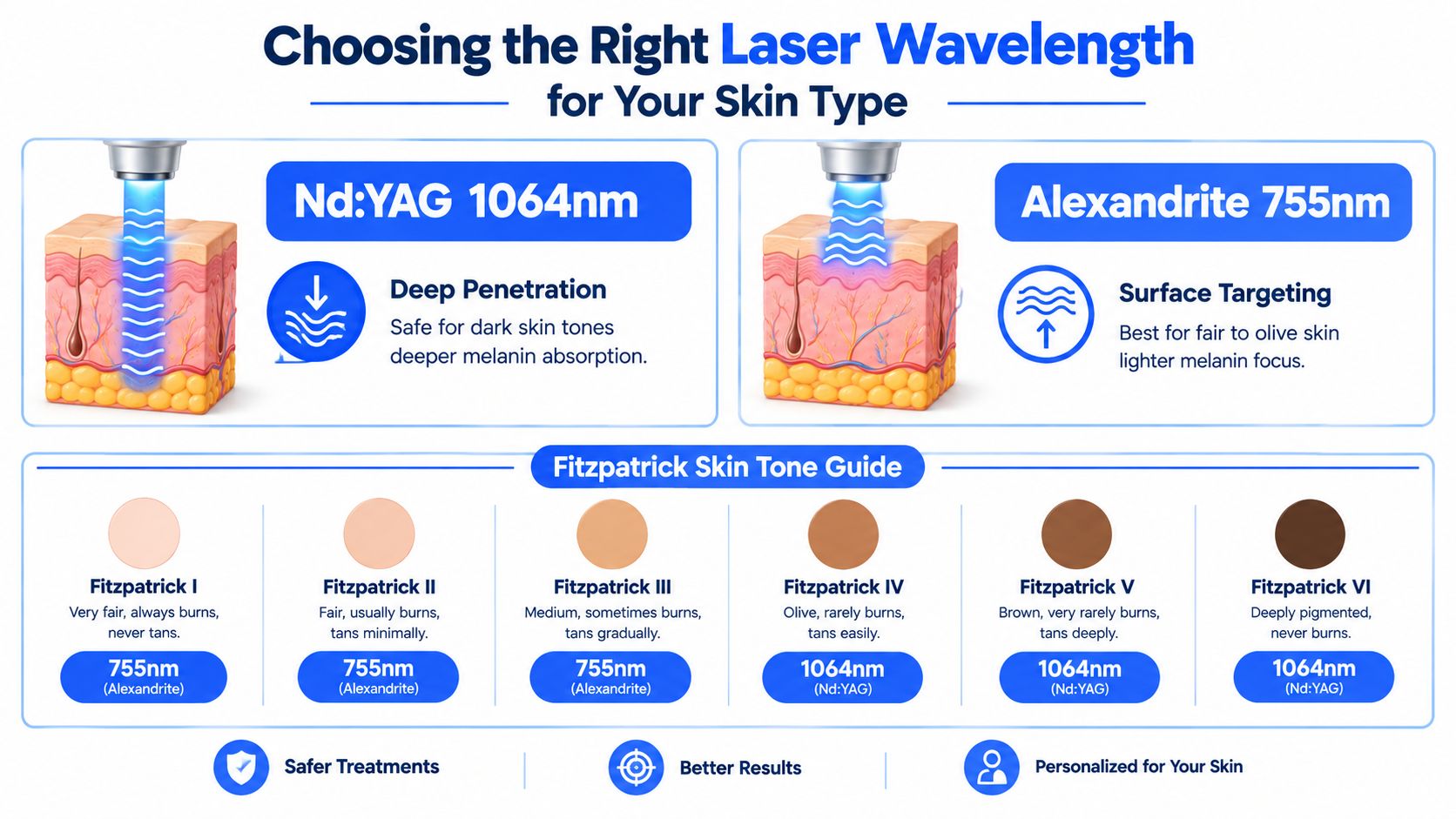
For darker complexions, long-pulsed Nd:YAG at 1064 nm is commonly preferred because its longer wavelength penetrates deeper and has less absorption by superficial melanin. Alexandrite at 755 nm is often considered a strong option for lighter skin, while diode at 810 nm is used for many medium skin and trunk-hair applications. A review of wavelength selection and skin-tone considerations describes these distinctions and emphasizes individualized treatment.
Wavelength Guide by Skin Type
| Skin Type | Recommended Wavelength | Effectiveness |
|---|---|---|
| Fitzpatrick I to II | Alexandrite 755 nm may be appropriate after assessment | Often effective for dark, coarse hair with suitable contrast |
| Fitzpatrick III to IV | Diode 810 nm may be considered, depending on the assessment | Can provide effective reduction when settings match skin and hair |
| Fitzpatrick V to VI | Long-pulsed Nd:YAG 1064 nm is commonly preferred | Designed to improve safety when superficial melanin absorption is a concern |
These categories aren't a substitute for an in-person assessment. Mixed ethnic backgrounds, recent tanning, active skin irritation, and uneven pigmentation can affect the safest approach. A provider should ask about tanning, medications, previous reactions, and the exact treatment zone before selecting settings.
Hair color matters too
Laser relies on pigment in the hair shaft and follicle. Dark brown or black hair generally gives the laser a clearer target than blonde, gray, or red hair. If a man wants removal of light facial hairs or scattered gray hairs, electrolysis may offer a more suitable path because it doesn't depend on the same pigment contrast.
Darker skin isn't a reason to avoid treatment, but it is a reason to avoid casual device selection. Ask which wavelength the clinic uses, how it evaluates your Fitzpatrick skin type, and what precautions it takes to reduce the risk of burns or pigment changes. More guidance is available in laser treatment for darker skin.
Male Treatment Areas and What to Expect
A man treating his back has a different clinical problem from a man refining his neckline. The back may involve dense, coarse hair over a broad surface. The neckline demands restraint, because excessive reduction can permanently alter the shape a patient wants to keep.

Chest, back, and shoulders
Trunk hair often responds well when the provider uses a diode protocol suited to large areas. In a prospective study of 20 male patients, an 810 nm diode laser produced mean hair reduction of 80.6% with a ±2.8 variation across treated areas. The study and device record describe strong performance on extended areas and difficult follicles such as the back and chest, as reported in the 810 nm diode-laser evidence record.
That result is a benchmark, not a promise for every patient. Density, hair pigment, skin tone, hormonal activity, treatment settings, and appointment consistency all influence the outcome. Trunk plans often require more sessions than a small facial zone, and maintenance may be appropriate when new growth appears.
Beard line and neckline
Many men don't want a bare face. They want less shaving, fewer ingrown hairs, or a cleaner contour that remains consistent between grooming appointments.
That requires conservative planning. A provider should define the lower edge of the beard, confirm whether you want reduction or removal, and avoid treating beyond the intended contour. Removing too much from a beard line can be difficult to reverse, so a gradual reduction strategy is safer than an aggressive first appointment.
A facial guide from a medical practice describes 6 to 8 sessions for common male facial treatment, with appointments approximately 4 to 6 weeks apart for the face and 6 to 8 weeks apart for the body. Those intervals and session expectations are detailed in the male laser hair removal treatment guide.
Underarms and abdomen
Underarms are smaller and often easier to monitor, while the abdomen may connect visually with the chest. Ask the provider to plan the borders before treatment so the result doesn't look uneven as reduction progresses.
Before an appointment, follow the clinic's shaving and skin-preparation instructions. Afterward, protect the area from avoidable irritation and report unusual blistering, persistent pain, or pigment changes promptly. A sound provider will adjust the plan based on your response rather than increasing intensity just because the hair is coarse.
Why Clinic Treatment Beats At-Home Devices for Men
A man treating a dense back or chest at home may finish each session without knowing whether the device reached enough of the target hair. Convenience does not guarantee effective follicle treatment. Large areas, coarse trunk hair, beard contours, and darker skin all require decisions that generic consumer devices cannot make reliably.
Clinic systems can be selected and adjusted for skin tone, hair density, treatment area, and treatment response. For dense back hair, a trained provider may choose a larger spot size and active cooling. For Fitzpatrick V or VI skin, an Nd:YAG 1064 nm approach may offer a safer balance than just increasing fluence. The aim is useful follicle heating while limiting burn and pigment-change risk. Device specifications and safety controls should be clear before treatment, as explained in this guide to clinic laser hair removal.
Where home treatment falls short
Consumer devices generally use lower energy than clinic systems. That can make them easier to operate without supervision, but it may limit their effect on thick, root-anchored hair. A user may also treat too frequently, miss areas across a broad back, or apply the device over recently tanned or irritated skin.
A clinic can screen for active inflammation, medications that increase sensitivity, and unexplained changes in hair growth. The provider can test a small area, assess the skin response, and adjust later sessions rather than repeating the same setting blindly. This matters when treating a beard edge, where excessive reduction can permanently alter the shape, or a trunk area where uneven reduction is immediately visible.
The comparison also includes time and risk. Poor coverage, ineffective settings, prolonged treatment, and avoidable skin injury can cost more than the device itself.
Safety check: If a device description does not explain skin-tone limitations, treatment precautions, and supervision requirements, seek professional advice before using it on a large or sensitive area.
Home devices may suit selected users with appropriate hair and skin characteristics. They are a weaker default for dense male hair, beard shaping, or darker skin where wavelength, cooling, and treatment coverage need careful control.
Making Your Decision – A Decision Framework for Men
Start with the result you want. “I want less hair” points toward laser reduction. “I want these specific hairs gone permanently” points toward electrolysis. “I want a sharper beard contour but still want a natural beard” requires a conservative shaping plan, not automatic full removal.
Use these questions during a consultation:
- What area matters most? Large zones such as the back and chest favor an efficient reduction strategy. A small beard-line adjustment favors precision.
- What are your hair and skin characteristics? Dark, coarse hair is generally a stronger laser target. Light or gray hair may require a different approach.
- What does your skin need? Ask how the provider determines Fitzpatrick type and which wavelength is appropriate for your complexion.
- Can you commit to repeated appointments? Laser works through growth cycles, so consistency matters. Electrolysis also requires repeated visits because follicles are treated individually.
- How much maintenance is acceptable? Long-term reduction isn't the same as a guarantee that no hair will ever return.
When combining methods makes sense
A combination plan can be useful when the treatment area is large but the final goal is precise. Laser may reduce the dense dark hair first, while electrolysis addresses selected residual hairs or a carefully defined facial contour.
Don't choose based on a generic “permanent hair removal men” package alone. Ask for an area-specific assessment, a realistic discussion of reduction versus removal, and a plan that accounts for your skin tone, hair color, and desired amount of remaining hair.
The best plan may be different for your back, beard, underarms, and shoulders. Treating every zone with the same settings or the same permanence promise is a warning sign.
Taking the Next Step Toward Lasting Results
A good consultation should leave you with more than a session recommendation. You should understand whether the proposed treatment is laser reduction or electrolysis removal, which wavelength fits your skin, how the provider will shape the area, and what maintenance may look like.
Before booking, confirm that the clinic:
- Assesses skin tone: The provider should explain wavelength selection and pigment-risk precautions.
- Examines hair characteristics: Dark, coarse trunk hair and light facial hair shouldn't receive the same expectations.
- Defines the treatment boundary: This matters especially for beard lines, necklines, and areas where you want to keep some hair.
- Explains preparation and aftercare: Ask about shaving, sun exposure, irritation, and when to report a reaction.
- Uses a realistic outcome statement: Permanent reduction and permanent removal are different clinical claims.
Laser hair removal for men is an established treatment category, not an unusual grooming request. Men represented a low-teens share of procedures across several years in the U.S. analysis cited earlier, and male-specific planning remains essential because density, hormones, skin tone, and contour goals vary widely.
Bring photos of the result you want, identify the areas you want treated, and ask the provider to separate immediate expectations from long-term outcomes. That conversation is what turns a vague search for permanent hair removal into a safer, more useful treatment decision.
ProMD Health offers laser hair removal for long-term reduction across male treatment areas such as the back, chest, shoulders, neck, beard line, face, and underarms. Visit ProMD Health to discuss your goals with a provider and determine whether a personalized laser plan is appropriate for your skin and hair.