
Only 12 severe complications were recorded among 290,307 hyaluronic acid filler injections, producing a severe-complication incidence of 0.0041% in a 2025 retrospective study (PubMed). That figure is reassuring, but it isn't a reason to treat dermal fillers casually. The same dataset showed that serious events, when they occurred, clustered around facial vascular anatomy, particularly the forehead, nose, nasolabial folds, and chin.
Temporary bruising, swelling, redness, itching, or tenderness are commonly experienced. A much smaller group faces complications that require rapid medical treatment, including vascular occlusion, tissue injury, infection, or vision problems. Knowing the difference helps you stay calm when a reaction is expected and act quickly when it isn't.
Table of Contents
- Introduction to Dermal Filler Side Effects
- Mechanisms Behind Common Filler Reactions
- Side Effects by Filler Type
- Complication Rates Common vs Rare
- Prevention Practices and ProMD Technique Standards
- Managing Urgent Complications and Vascular Occlusion
- Recovery Timeline and Patient Expectations
- Conclusion and Key Takeaways
Introduction to Dermal Filler Side Effects
Dermal filler safety depends on two kinds of knowledge. First, you need to recognize the body's ordinary response to an injection. Second, you need to identify the uncommon warning signs that suggest the filler has affected blood flow or triggered a more serious inflammatory or infectious process.
This guide explains why common reactions happen, how side effects can vary by filler material, what surveillance data reveal about routine and severe complications, and which prevention measures support safer treatment. It also outlines what patients and providers should do when symptoms suggest vascular compromise, how recovery usually progresses, and how ProMD's clinical approach incorporates anatomy awareness and conservative technique.
If you're researching treatment options, ProMD's overview of dermal fillers can help explain how injectable products restore volume and shape. For a broader patient-facing introduction to dermal filler injections, look for resources that explain both expected aftercare and possible complications rather than focusing only on cosmetic outcomes.
The most useful question after treatment isn't limited to, “Is this a side effect?” Ask instead: Is this reaction mild and improving, or is it painful, progressive, discolored, or associated with a change in vision or general health? That distinction guides the right next step.
Mechanisms Behind Common Filler Reactions
A filler injection creates several predictable changes at once. The needle or cannula passes through skin and soft tissue, the product occupies space, and the immune system responds to the procedure. Think of these as three connected points on a concept map rather than separate problems.
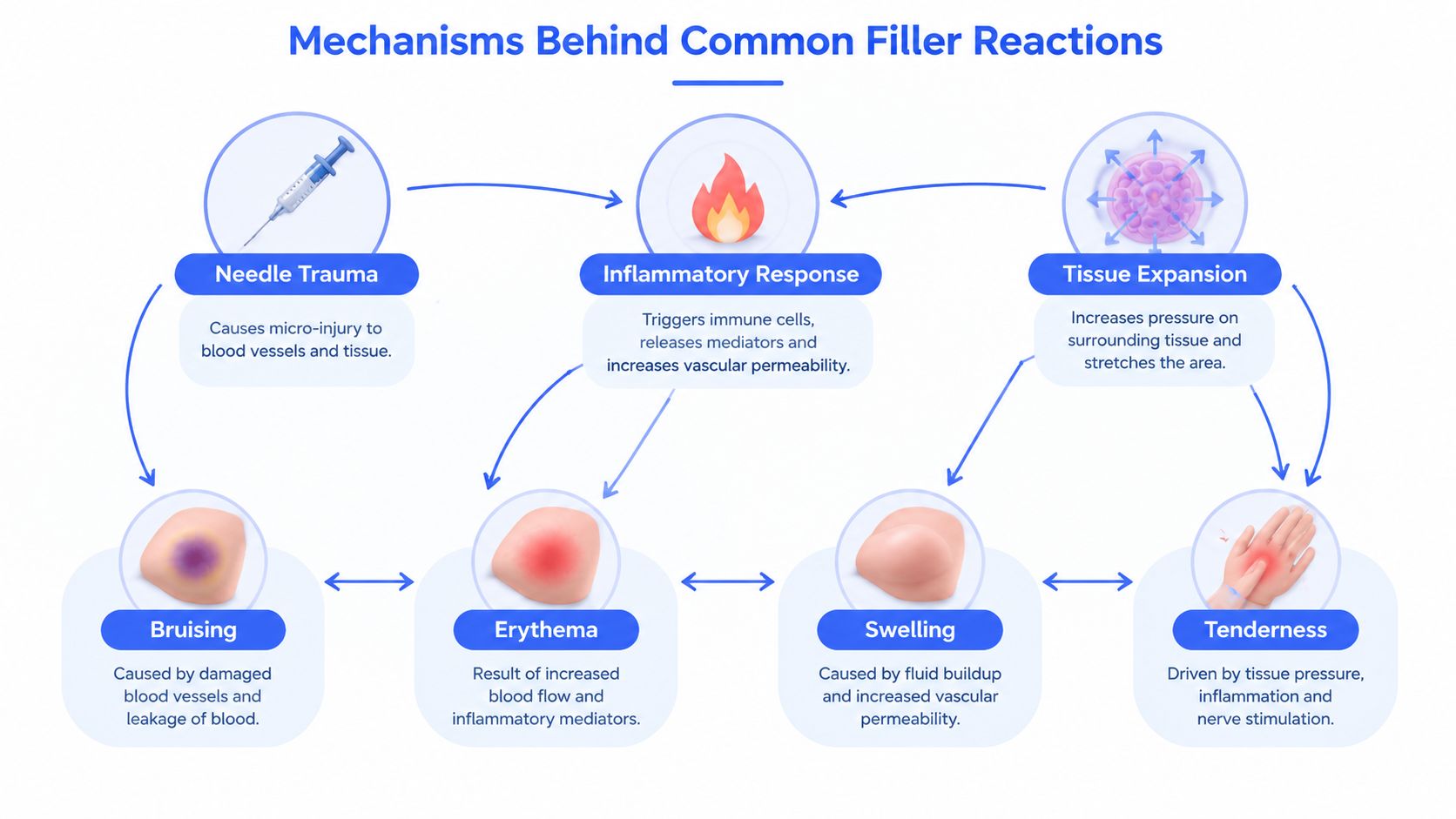
Needle trauma and bruising
Small blood vessels can be disturbed during injection. Blood that escapes into surrounding tissue creates a bruise, while the body gradually breaks down and clears the trapped blood. Bruising may look darker before it fades, especially in areas where the skin is thin or the tissue is highly vascular.
The same physical disruption can produce short-term soreness. Tenderness doesn't automatically mean something has gone wrong, particularly when it remains localized and begins to settle.
Tissue expansion and swelling
Filler adds volume beneath or within the skin. That expansion can create a temporary feeling of tightness, firmness, or puffiness while the surrounding tissue adjusts. The product itself can also attract water, depending on its composition and placement, which contributes to edema.
Inflammation adds another layer. The immune system sends fluid and signaling molecules to the treated area as part of routine healing, leading to warmth, redness, itching, or sensitivity. FDA guidance identifies bruising, swelling or edema, erythema, pain or tenderness, itching, and redness as common post-injection reactions, with most resolving over days to weeks (FDA guidance).
For practical guidance about monitoring an injection site, Trim's advice on injection site reactions offers a useful general framework for observing localized redness, swelling, and discomfort. Dermal filler aftercare still needs to follow the specific instructions provided by the treating clinician.
Why vascular anatomy changes the risk
A routine injection becomes a medical emergency when filler enters or compresses a blood vessel. The affected tissue may then receive inadequate oxygen, a process called ischemia. If blood flow isn't restored, tissue injury can progress to necrosis, and an embolic event may threaten vision or neurological function.
That's why a skilled injector treats facial anatomy like a detailed road map. The safest plan considers where vessels travel, how deep the product should sit, and how much pressure the tissue can tolerate. Common swelling follows the expected route of healing. Vascular compromise follows a different pattern, often involving unexpected pain, abnormal skin color, or symptoms that progress rather than improve.
Side Effects by Filler Type
Filler material influences how the body responds. Hyaluronic acid, often selected for its reversible nature, commonly produces early swelling, bruising, tenderness, and temporary firmness. Biostimulatory products, including poly-L-lactic acid, work through a different process and may create delayed nodules or inflammatory changes as collagen support develops.
Calcium hydroxylapatite and polymethylmethacrylate also have distinct material properties. A reported complication may reflect the product, the injection technique, the treatment area, patient anatomy, or a combination of these factors. The figures below describe the distribution of reported complications in one analysis, not the individual risk faced by every patient.
| Filler Type | Reported Complication Percentage |
|---|---|
| Hyaluronic acid | 44% |
| Poly-L-lactic acid | 40% |
| Calcium hydroxylapatite | 15% |
| Polymethylmethacrylate | Less than 1% |
These percentages come from an analysis of 3,782 reported complications, where 44% involved hyaluronic acid fillers, 40% involved poly-L-lactic acid, 15% involved calcium hydroxylapatite, and less than 1% involved polymethylmethacrylate (product distribution analysis). Because the dataset contains reported complications rather than every injection performed, it shouldn't be read as a direct head-to-head probability comparison.
Hyaluronic acid considerations
Hyaluronic acid fillers can cause visible edema soon after treatment, especially in areas that naturally swell easily. Temporary lumps or asymmetry may also appear while the product settles. If a persistent inflammatory response or vascular problem develops, clinicians may consider targeted treatment, including hyaluronidase when medically appropriate.
The ability to use hyaluronidase is an important clinical consideration, but it doesn't eliminate the need for careful injection. Product choice, placement, depth, volume, and immediate recognition still matter.
Biostimulatory and longer-lasting materials
Poly-L-lactic acid is designed to stimulate collagen support rather than provide immediate volume. Its response may therefore unfold gradually, and nodules or inflammatory changes can present later. Long-lasting materials can also raise management challenges when a persistent nodule, granuloma, or immune reaction develops.
A consultation should cover more than the desired contour. Ask how long the product is expected to remain, what delayed reactions may look like, and what treatment options exist if a lump or inflammatory response persists. ProMD's information on non-surgical facial contouring with fillers provides additional context for discussing treatment goals and product selection.
Complication Rates Common vs Rare
17,768 serious injury reports associated with dermal filler product codes LMH and PKY were documented in FDA post-market surveillance. Reported events included 1,235 abscesses, 1,038 nodules, 986 obstruction or occlusion reports, and 846 granulomas (FDA surveillance data). These figures come from a medical device reporting system. They show reported patterns, not the probability that any individual injection will cause a complication, because the total number of treated patients and reporting completeness are unknown.
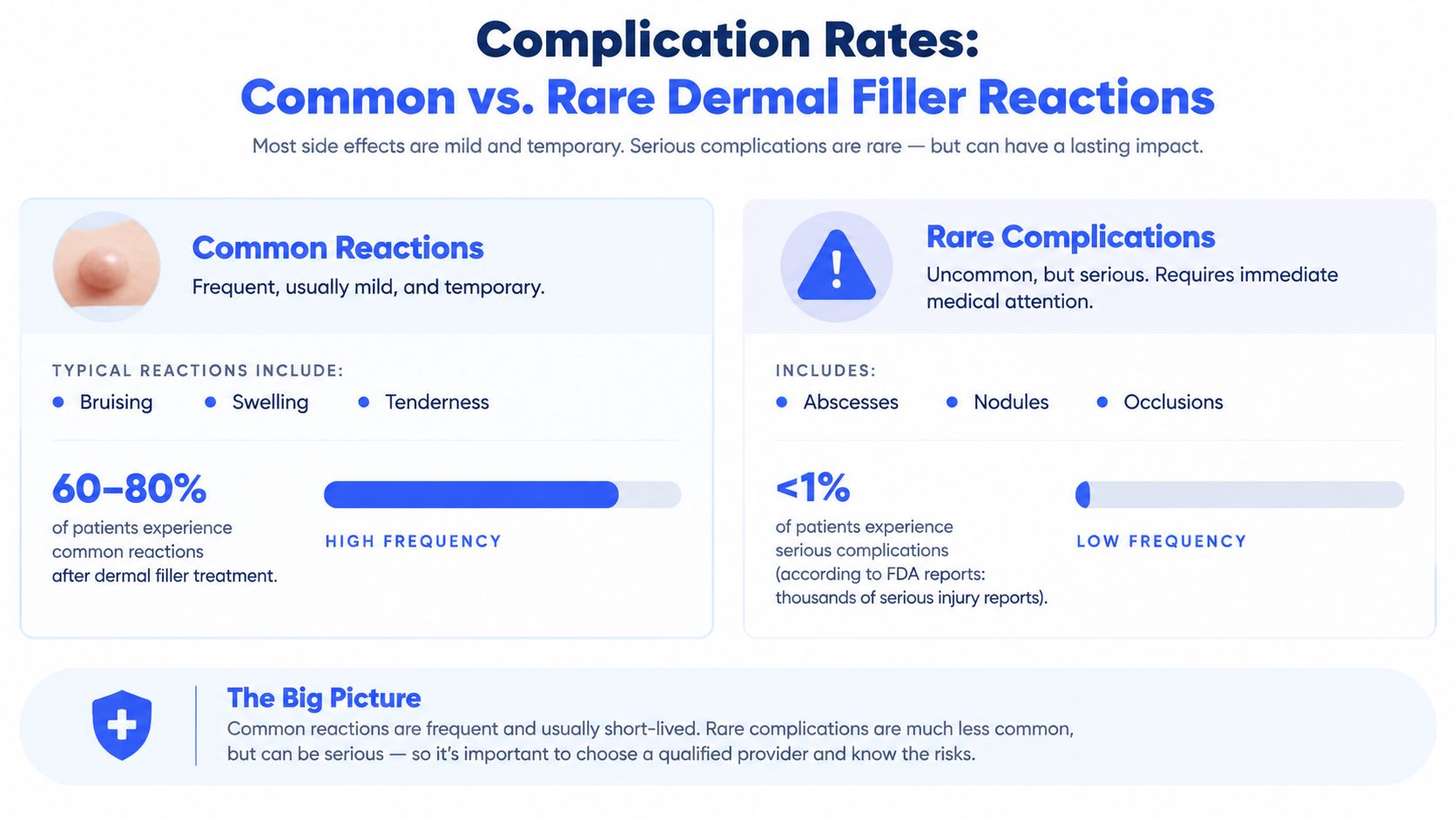
A separate 2025 retrospective study reviewed 290,307 hyaluronic acid filler injections and recorded 12 severe complications, including 2 infections and 10 vascular obstructions. Its severe-complication incidence was 0.0041% (retrospective safety study). The study's denominator helps place those events in context, while the findings still support careful anatomical assessment and rapid recognition.
How to interpret the numbers
Surveillance data are useful for spotting signals, but they do not operate like a controlled trial. Reports can vary in clinical detail, completeness, product exposure, and follow-up. A study based on injection counts supplies a denominator, yet its results reflect the patients, clinicians, and protocols included in that dataset.
A practical escalation framework separates appearance from urgency:
- Routine reactions: Bruising, swelling, redness, itching, and tenderness are generally localized and temporary. Monitor the expected course and follow the provider's instructions.
- Problems needing assessment: Nodules, infection, persistent inflammation, or allergic reactions may require clinical review and treatment.
- Urgent complications: Sudden or escalating pain, unusual blanching or dusky discoloration, delayed capillary refill, or visual symptoms can signal vascular compromise. Contact the treating clinic immediately and follow its emergency protocol. Vascular occlusion, tissue necrosis, stroke, and blindness require rapid escalation, not watchful waiting.
ProMD's safety approach should make that pathway clear before treatment: patients need to know which changes are expected, which require prompt review, and where to seek urgent help. “Side effects are rare” is incomplete reassurance without those action points.
Prevention Practices and ProMD Technique Standards
Risk reduction starts before the needle touches the skin. The injector should review medical history, prior filler, allergies, active skin conditions, previous reactions, treatment goals, and the anatomy of the proposed area. A careful consultation also helps distinguish a patient seeking subtle contour refinement from someone who may need a different approach to volume loss or skin quality.
A safer treatment sequence
Map the treatment area. The provider evaluates facial landmarks, tissue thickness, prior injection sites, and known vascular pathways. Periorbital and glabellar areas require particular caution because their anatomy can place tissue and vision at greater risk.
Choose conservative volume. More product isn't a substitute for better planning. Conservative placement allows the clinician to assess symmetry and tissue response without creating unnecessary pressure or excessive expansion.
Select the delivery method deliberately. A needle can offer precision in specific planes, while a cannula may be appropriate for other areas. Neither device makes a treatment automatically risk-free. The decision should reflect anatomy, depth, product behavior, and the clinician's assessment.
Inject slowly and with control. Slow injection gives the provider time to observe tissue changes and gives the patient an opportunity to report unusual discomfort. Higher-risk zones demand conservative volume, slow injection, and constant awareness of vascular anatomy because delayed recognition of vascular compromise can worsen tissue-loss risk (technical review).
Monitor immediately afterward. The clinician should check color, pain, swelling pattern, symmetry, and other relevant findings before the patient leaves. Clear written instructions should identify which symptoms are expected and which require an urgent call.
What patients can do
Patients improve safety by providing accurate information and avoiding pressure to treat an unsuitable area or use more product than the clinician recommends. Tell the provider about previous filler, unexplained lumps, immune conditions, recent illness, dental procedures, medications, and any history of abnormal scarring or allergic reactions.
Practical rule: If the treatment plan feels rushed, the product isn't clearly identified, or no emergency contact process exists, pause before proceeding.
Technique standards reduce risk, but they can't make risk zero. The strongest safeguard is a partnership in which the provider plans conservatively and the patient reports unusual symptoms promptly.
Managing Urgent Complications and Vascular Occlusion
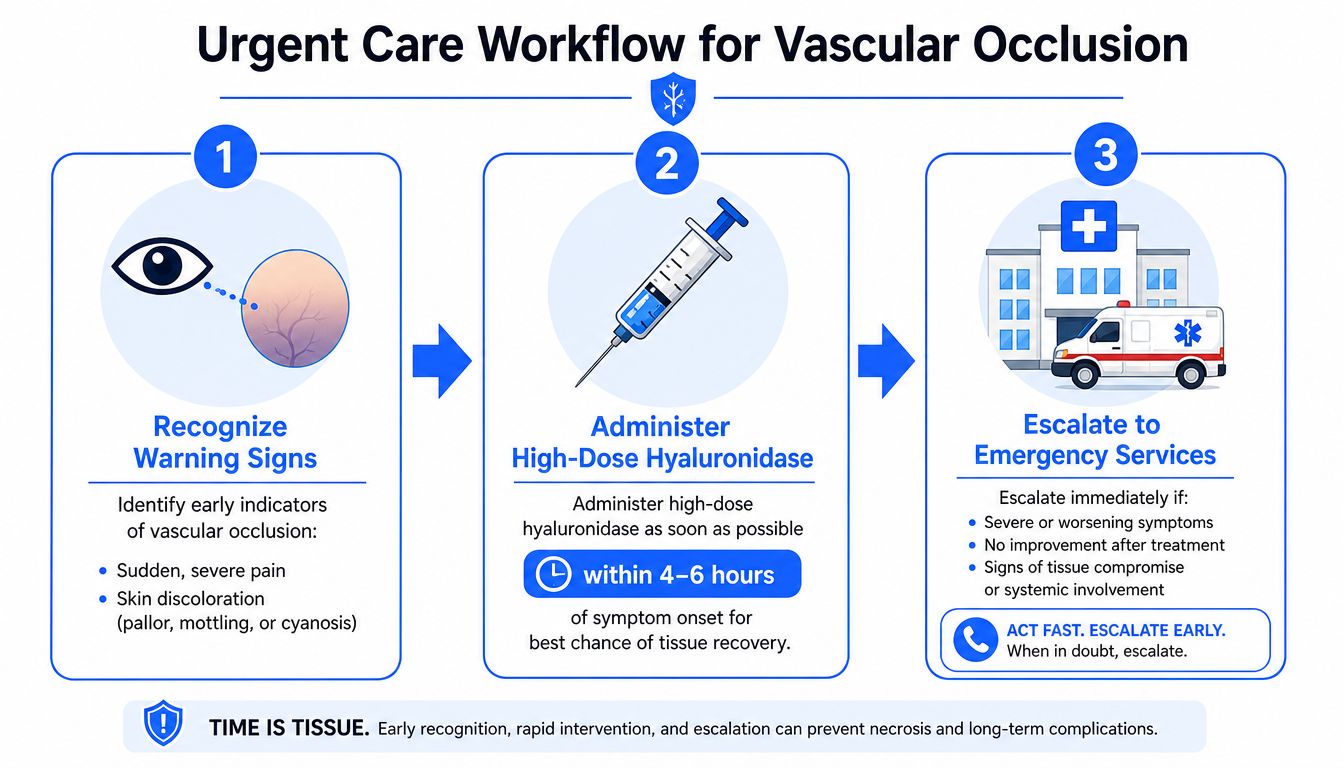
Vascular occlusion is uncommon, yet delayed recognition can cause serious tissue injury. Patients do not need to diagnose it themselves. They do need to recognize a warning pattern and contact the treating provider promptly. Sudden or escalating pain, pale or dusky skin, unusual mottling, delayed capillary response, blistering, or a visual change should be treated as urgent. Severe or rapidly progressing symptoms may require emergency services.
The first response
The provider reviews the skin color, pain distribution, circulation, injection history, and any eye or neurological symptoms. Swelling can occur during an ordinary recovery, but it should not be used to explain away severe or escalating pain. If vascular compromise is suspected, assessment and treatment should begin promptly.
For hyaluronic acid filler, clinicians may use high-dose hyaluronidase within the first 4 to 6 hours as part of urgent management. A systematic review reported irreversible vascular complications at about 1 to 2 per 1,000,000 patients, skin necrosis at about 5 per 1,000, and better prognosis when treatment began within 4 to 6 hours (vascular occlusion review). These figures are reported clinical estimates, not a prediction for one patient.
A useful escalation framework is simple: expected, concerning, urgent. Mild, localized discomfort that remains stable belongs in the first category. Worsening pain, unusual color, or spreading skin changes require immediate clinical contact. Vision, breathing, neurological, or rapidly worsening tissue symptoms require emergency action.
Vision and neurological symptoms
A visual disturbance after filler injection is an emergency. Sudden blurred vision, loss of vision, eye pain, double vision, or unusual neurological symptoms should be reported immediately, even if the injection occurred earlier and swelling seems responsible. FDA adverse-event analysis found that vision impairment could begin immediately or after a delay, so symptom timing alone cannot safely rule out a connection.
Other urgent complications
Increasing warmth, spreading redness, drainage, fever, or worsening tenderness may indicate infection and requires medical evaluation. Widespread hives, facial or throat swelling, breathing difficulty, dizziness, or collapse may indicate a severe allergic reaction. Call emergency services for breathing difficulty, fainting, stroke-like symptoms, or sudden vision loss.
Do not massage a painful, discolored area or attempt to correct a suspected occlusion at home. Contact the treating clinic immediately, follow its emergency instructions, and seek emergency care when symptoms involve vision, breathing, neurological function, or rapidly worsening tissue changes.
Recovery Timeline and Patient Expectations
Normal healing usually follows a gradual pattern, but individual recovery varies by product, treatment area, injection depth, skin sensitivity, and the amount of tissue manipulation. Early swelling can make a result look fuller or less even than intended. That temporary appearance doesn't necessarily predict the final contour.
What the first days may feel like
Swelling and tenderness often become most noticeable early in recovery. Bruising can also evolve in color before it fades, and a small area of firmness may soften as the product settles and inflammation decreases.
Use a cool compress gently if your provider recommends it, keep your head raised while resting, and avoid pressing or massaging the area unless the treating clinician specifically instructs you to do so. Follow the clinic's guidance about exercise, heat, alcohol, makeup, and facial treatments because those instructions may depend on the treated site.
For cosmetic strategies that can help disguise visible discoloration while you heal, see ProMD's guide on how to conceal a bruise on your face. Concealment should never replace medical assessment when bruising is accompanied by severe pain, unusual skin color, worsening swelling, blistering, or visual symptoms.
When recovery no longer looks routine
A reaction that stays localized and gradually improves is generally less concerning than one that spreads or intensifies. Contact your provider if swelling continues to worsen, pain becomes severe, the skin turns pale or dusky, a firm lump persists, or redness becomes increasingly warm and tender.
Delayed inflammation deserves special attention. FDA guidance notes that inflammation near filler sites can occur after illnesses, infections, vaccinations, or dental procedures, and delayed reactions may appear hours to weeks after a viral exposure with swelling, erythema, angioedema, or facial edema (FDA dermal filler safety information). A clinician can help distinguish a temporary immune flare from infection, allergy, or vascular injury.
Conclusion and Key Takeaways
Most dermal filler side effects are local, visible, and temporary. Bruising, swelling, redness, itching, tenderness, and short-term firmness usually reflect needle trauma, tissue expansion, and the inflammatory response. They can be uncomfortable and cosmetically inconvenient, but they don't automatically indicate a dangerous complication.
The safety conversation changes when symptoms are severe, progressive, or associated with abnormal circulation. Sudden pain, pale or dusky skin, rapidly changing discoloration, blistering, vision changes, breathing difficulty, or neurological symptoms require immediate action. Vascular occlusion is rare, but early recognition gives clinicians the best opportunity to protect tissue and manage the complication.
Material selection also matters. Hyaluronic acid, poly-L-lactic acid, calcium hydroxylapatite, and longer-lasting materials have different behavior and different management considerations. Your provider should explain the product, placement, expected recovery, delayed risks, and emergency contact process before treatment begins.
A safe consultation should leave you with more than an aesthetic plan. You should know what normal healing looks like, when to call the clinic, and where to go if symptoms involve vision, breathing, or neurological function. ProMD Health offers dermal filler consultations and non-surgical facial contouring at approved locations across Maryland, Virginia, Washington, DC, Florida, Texas, Colorado, and Delaware, with treatment planning based on your anatomy and goals.
Visit ProMD Health to schedule a personalized dermal filler consultation and discuss product selection, vascular safety, aftercare, and warning signs with a qualified care team. Bring your questions and medical history so your provider can create a conservative, informed plan for facial rejuvenation.


