
You might be looking in the mirror and noticing a mix of changes that don't fit neatly into one category. Maybe it's a little forehead movement that now leaves lines behind, a loss of cheek support, more visible pores, uneven pigment, or skin that doesn't bounce back the way it used to. These observations typically indicate a pattern of changes, not an isolated problem.
That's why the conversation around skin rejuvenation treatments has shifted. Patients want visible improvement without surgery, but they also want results that still look like them. That demand isn't small. The global skin rejuvenation market was valued at USD 2.36 billion in 2026 and is projected to reach USD 5.22 billion by 2035, with over 65% of consumers favoring non-invasive aesthetic procedures over surgical alternatives according to skin rejuvenation market analysis.
Table of Contents
- The Modern Approach to Skin Rejuvenation
- Injectable Treatments Neuromodulators and Dermal Fillers
- Lasers and Energy Devices Resurfacing and Contouring
- Advanced Skin Therapies and Regenerative Options
- Building Your Personalized Rejuvenation Plan
- Managing Expectations Results Timelines Risks and Aftercare
- Choosing a Provider and Understanding Costs
The Modern Approach to Skin Rejuvenation
Modern skin rejuvenation isn't one treatment. It's a strategy for improving skin quality, facial balance, and tissue support with the least disruption that still makes sense for the concern being treated.
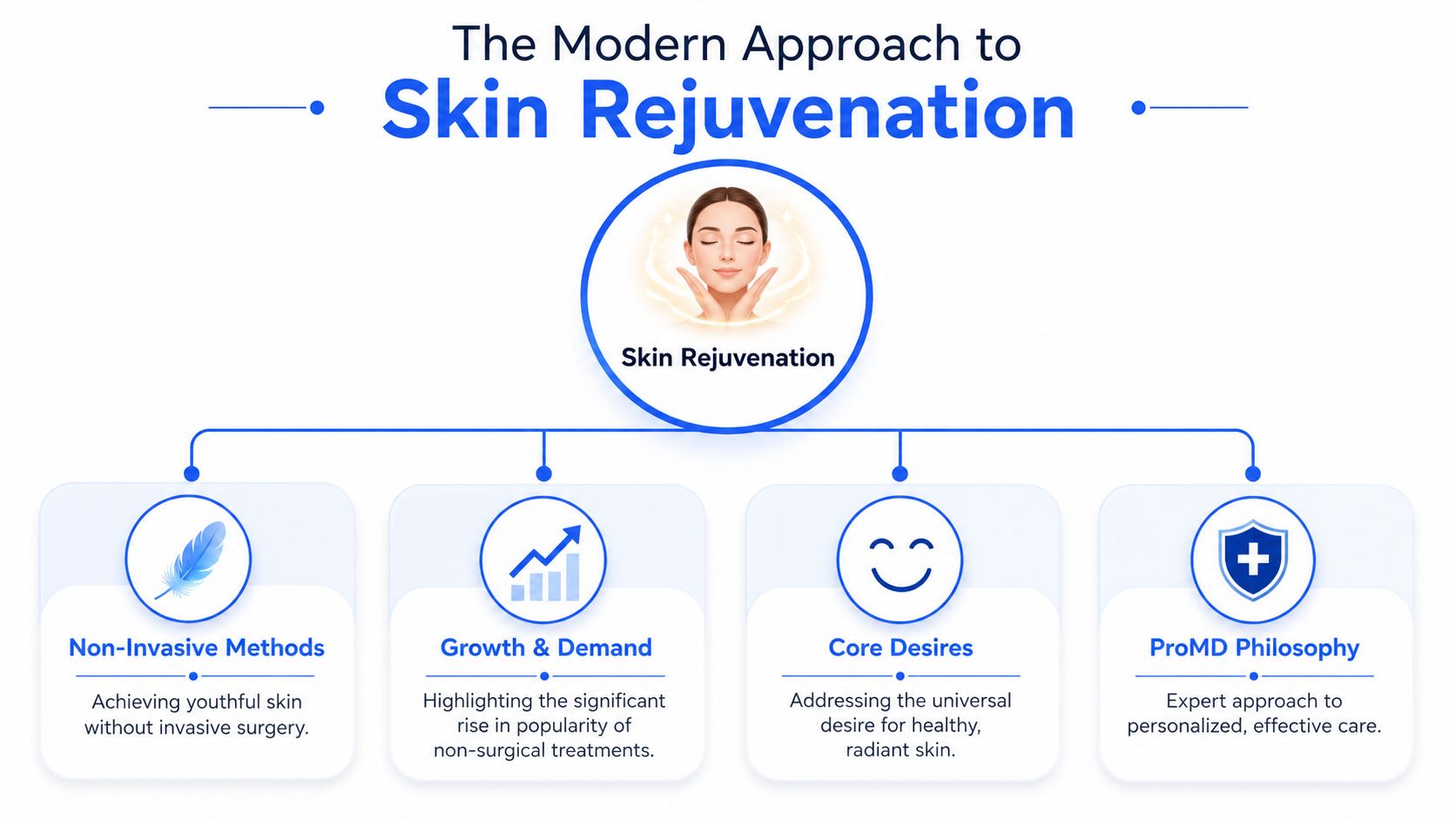
In practice, that usually means dividing treatment into three lanes. Injectables help with movement lines and volume changes. Energy-based devices address resurfacing, tightening, and contouring. Advanced skin therapies improve the surface environment so skin behaves better over time.
That framework matters because patients often choose the wrong tool when they self-diagnose. Fine lines from repeated muscle movement won't respond the same way as pigment. Volume loss won't improve with a peel alone. Texture can look worse if the structure underneath hasn't been addressed.
What rejuvenation actually includes
A useful way to think about skin rejuvenation treatments is by the problem they solve:
- Dynamic lines: These come from muscle activity and often respond best to neuromodulators.
- Volume loss and contour change: These usually need filler, biostimulation, or regenerative volume support.
- Pigment and surface irregularity: These often respond to lasers, peels, microneedling, and skincare.
- Laxity and tissue quality: These usually improve with collagen-focused treatment plans over time.
Clinical reality: Natural-looking rejuvenation usually comes from treating more than one layer of aging, not from repeatedly correcting the same visible line.
Patients also do well when they understand that at-home care still matters. In pigment-prone skin, for example, lifestyle and topical choices affect how long in-office results hold. For readers trying to better understand discoloration after acne or irritation, Neutralyze's guide to fading dark spots is a useful companion resource.
Injectable Treatments Neuromodulators and Dermal Fillers
Injectables remain the starting point for many patients because they can address two common complaints quickly. First, visible lines created by facial movement. Second, volume loss that changes facial proportions.
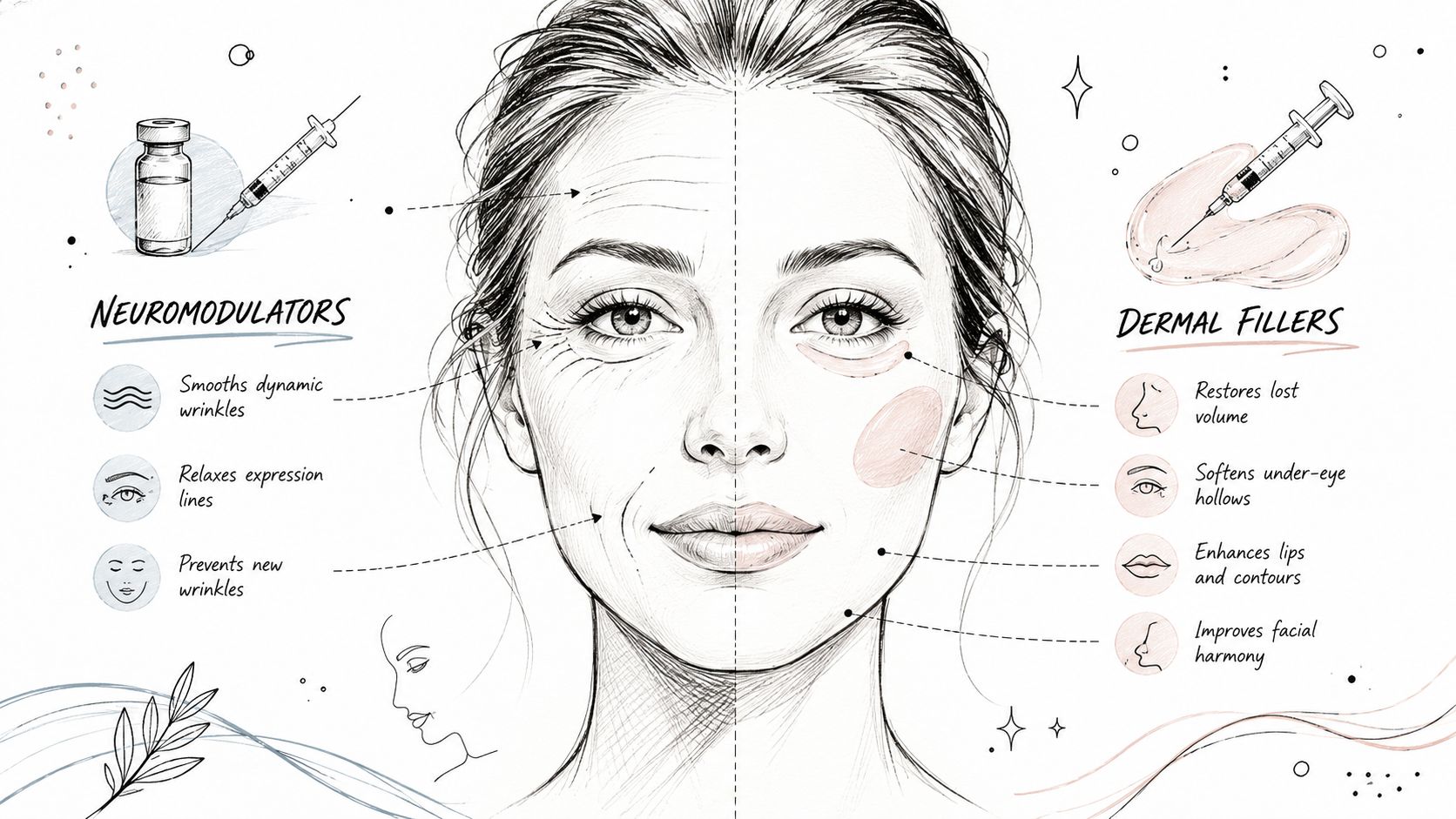
How neuromodulators soften movement lines
Neuromodulators such as Botox, Dysport, and Daxi reduce the muscle activity that creates repetitive creasing in areas like the brow, crow's feet, and around the mouth. They don't fill lines. They reduce the force that keeps folding the skin in the same place.
At ProMD Health, neurotoxin injections target muscle activity that causes visible facial lines, with clinical studies showing up to 80% improvement in glabellar frown lines within 7 to 14 days after a standard 30-unit dose to the upper face according to ProMD Columbia treatment information.
That speed is one reason patients like this category. The trade-off is that neuromodulators only solve the movement part of aging. If the cheek has flattened, the jawline has softened, or the under-eye area looks hollow, toxin alone won't restore structure.
Where fillers and biostimulators fit
Dermal fillers restore support, shape, and transition points in the face. They're useful when a patient says they look tired, drawn, or less defined even when their skin is otherwise healthy. If you want a practical overview of treatment mechanics and common uses, ProMD's dermal filler guide gives a solid foundation.
Biostimulators belong in the same conversation, but they work differently. Rather than acting mainly as an instant volumizer, collagen biostimulators such as PLLA, CaHA, and PCL trigger a controlled micro-inflammatory response that activates fibroblasts to produce new collagen and elastin, leading to progressive remodeling over time according to a systematic review on collagen biostimulators.
Here's the practical distinction:
| Treatment type | Best known for | What patients should know |
|---|---|---|
| Neuromodulators | Softening dynamic wrinkles | Best for movement-related lines |
| Hyaluronic acid fillers | Immediate contour and volume support | Helpful for shaping and facial balance |
| Biostimulators | Progressive collagen remodeling | Results build gradually, not instantly |
Superficial-only filler can create puffiness, while deeper structural correction without attention to the skin surface can leave the face looking incomplete.
That's why filler plans should respect anatomical layering. A natural result usually comes from treating structure and surface in balance, not chasing isolated lines.
Lasers and Energy Devices Resurfacing and Contouring
Lasers and other energy-based devices are often misunderstood because patients group them all together. They shouldn't. Different devices do different jobs, and the endpoint matters more than the category name.
Resurfacing for tone texture and visible damage
When the issue is brown spots, rough texture, acne marks, or dullness, resurfacing tools are often more useful than injectables. Some devices focus on the outer layer of skin. Others deliver energy deeper to encourage collagen remodeling without removing the top layer.
A simple rule helps. If the complaint is about what you see on the skin, resurfacing is usually part of the answer. If the complaint is about what the face has lost underneath the skin, resurfacing alone usually won't be enough.
Common goals for this category include:
- Pigment correction: Sun-related discoloration and uneven tone.
- Texture refinement: Roughness, pore prominence, and acne scarring.
- Maintenance rejuvenation: Supporting skin quality between larger treatments.
- Hair and tattoo reduction: Using targeted light energy for concerns beyond facial aging.
Patients considering this category can review laser face rejuvenation options to understand how treatment selection changes based on skin goals and downtime tolerance.
Energy for tightening shaping and support
Energy can also be used to tighten tissue and reshape the body. Radiofrequency and related modalities are useful because they work below the surface, where collagen support and tissue behavior matter more than visible pigmentation.
One of the clearer examples is Emsculpt NEO. This device-based service uses simultaneous radiofrequency and high-intensity focused electromagnetic energy to induce up to 25% abdominal fat reduction and 16% muscle mass increase after four 30-minute sessions according to ProMD Health clinic information.
That doesn't make it a substitute for weight management, and it doesn't replace skin-specific treatments. What it does well is improve contour in patients who want a non-surgical body approach as part of a broader rejuvenation plan.
A few trade-offs matter here:
- More intensity usually means more recovery: Stronger resurfacing can produce more dramatic change, but it also asks more of the healing process.
- Gentler devices often require repetition: The payoff is less interruption, but not instant transformation.
- Technology isn't interchangeable: A tightening device won't correct pigment the way a resurfacing device can.
The best plans use energy with discipline. Too little treatment produces frustration. The wrong device produces mismatch.
Advanced Skin Therapies and Regenerative Options
Not every patient needs a laser or filler first. Some need the skin itself to function better. That's where provider-directed skin therapies become important.
Surface treatments that improve skin behavior
Chemical peels, microneedling, Hydrafacial, dermaplaning, and medical-grade skincare all work at a different level than injectables. They can improve the way skin reflects light, holds hydration, sheds damaged cells, and responds to inflammation.
These treatments often help patients who say things like:
- “My skin looks tired.” Usually a tone, texture, hydration, or dullness issue.
- “Makeup doesn't sit right anymore.” Often linked to rough surface texture or dehydration.
- “I want maintenance, not a dramatic change.” A good use case for ongoing skin therapy.
Microneedling deserves special mention because it sits between facial and device care. It can support collagen activity, but it still requires a series-based mindset. Patients who expect one session to behave like a full resurfacing treatment are often disappointed.
For patients who want to support collagen production between office visits, VitzAi collagen strategies offer practical lifestyle context that pairs well with a professional treatment plan.
Regenerative care for deeper restoration
Regenerative options move beyond surface improvement and aim to restore tissue quality more directly. Regenerative medicine examples at ProMD Health outline how these approaches can fit into aesthetic care when a standard filler-only plan isn't the best match.
A more advanced option is Vital Cell Volume Restoration, which uses adipose-derived stem cell grafting and stromal vascular fraction from micro or nano fat grafting. Studies cited for this service show that SVF-enriched grafts improve graft survival rates by 30 to 40% compared to conventional fat transfer according to ProMD Health Arlington service information.
Some of the most satisfying rejuvenation cases aren't the fastest. They're the ones where skin quality and structure improve together.
This category isn't for everyone. It requires good candidacy, careful evaluation, and realistic goals. But for the right patient, regenerative treatment can offer a more natural-feeling path when the objective is lasting tissue improvement rather than repeated short-term correction.
Building Your Personalized Rejuvenation Plan
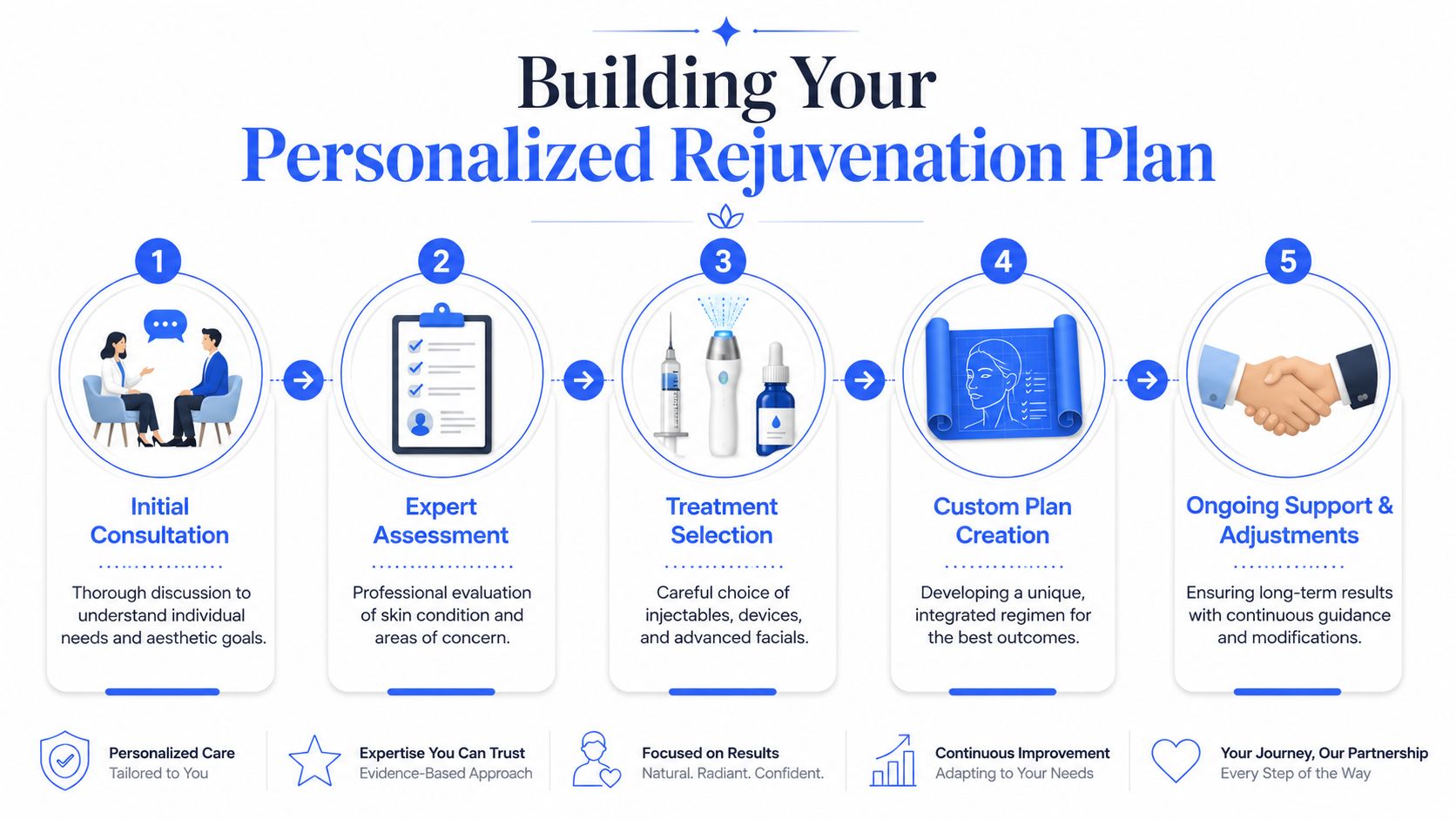
The most natural results rarely come from choosing one favorite treatment and repeating it forever. Faces age in layers, and a good rejuvenation plan respects that.
Why combination treatment plans look more natural
A patient may need neuromodulator treatment for the upper face, filler or biostimulation for support in the midface, and a laser or peel series for uneven texture. None of those treatments is “extra.” They're solving different pieces of the same visual problem.
That's the main reason combination planning works better than isolated correction. If you only soften lines but leave hollowing untreated, the face can still look fatigued. If you only add volume but ignore the skin surface, the result can look heavier rather than fresher.
How a long-term plan is built
A strong plan usually accounts for four variables at the start:
- Anatomy and movement
Some patients crease early because of expressive muscle activity. Others lose support first. The map matters.
- Skin behavior
Pigment tendency, acne history, inflammation, and healing pattern affect treatment choice.
- Tolerance for downtime
The right treatment on the wrong timeline is still the wrong treatment.
- Maintenance style
Some patients want a structured annual plan. Others prefer occasional reset treatments plus skincare.
A personalized plan may also include services offered through ProMD Health, such as injectables, lasers, advanced facials, Emsculpt NEO, and regenerative care, depending on the concern being treated and the office's service availability.
Good rejuvenation planning asks, “What combination will age well?” not just, “What can we do today?”
The benefit of that mindset is subtlety. Patients usually don't want to look treated. They want to look rested, healthier, and more in proportion.
Managing Expectations Results Timelines Risks and Aftercare
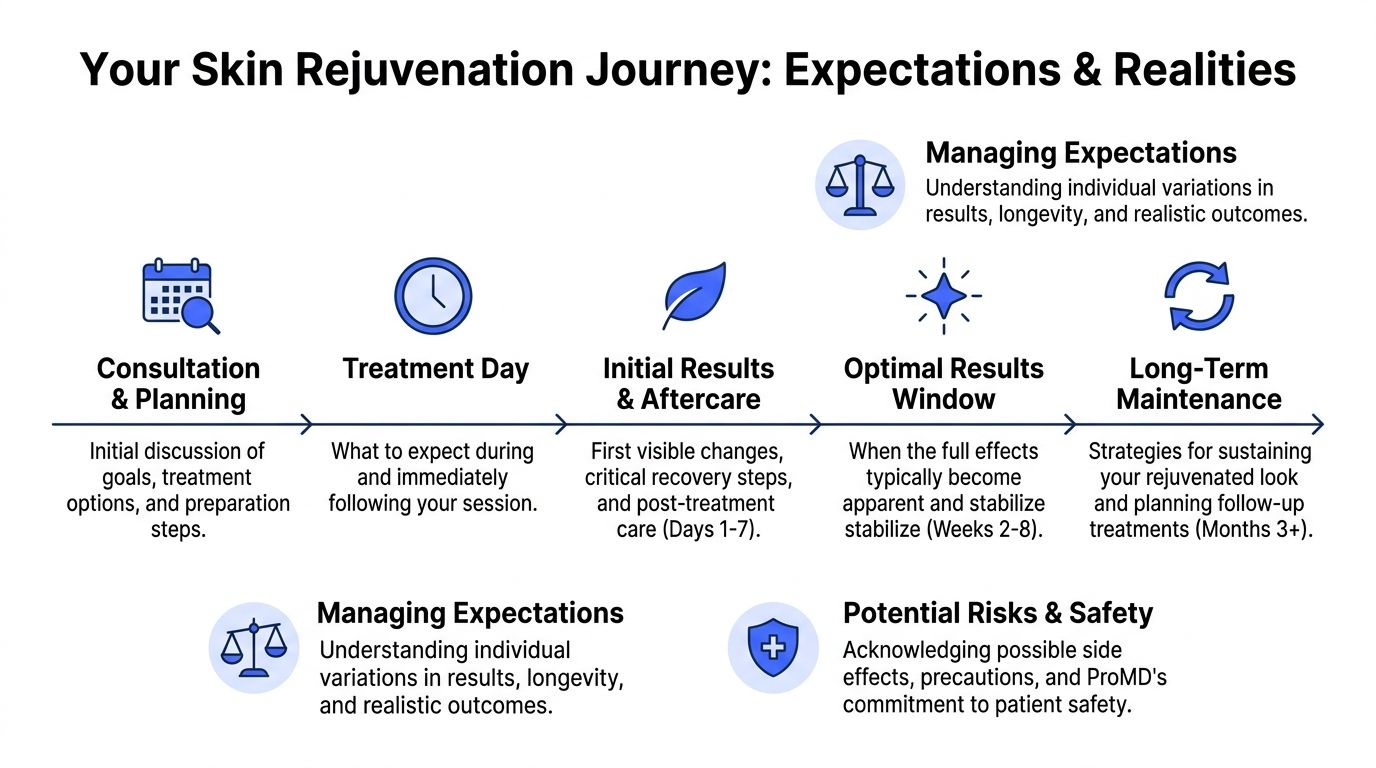
One of the biggest reasons patients get frustrated with skin rejuvenation treatments is simple. They expect one timeline when the biology is operating on another.
The biological timeline matters
Some treatments show an effect quickly. Others ask for patience because they rely on collagen production, wound repair, and cellular turnover. Those are not same-day processes.
Research from the American Society for Dermatologic Surgery notes that non-ablative rejuvenation requires multiple sessions and that improvement is “gradual” and may take “several months” to peak, which helps explain why patients sometimes stop treatment too early when they don't see immediate change in non-ablative skin rejuvenation guidance.
Biostimulators are a good example of this timeline difference. They trigger collagen remodeling rather than immediate plumping. Peak results typically appear two to three months post-treatment, with full aesthetic outcomes at 4 to 6 months and durability extending 18 to 24 months according to the previously cited review on collagen biostimulators. Patients need to understand that “nothing happened yet” often really means “the process is underway.”
Risks aftercare and what patients often underestimate
The common mistake isn't just impatience. It's underestimating aftercare.
A few principles help patients protect their results:
- Follow recovery instructions closely: Heat, exercise limits, skincare restrictions, and timing all matter after procedures.
- Don't judge too early: Swelling, dryness, flaking, or temporary asymmetry can be part of normal recovery depending on treatment.
- Use supportive skincare: Barrier support, sun protection, and provider-guided topicals help preserve gains.
- Return for reassessment: Adjustment visits are part of good care, not a sign that treatment failed.
Risks vary by category. Injectables can create imbalance if the product choice or placement is wrong. Surface treatments can irritate reactive skin if timing and aftercare aren't respected. Energy-based treatment can disappoint when the device doesn't match the problem.
A realistic conversation should include three questions before treatment:
- What change should be visible first?
- What part improves later?
- What would count as normal healing for me?
Patients who understand those answers are more likely to stay with the plan and less likely to chase unnecessary correction.
Choosing a Provider and Understanding Costs
The provider matters as much as the treatment menu. A syringe, a laser platform, or a peel protocol is only as good as the assessment behind it.
What to look for in a rejuvenation provider
Look for a clinic that can explain why a treatment is appropriate for your anatomy, your skin behavior, and your tolerance for downtime. A strong consultation should feel specific, not scripted.
Useful signs include:
- Clear reasoning: The provider can explain why one modality fits better than another.
- Range of options: Treatment plans aren't limited to one favorite service for every patient.
- Expectation management: You hear honest discussion about timelines, maintenance, and trade-offs.
- Attention to layering: The plan considers movement, volume, texture, and skin quality separately.
If a clinic jumps straight to a popular product without clarifying the actual problem, slow down. Good aesthetic medicine isn't about selling a category. It's about matching the tool to the diagnosis.
How to think about pricing and payment
Aesthetic rejuvenation is elective care. At ProMD Health, services are provided on a cash-pay model, so patients shouldn't expect insurance coverage for these treatments.
That matters because cost conversations should be framed correctly. You're paying for the treatment itself, the judgment behind treatment selection, the clinical environment, and the follow-up that helps keep results on track. The cheapest plan often becomes the most expensive when it creates correction work later.
Patients who want a lower-friction first step may prefer a virtual starting point through ProMD Connect, especially when the goal is to discuss options, timing, and whether an in-person visit makes sense.
If you're considering ProMD Health, start with a consultation focused on your actual pattern of aging, not just a single line or feature. The right plan may combine injectables, lasers, skin therapies, or regenerative options over time. What matters most is choosing a provider who can build a strategy that looks natural now and still makes sense later.


