
If you're looking at your legs and thinking about another week of shaving, razor bumps, missed spots behind the knees, or the hassle of timing wax appointments around work and travel, you're not alone. Leg hair is one of the most frustrating maintenance issues patients bring up, especially because it covers such a large area and never really stays “done” for long.
That's why leg laser hair removal has become such a practical option. Instead of repeating the same short-term routine, you move toward long-term reduction with a treatment plan built around how hair grows. Done well, it can mean less daily upkeep, softer regrowth, and a much more predictable routine.
At a medical practice, the process should feel clear from the start. You should know how the laser works, whether you're a good candidate, what treatment feels like, how many visits you'll likely need, what “permanent reduction” really means, and what the investment looks like in a cash-pay setting.
Table of Contents
- Tired of the Shaving and Waxing Cycle
- How Laser Hair Removal Achieves Smooth Legs
- Are You a Good Candidate for Leg Treatments
- Your Treatment Journey from Consultation to Aftercare
- Expected Results and How Many Sessions You Will Need
- How Laser Compares to Shaving Waxing and Electrolysis
- Understanding the Costs and Payment Options
- Why Choose a Medical Practice for Your Treatment
Tired of the Shaving and Waxing Cycle
Most patients don't start searching for laser hair removal because they're curious about laser physics. They start because they're tired. Tired of shaving in a rush. Tired of stubble coming back quickly. Tired of planning vacations, gym days, dresses, and beach trips around hair removal.
Waxing solves the problem for longer than shaving, but it creates its own trade-offs. You have to grow the hair out first, the appointments repeat, and many people still deal with irritation or ingrown hairs afterward. For legs, that cycle gets expensive in time and maintenance even before you think about the financial side.
Laser hair removal changes the question. Instead of asking, “How do I remove this hair again this week?” you start asking, “How do I reduce how much hair grows back at all?” That shift matters because laser treatment targets the follicle, not just the hair you can see above the skin.
Why legs are such a common treatment area
Legs are one of the most popular areas for treatment because the area is large and the upkeep is repetitive. If you've been shaving for years, even a modest reduction in growth can make your routine much easier.
Patients usually care about a few things:
- Time back in your routine because daily or frequent shaving adds up
- Smoother feel between appointments, workouts, and events
- Less visible regrowth so you don't feel like hair is “back” right away
- Fewer maintenance decisions compared with constant waxing schedules
A good leg treatment plan isn't about chasing one perfect session. It's about reducing hair steadily over a series of visits so your skin becomes easier to maintain.
That's the practical value of laser hair removal legs treatment. It's not magic, and it isn't instant. It is a structured, medical approach to long-term reduction that can make life a lot simpler when expectations are set correctly.
How Laser Hair Removal Achieves Smooth Legs
A patient will often say the same thing after her first leg session. The hair still appears for a week or two, then it starts shedding unevenly, and the skin begins to feel smoother without the usual daily stubble. That pattern is normal. Laser hair removal changes how the follicle functions over time, so the result is gradual reduction, not instant hairlessness the day you leave the office.
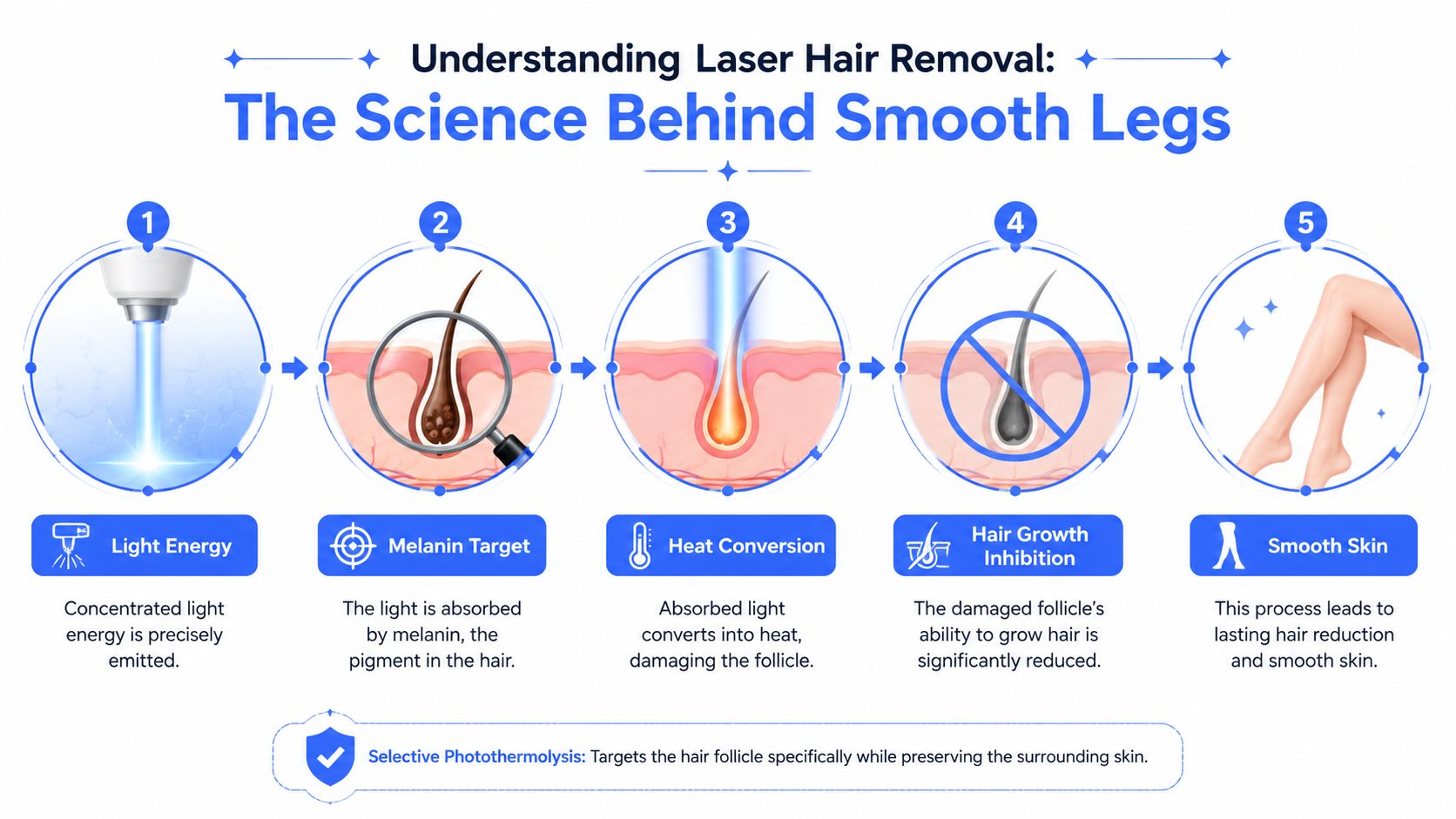
Laser energy is attracted to pigment in the hair shaft and follicle. That pigment absorbs the light, converts it to heat, and the heat injures the follicle enough to slow or reduce future growth. The goal is controlled damage in the follicle while protecting the surrounding skin.
What the laser is actually targeting
The target is the follicle below the surface, especially hairs in an active growth phase. Visible hair above the skin is not the treatment goal. It is only the marker that tells us there is pigment available to carry heat downward.
That is why leg treatment happens in a series. Some follicles are active at the time of your appointment, and some are resting. In practice, this means one session can reduce a portion of the hair, while later sessions address follicles that were not ready to respond the first time.
Patients usually notice a few changes as the series progresses:
- Less overall hair across the calves, knees, and thighs
- Softer regrowth instead of the same coarse feel after shaving
- More patchy return rather than uniform regrowth
- Longer stretches of smoother skin between appointments
On legs, that matters because the area is large and growth is not always perfectly uniform. Knees, shins, and the backs of the thighs can respond a little differently, so technique has to stay consistent across the whole treatment field.
Why settings matter on legs
Legs are a broad treatment area, and broad areas expose rushed technique quickly. Uneven overlap, settings that are too conservative, or settings that are too aggressive can all affect the outcome. In a medical practice, the provider adjusts for skin tone, hair density, recent sun exposure, and how your skin handled earlier sessions.
Published treatment parameters for long-pulsed laser hair removal describe ranges such as 20 to 30 J/cm² fluence, 10 Hz pulse frequency, and a 30 ms pulse width for body hair treatment in appropriate candidates, as outlined in this dermatology protocol reference. Those numbers are not used the same way for every patient. They are starting points within a clinical framework, not a one-size-fits-all recipe.
Comfort also depends on settings and device choice. Modern systems often include cooling that makes leg sessions much more tolerable than many patients expect, but stronger settings can still create brief snapping or heat sensations. The trade-off is straightforward. Settings have to be high enough to affect the follicle, while still staying appropriate for your skin.
At ProMD Health, that balance is what makes leg laser treatment feel medical rather than generic. Smooth legs come from repeatable technique, careful coverage, and a plan that aims for long-term hair reduction, knowing that some patients will still need maintenance later, especially if hormones influence regrowth.
Are You a Good Candidate for Leg Treatments
The classic laser candidate has darker hair and lighter skin, because that contrast makes it easier for the laser to find the pigment in the hair without competing with pigment in the surrounding skin. When that contrast is strong, results are often more straightforward and treatment planning is simpler.
But that older rule has led many patients with darker skin to assume they can't be treated. That isn't accurate. Rather, the question is whether the provider is using the right device, the right wavelength, and the right treatment approach for your skin tone.
Who usually responds most predictably
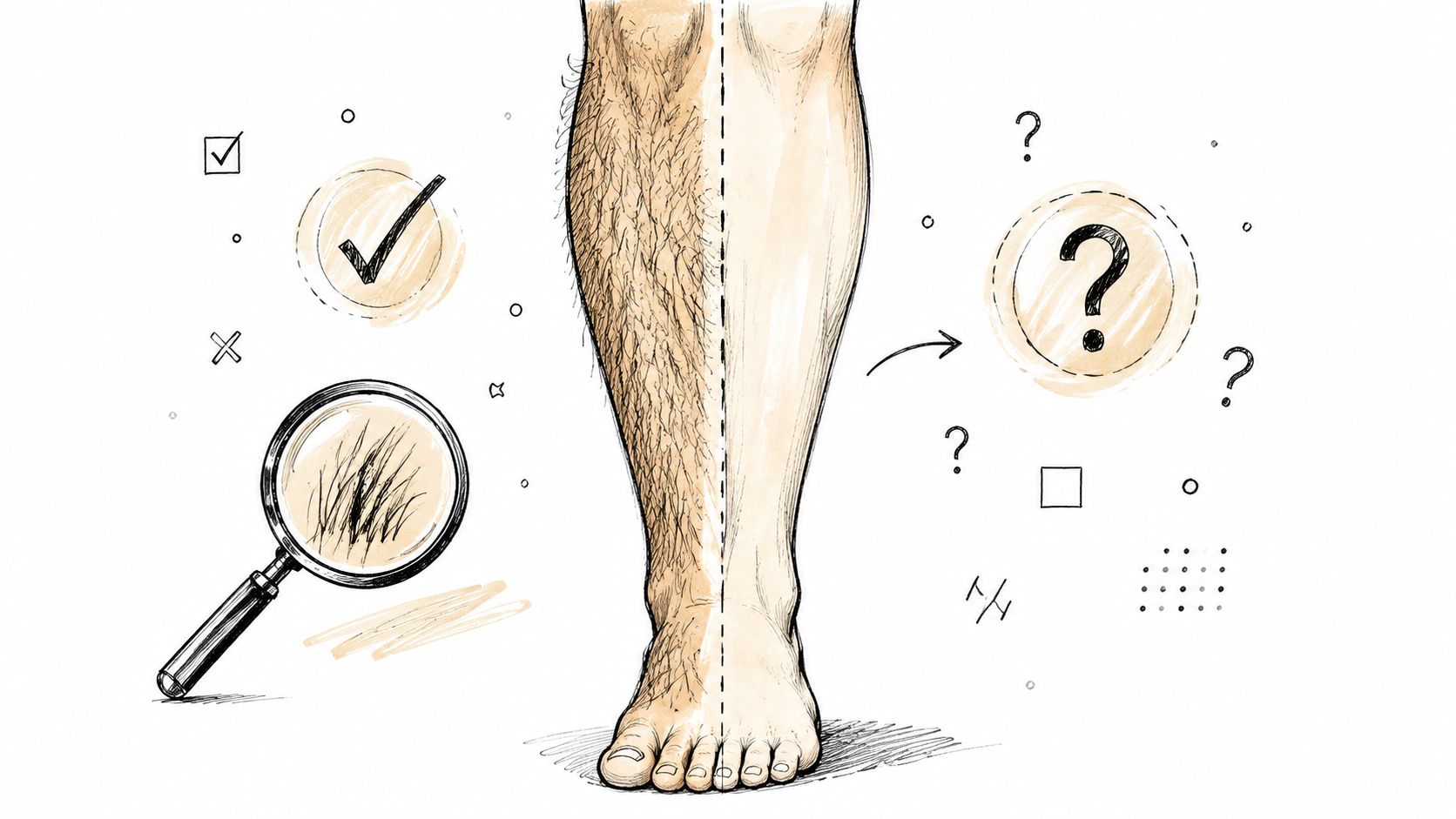
Patients often do best when they have enough pigment in the hair for the laser to recognize a strong target. Coarse, dark hair tends to respond more clearly than very light, gray, red, or fine hair.
A consultation should look at more than skin color alone. It should also include:
- Hair color and thickness because the follicle has to absorb the light effectively
- Recent sun exposure since tanned skin can change safety planning
- History of pigmentation issues if your skin tends to darken or lighten after irritation
- Hormonal background when regrowth patterns seem unusual or widespread
What darker skin patients need to know
For darker skin, the issue isn't that treatment is off-limits. The issue is that treatment has to be performed with more caution and better protocol selection. The American Academy of Dermatology states that laser hair removal is an option for dark skin but it “must be performed very carefully” with longer wavelength lasers to avoid “burns, permanent changes to skin color, and scars”.
On legs, that nuance matters even more because the area is large and hair can be dense or coarse. A provider may need to slow down, adjust pulse behavior, or choose a wavelength better suited to darker skin so the treatment stays focused on the follicle rather than overheating the epidermis.
That's why “Can dark skin be treated?” is the wrong first question. Better questions are:
- What laser are you using for my skin tone?
- How do you reduce the risk of pigment change on legs?
- Will you test and adjust settings based on my response?
If those questions aren't answered clearly, keep looking. Laser hair removal legs treatment should be customized, not generalized.
Your Treatment Journey from Consultation to Aftercare
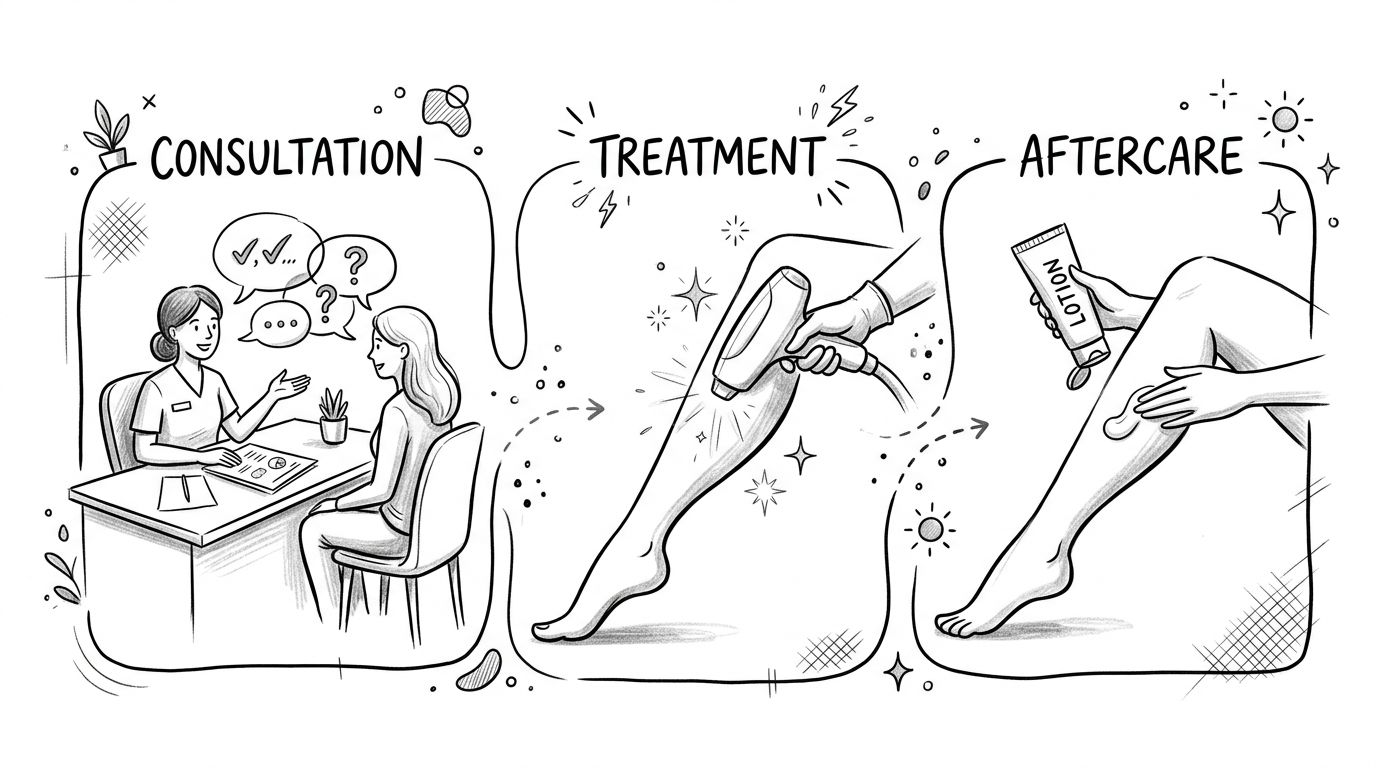
You book because you are tired of planning your week around shaving, then wondering how a full-leg laser series works in real life. The process is straightforward, but it should never feel rushed. At ProMD Health, the goal is to map out a treatment plan that fits your skin, hair pattern, schedule, and tolerance for downtime, then adjust based on how your legs respond over time.
Before your first session
The consultation sets the tone for everything that follows. A provider reviews your medical history, medications, skin tone, hair density, recent sun exposure, and any history of irritation or pigment change. Full legs cover a large surface area, so small details matter. If one area of the legs is more sensitive, more tan, or more densely grown than another, settings and technique may need to change across the treatment zone.
Preparation is simple, but it affects both safety and comfort. The hair follicle needs to be present under the skin, which is why patients are asked to stop waxing, plucking, and epilating before treatment. Shaving is usually recommended shortly before the appointment so the laser can target the follicle without excess surface hair absorbing heat. Patients should also arrive with clean skin and follow the office instructions in this laser hair removal preparation guide.
What treatment day feels like
For new patients, the biggest surprise is usually that leg treatment is very manageable with current devices. Full legs still take longer than a small area, but modern platforms can treat large zones efficiently, and cooling makes a real difference. In practice, patients usually describe the sensation as quick snaps of heat, warmth, or a rubber-band flick, with some spots around the knees, ankles, and shins feeling sharper than the thighs.
Comfort is not identical from patient to patient. Coarse, dense hair often feels more intense during early sessions because there is more pigment for the laser to target. Later visits are often easier as the hair becomes sparser and finer. If a patient is anxious or especially reactive, the treatment can be paced more slowly, with breaks and ongoing skin checks rather than trying to push through discomfort.
I tell patients to expect a medical treatment, not a spa service. It should feel controlled, predictable, and worth repeating.
What happens after each visit
Right after treatment, mild redness, perifollicular swelling, or a warm sun-exposed feeling can happen. That reaction is common and usually settles within hours to a couple of days, depending on skin sensitivity and the settings used. Most patients return to normal activity the same day, but heat-heavy workouts, hot tubs, and significant sun exposure are usually best avoided right away if the skin is still reactive.
The next part often causes confusion. Treated hairs can look as if they are still growing for a period after the session, but many of those hairs are shedding out of follicles that were successfully treated. That delayed shedding is normal.
Aftercare is less about doing a lot and more about avoiding irritation. Keep the skin calm, protect it from sun exposure, and resist the urge to wax or tweeze between sessions. Consistency matters. In a multi-state practice like ProMD Health, one advantage is that treatment plans and follow-up instructions can stay consistent even if a patient's schedule changes or they are seen in a different office during their series.
Expected Results and How Many Sessions You Will Need
Patients usually ask this after the first treatment, when the legs still look similar and they are waiting for a dramatic change. The right expectation is steady reduction over time. Leg laser hair removal tends to reward consistency more than impatience.
A good result on the legs usually means less hair, slower regrowth, and softer texture. Some follicles stop producing visible hair for long periods. Others come back with finer, lighter strands that are easier to shave and less likely to create the constant maintenance cycle that brought many patients in to begin with.
What kind of reduction is realistic
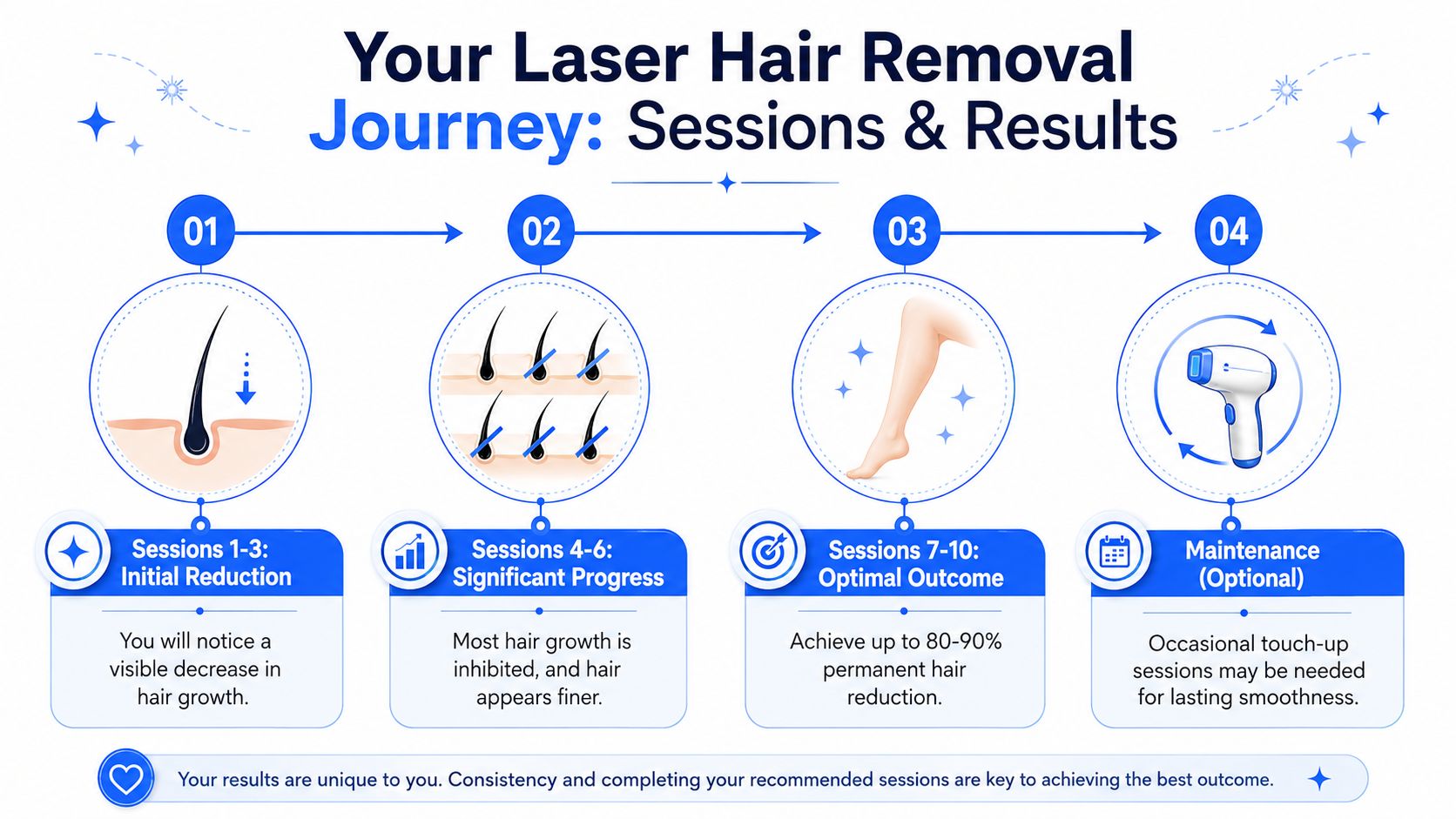
In practice, full legs usually take a series of sessions because only a portion of follicles are in the right growth phase at each visit. Most patients need about 6 to 8 treatments, spaced several weeks apart, before the improvement feels obvious and stable. Some need fewer. Some need more, especially if the hair is lighter, finer, hormonally influenced, or the starting density is high.
The midpoint matters. By the third or fourth session, many patients notice that shaving takes less time, stubble is less dense, and patches of slower regrowth start to show. By the end of a full series, the goal is meaningful long-term reduction, not a guarantee that every follicle is gone forever.
That distinction matters in clinic. “Permanent reduction” means the treated hair burden stays lower over time. It does not mean no future regrowth under any circumstance.
Why your session count can vary
The legs are a large treatment area, and outcomes depend on more than the laser itself. Skin tone, hair color and thickness, treatment spacing, recent sun exposure, and whether sessions are missed all affect the pace of change. Hormonal factors also matter. Thyroid changes, menopause, pregnancy-related shifts, and some medications can lead to new growth months or years later, even after a strong response.
This is one reason I set expectations carefully at consultation. A patient with coarse dark hair on the lower legs often responds differently from a patient with finer mixed hair on the thighs. Both can improve. The timeline and endpoint may not be identical.
For a broader patient-friendly explanation of how results build across a series, this laser hair removal results timeline is helpful, even though it discusses another treatment area.
Why maintenance is sometimes needed
Maintenance is part of honest treatment planning. Some patients finish a leg series and go a long time before wanting a touch-up. Others benefit from occasional maintenance visits to keep scattered regrowth minimal. That does not mean the original series failed. It reflects how hair biology works over time.
If you are comparing long-term methods for leftover or resistant hairs, insights from beautysecrets.agency can help clarify where electrolysis may fit. For most leg patients, though, laser remains the more practical way to reduce a broad area efficiently.
The biggest win is usually not perfectly hairless skin forever. It is fewer ingrowns, less frequent shaving, and legs that stay smoother with much less work.
How Laser Compares to Shaving Waxing and Electrolysis
For legs, the right choice usually comes down to one question. Do you want the fastest short-term fix, or do you want a method that reduces how much maintenance you'll be doing later?
Shaving wins on convenience in the moment. Waxing lasts longer between appointments. Electrolysis can be appealing for very targeted work. But for a broad area like the legs, laser usually stands out because it treats many follicles efficiently and fits better with a long-term reduction goal.
Leg Hair Removal Method Comparison
| Method | Results | Cost Over 5 Years | Pain Level | Best For |
|---|---|---|---|---|
| Laser hair removal | Long-term hair reduction with finer regrowth over a treatment series | Higher upfront investment, often lower ongoing maintenance burden than repeated temporary methods | Usually moderate and brief | Large areas like full or half legs |
| Shaving | Very short-term smoothness | Ongoing recurring spend on razors and products | Low, but irritation and razor burn can happen | Fast home upkeep |
| Waxing | Longer hair-free periods than shaving, but hair returns and appointments repeat | Recurring appointment-based cost | Often moderate to high | Patients who want temporary longer gaps between upkeep |
| Electrolysis | Follicle-by-follicle treatment that can be useful for targeted areas | Can become time-intensive for large areas | Often moderate to high because of the repeated pinpoint treatment style | Small areas or isolated hairs |
A common mistake is comparing these methods only by what a single appointment feels like. Legs are a high-surface-area treatment zone. That means efficiency matters. A method that works well on a few stray hairs may not be the method you want for both lower legs or full legs.
If you're trying to understand where electrolysis fits, these insights from beautysecrets.agency offer a useful high-level explanation of how electrolysis differs from laser in practical use. For most leg patients, the decision isn't about which method is universally superior. It's about which method fits a large treatment area, your tolerance for repeat upkeep, and your long-term goal.
If you're treating a broad area, convenience over time matters more than convenience on one random Tuesday.
Understanding the Costs and Payment Options
Leg laser hair removal is a cash-pay cosmetic treatment, so the right way to budget for it is as a treatment plan, not a one-time visit. In practice, patients do best when they know the full-leg or lower-leg price, the recommended number of sessions, and whether occasional maintenance may be needed later.
Price usually changes for straightforward reasons. Treating full legs costs more than lower legs because the area is larger and the appointment takes longer. Buying a series often lowers the per-session rate compared with paying visit by visit. Medical oversight, device type, and the experience of the team also affect cost because they influence how consistently treatments are performed and how safely settings are chosen for your skin and hair.
A common range for leg treatments is a few hundred dollars per session, and some clinics offer discounted series pricing, with six-session packages sometimes landing around the mid four-figure range. Exact pricing still depends on geography, treatment area, and how the practice structures packages.
Ask direct questions before you commit:
- Is this quote for lower legs or full legs?
- Does the package include all recommended sessions, or only a starter series?
- What is the per-session price if I do not buy a package?
- How are maintenance visits priced if I need one later?
- Are financing or monthly payment options available?
Payment flexibility matters for many patients. Some offices offer package pricing, financing, or phased payment plans that make a full series easier to manage. If you want a useful checklist for evaluating a clinic before you buy a package, this guide to choosing a laser hair removal clinic can help you compare what is included.
Cost is only part of the decision. I tell patients to look at value over the full course of treatment. A lower advertised price does not help if the plan is vague, follow-up is inconsistent, or there is no clear explanation of long-term maintenance. Privacy matters too when you are discussing financing, treatment plans, and photos. For a plain-language reference on secure patient communication, see AONMeetings' HIPAA insights.
Why Choose a Medical Practice for Your Treatment
A patient usually notices the difference between a medical practice and a medspa when something is not straightforward. The skin tans easily. Hair grows unevenly because of hormones. A past wax left pigment changes. Full-leg treatment covers a large surface area, so settings, timing, and skin response matter more than many people expect.
That is why provider training and medical oversight matter. Leg laser hair removal works best when the person evaluating you can assess skin tone, hair caliber, medication use, recent sun exposure, and any history of irritation or discoloration before the first pulse is delivered. If your plan needs to change after a session because your skin reacted more strongly than expected, a medical practice is set up to make that adjustment safely.
At a multi-state practice such as ProMD Health, the benefit is not just access to treatment. It is consistency in how consultations are handled, how candidacy is assessed, and how realistic expectations are set around permanent reduction, maintenance, and hormonal regrowth. If you want a practical checklist for comparing providers, this guide to choosing a laser hair removal clinic is a useful place to start.
Privacy matters too. You may be discussing photos, medical history, medications, payment plans, and follow-up instructions. For a plain-English reference on secure patient communication, AONMeetings' HIPAA insights are helpful.
What should you look for at the consultation?
Look for clear clinical reasoning. The provider should explain whether you are a good candidate for full legs or lower legs, how your skin type affects device choice and settings, what the treatment should feel like, and what kind of regrowth is still normal during a series.
Ask direct questions about who performs the treatment, how test spots are handled when needed, and what happens if your skin becomes irritated or your response is slower than expected. Good answers are specific.
Do medical practices produce better results?
They often produce better decisions, and that affects results. The best outcome is not just fewer hairs after one session. It is a treatment plan that balances reduction, comfort, skin safety, and long-term maintenance based on how your body grows hair.
For legs, that matters because patients often expect every follicle to disappear permanently. In practice, many patients achieve a strong long-term reduction, then decide to come in occasionally for maintenance, especially if hormones, genetics, or missed timing between sessions affect regrowth. A medical practice tends to explain that clearly from the start instead of overselling a one-and-done result.
If you're ready to spend less time shaving and want a clearer plan for smoother legs, ProMD Health offers consultations for laser hair removal and other non-surgical aesthetic services across its active locations. A proper evaluation can help you decide whether full or half-leg treatment makes sense, what timeline to expect, and how to build a realistic series around your skin, hair, and goals.


