Sculptra's first preview can be misleading. Swelling and dilution water may briefly make the face look fuller, then fade and reveal the starting contour again. Collagen follows a slower clock, so a flat-looking face in the first week does not mean treatment failed.
These are three separate stages: temporary swelling, the fade back toward baseline, and delayed collagen production. Judge progress by a dated checkpoint, not by the mirror on injection day.
For a trip in two weeks, the timing matters. Cheeks may look smoother the morning after treatment, then return toward their usual contour by day four. That early fullness is not the finished result, and a gel filler follows a different timeline. Sculptra's result needs time to develop.
Table of Contents
- How Long Sculptra Takes to Show Results
- Why Collagen Shows Up Weeks Later
- The Session Schedule Behind the Wait
- What Changes How Fast Results Show
- When to Judge Results and Watch Lumps
- How Long a Finished Result Can Last
- Decide If Sculptra Fits Your Calendar
How Long Sculptra Takes to Show Results
The mirror can show a fuller face on treatment day, then a flatter one a few days later. Those are two different stages, not a same-day transformation followed by failure. Sculptra's visible contour changes develop gradually, so use dated checkpoints to judge what is happening.
| Phase | What you usually see | How to read it |
|---|---|---|
| Hours to a few days | Swelling and dilution water can look like instant improvement | Temporary, not the collagen result |
| First week | Temporary fullness fades and the prior contour can return | The early appearance is not the lasting result |
| About 1 month | Early visible change for many study participants | First fair photo comparison |
| 4 to 6 weeks after a session | Fuller effect of that session often becomes visible | Per-session checkpoint |
| About 12 weeks from the start | Slower remodeling; about 4–6 mm average skin-thickness gain in one FDA-reviewed study | Meaningful course check, especially after the series |
Right after treatment, swelling and dilution water can create an apparent improvement that fades within hours to days, according to FDA patient materials. As that fluid leaves, the original contour can return. That change is expected.
The first fair look
Sculptra's manufacturer reports that most clinical-study participants saw results as soon as 1 month after treatment, with a typical plan of 3 sessions spaced at least 3 to 4 weeks apart. Galderma Aesthetics also states that visible results may begin approximately 1 month after treatment and develop progressively. A month is a useful first photo comparison, not the finished face.
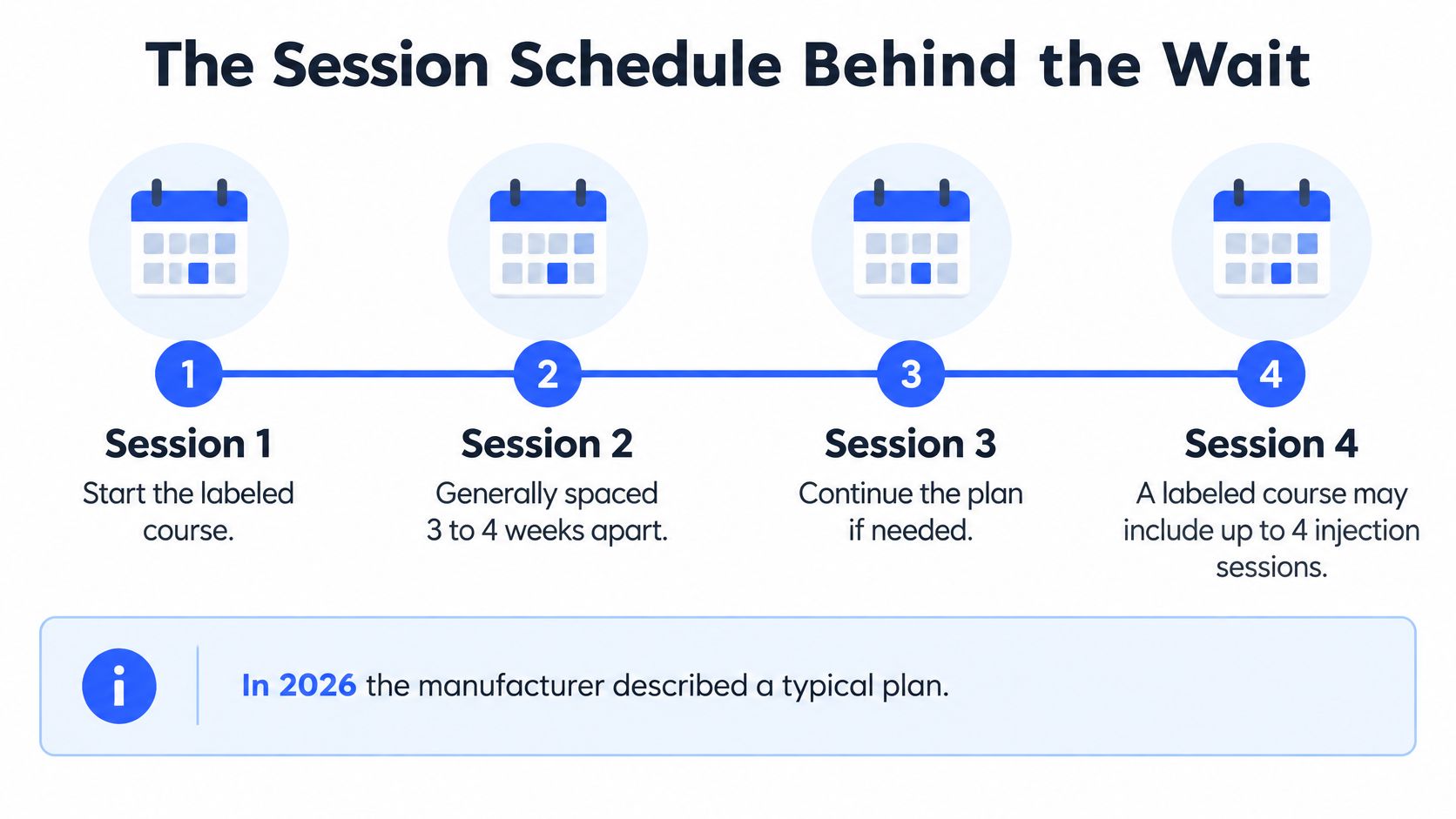
FDA labeling says visible contour, line, or wrinkle correction appears slowly. It recommends reassessing after at least 3 weeks before adding more injections. A labeled course can include up to 4 injection sessions, generally 3 to 4 weeks apart. If all sessions are used, the course can span about 9 to 12 weeks. The labeling places full treatment effects within “weeks to months.” In one FDA-reviewed study, average skin thickness increased by approximately 4 to 6 mm at 12 weeks after treatment started.
One visit or the whole series
“Time to work” can mean time after one appointment or time after the series. At week four, modest change may be an early sign rather than the course result if sessions remain. Once the series is complete, assess the overall change closer to 2 to 3 months of remodeling.
Nutrition does not replace the treatment timeline. People losing weight may also consider supporting facial fullness during weight loss. Weight-related changes in facial fullness and Sculptra's gradual contour changes can happen on separate timelines, so compare dated photos rather than relying on one day's appearance.
Why Collagen Shows Up Weeks Later
Sculptra can look as though it has faded before its longer-term change appears. That shift reflects three separate clocks: temporary swelling after treatment, the return toward baseline as that swelling settles, and gradual collagen development. The liquid in the syringe does not become lasting volume. Poly-L-lactic acid particles signal fibroblasts to produce collagen, a process that takes time.
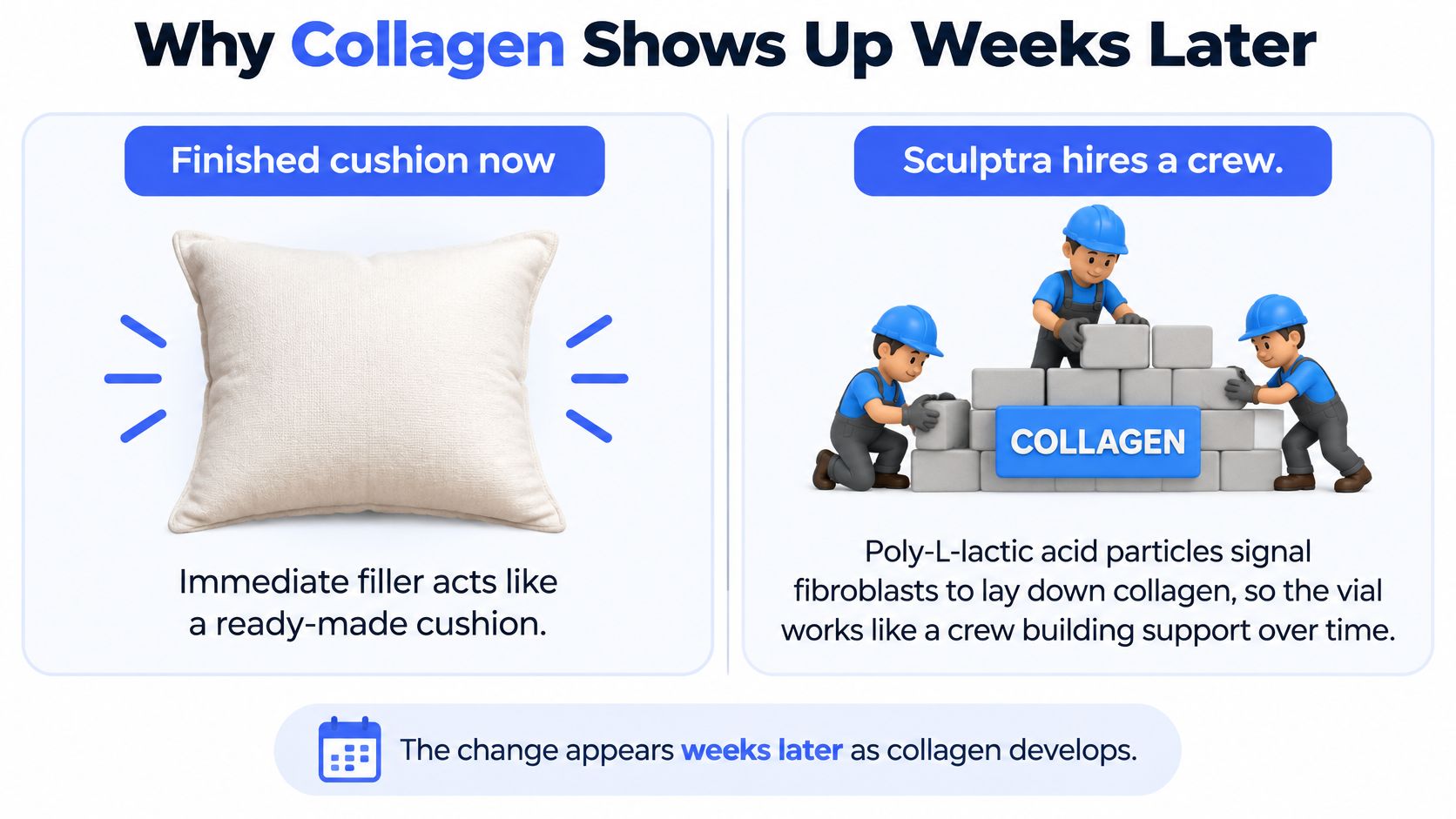
A hyaluronic acid filler occupies space on the day it is placed. Once ordinary swelling settles, its shape is easier to assess. With Sculptra, the early fullness can recede while collagen is still developing, so the mirror may show less change before it shows more.
The quiet middle
The American Society of Plastic Surgeons explains that results generally appear gradually over several months, and that the full effect of each session may take approximately four to six weeks to become visible. At that checkpoint, look for a developing change in contour rather than expecting a dramatic overnight shift. Collagen continues to develop beyond the first few weeks.
This timing can feel confusing: a face that looked fuller soon after treatment may look closer to its starting point once temporary swelling fades. That appearance alone says little about the later result. A dated photo comparison helps separate the early swelling clock from the slower collagen clock.
Why two faces on one plan differ
The same treatment schedule can produce different-looking progress photos. One person may notice a softer cheek shadow near the four-week mark; another may still look close to the starting photo at that point, with a clearer change later. Skin and facial volume differ, so the visible pace varies.
Use the four-to-six-week check as a point to review that session's progress. If week one looks like the before photo, wait for the swelling to settle and compare again at the planned checkpoint rather than judging the result from the treatment-day mirror.
The Session Schedule Behind the Wait
A Sculptra course is a series of decisions, not a fixed set of appointments. The calendar should leave room to review how each session settled before planning the next one. A flat-looking face in week one does not answer whether more treatment is needed: early fullness can fade before collagen-related change becomes easier to see.
| Plan piece | Typical figure | Why it matters |
|---|---|---|
| Sessions in a course | 1 to 4; often 3 | The injector can tailor the course to the treatment plan |
| Spacing | At least 3–4 weeks | Gives time for temporary fullness to settle before the next decision |
| Length of the injection course | About 9–12 weeks if all 4 sessions are used | Shows how the visits can fit across a calendar |
| When the series is judged | Weeks to months after treatment starts | Allows time for gradual change to become visible |
Why the gap exists
Temporary swelling and fullness can make the treated area look different before longer-term change is clear. The gap between visits gives the injector a more useful comparison: how the area looks after the early fullness has faded, alongside photographs and the treatment plan. It is a pause for a better decision, not a shortcut to faster results.
How to use each date
A course with four sessions can span about 9 to 12 weeks. That is the appointment schedule, not a promise that the finished result will be visible by the final visit. Three sessions are common; a fourth depends on the injector's assessment rather than an automatic slot on the calendar.
At each appointment, review the area and your photos with the injector, then confirm whether another session fits the plan. Before leaving, set the next visit around the timing your injector recommends. If a work trip conflicts with the appointment, ask the clinic about rescheduling instead of moving it earlier to stay on the original calendar. The goal is a clear comparison at each visit, not a rushed series.
What Changes How Fast Results Show
The collagen clock does not run at the same pace in every face. Your starting volume, skin quality, and daily habits affect how clearly change shows in photos. Temporary swelling can fade before new collagen becomes visible, so week-one appearance and later progress may tell different stories.
What you can steer
You cannot set the date collagen appears, but you can make changes easier to assess.
- Complete the planned sessions. One visit may not provide the full course your injector recommends.
- Keep the appointment spacing your injector sets. A consistent schedule makes it easier to assess each stage.
- Follow your injector's massage and activity instructions. Those directions help guide how you care for the treated area after injections.
- Use daily sun protection. It helps limit further sun damage to skin.
- Take photos from the same angle and in similar lighting. A different tilt or brighter room can make subtle changes appear larger or smaller.
What you cannot steer
Your starting collagen, degree of volume loss, and baseline skin quality are already part of the picture. Age, healing capacity, smoking, and long-term sun damage can also affect collagen quality, even when appointments stay on schedule. You can change habits such as smoking and sun exposure, but you cannot change the skin's history.
Consider two people following the same three-session cheek plan. One has mild hollowing, little sun damage, and no tobacco history. At a one-month photo, the midface looks slightly fuller, and the next session refines the result. The other has deeper volume loss and years of unprotected sun exposure. At the same checkpoint, the change looks smaller. That person may need the full series and more time after the final visit to reach a similar visible point.
A timeline is a range, not a promise that every face will look different on the same date. Published checkpoints describe groups, while your photos track your own changes. Compare images taken under similar conditions, and follow your injector's instructions between visits so changes in lighting, swelling, or aftercare do not cloud the comparison.
When to Judge Results and Watch Lumps
A face that looks unchanged in week one has not failed treatment. Sculptra runs on three clocks: temporary swelling can fade, the face can settle back toward its starting appearance, and collagen develops later. The best time to judge depends on which clock you are watching.

The cosmetic clock and the safety clock do not stop together. FDA data report that papules may appear well after treatment: median onset was 55 days and mean onset 159 days. For nodules, median onset was 160 days and mean onset 209 days. The same FDA data report these onset figures.
In the VEGA study, papules had an average onset of seven months, with a range of about 0.3 to 25 months; 24% of affected patients resolved spontaneously during the study. These later possibilities are why a pleasing cosmetic result does not, by itself, end the period for watching for lumps.
A small lump felt only by touch differs from a larger lump that is red, painful, growing, or persistent. Contact the treating clinician promptly about red, enlarging, or painful findings. Do not massage a new painful lump or try to treat it at home. For more on Sculptra nodules and how they are assessed, bring your concern to the clinician rather than waiting for a routine cosmetic review.
A photo can help document a change, much as when to assess knee injection results depends on checking at the right interval. But a phone image cannot replace an in-person exam when a lump is changing.
How Long a Finished Result Can Last
A flat-looking face in week one does not predict how long Sculptra will last. Early swelling fades first; collagen develops later. A useful durability check comes after the treatment course has had time to show its effect, not on the day of an appointment.
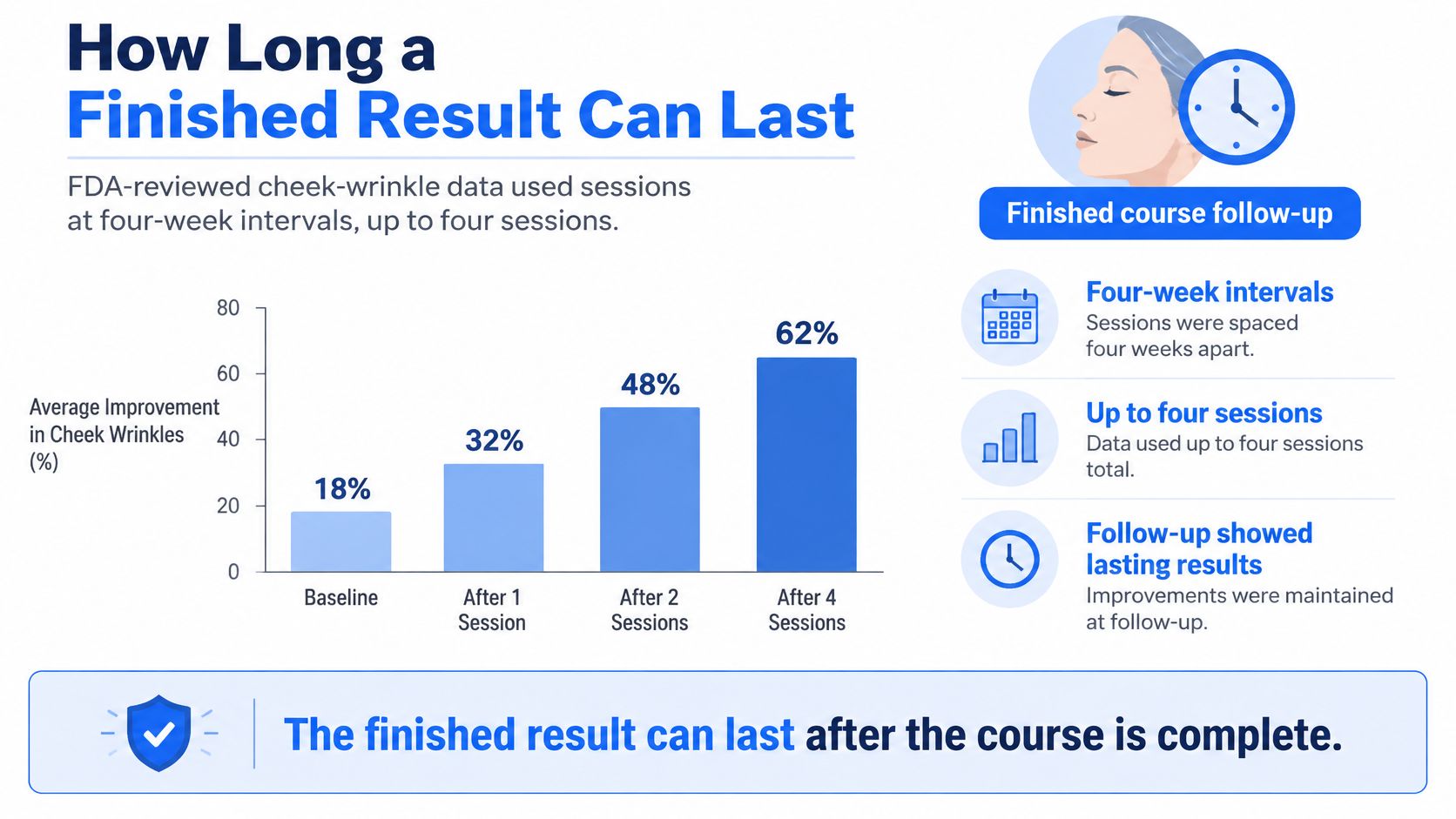
FDA-reviewed Sculptra data document effects through 24 months. In the cheek-wrinkle study, participants received sessions at four-week intervals, with up to four sessions. Follow-up found effects maintained through two years, including in an extension evaluation from 12 through 24 months. That is the study's follow-up horizon, not a guarantee that every person will have the same result at month 24.
| Checkpoint | What was reported | Source |
|---|---|---|
| About 1 month / week 4 | Participants reported results and high satisfaction in a phase IV report | Galderma's 2025 phase IV report |
| Month 9 | Improvements were maintained in the phase IV report | Galderma's 2025 phase IV report |
| 12 months | 90.57% improvement in midfacial volume among 331 subjects | Multicenter report cited by Vibe Pharma |
| 52 weeks | 67.6% improvement in wrinkle severity among 260 participants | Randomized trial cited by Cosmetic Injectables |
| 12 through 24 months | Effects were maintained in cheek-wrinkle follow-up | FDA-reviewed extension data |
These figures describe study groups, not a schedule for every face. The study results help set expectations; follow-up photos and a clinical exam help assess an individual result.
Maintenance is not a restart
Aging, weight change, and sun exposure continue after treatment. Maintenance is a fresh decision based on the result at follow-up, rather than an automatic repeat of the original course. If you are comparing that timeline with gel fillers for the cheeks, this guide to how long cheek fillers last explains the difference in duration.
Decide If Sculptra Fits Your Calendar
If you need a look for an event in the next few days, Sculptra is the wrong tool. Say that plainly in the consult. A hyaluronic acid filler, or a neurotoxin plan for lines that move, matches a short calendar. Sculptra will still be in the swelling clock when the photos are taken.
If the goal is gradual cheek and facial collagen support, and you can attend a series with checks at least three weeks apart, the product matches the biology. You are hiring a crew and agreeing to grade the work on dates, not on the drive home.
Bring three things to the consult.
- Reference photos in your usual lighting, not a filtered selfie from a wedding.
- Dates of any prior filler, so old product is not mistaken for this course.
- A real yes that you can return for photos about one month after each session and again after the series.
Ask how many sessions your starting volume suggests. Agree on the dates when before-and-after photos will be compared. Ask which new lumps need an in-person exam rather than a picture. The visit is cash-pay. Do not assume insurance will cover it.
If you are still choosing between a space-occupying product and a collagen stimulator, read Radiesse versus Sculptra before you book, then schedule a consultation with those dates in hand. The useful finish line is a dated plan, not a same-day reveal.
ProMD Health offers Sculptra as gradual collagen support for the cheeks and facial contour, with the series and photo checks arranged during the consultation rather than guaranteed as a same-day change. Visits require cash payment, and the timeline follows the clinical interval, not an insurance calendar. If that pace suits your plans, schedule a consultation at ProMD Health and bring the dates you can return.