You may be comparing dermal fillers jawline before and after photos and wondering whether the same sharper border would suit your face. The honest answer depends less on the photograph than on what creates your current softness, whether that cause can respond to filler, and how much change your anatomy can support without looking heavy.
A well-planned result can improve definition without making the face look overfilled. It can also disappoint when filler is asked to lift loose skin, remove substantial fat, or replace a weak bony foundation. The consultation should begin with those limits, not with a promise of a dramatic transformation.
Table of Contents
- What Jawline Filler Actually Changes
- How Injectors Build the Jawline
- Filler Materials and How Long Results Last
- Who Is and Is Not a Good Candidate
- A Realistic Timeline of Before and After Changes
- Safety, Downtime, and FDA Guidance
- Case Notes From Real Jawline Filler Treatments
- Questions to Ask Before Booking
What Jawline Filler Actually Changes
A patient often points to the area below the ear, traces a finger toward the chin, and says, “I want this line to look cleaner.” That request may involve several different anatomical issues. The jawline includes the mandibular border and gonial angle, while the pre-jowl sulcus is the depression that can develop beside the chin as facial volume shifts. The chin-to-jaw transition also affects whether the lower face looks continuous or interrupted.
Dermal filler adds volume and structure in selected planes. At the mandibular angle, deeper placement can create a more distinct corner. Along the pre-jowl sulcus, it can soften a hollow that makes early jowling appear more prominent. Near the chin and mandibular border, carefully placed product can improve the transition between the front and side of the lower face.
It doesn't tighten loose skin or reposition descended tissue. It won't remove substantial submental fat, and it can't reshape the underlying mandible. A person with mild volume loss and relatively elastic skin may see a clearer border, while someone with pronounced laxity may have more fullness but still lack a crisp outline.
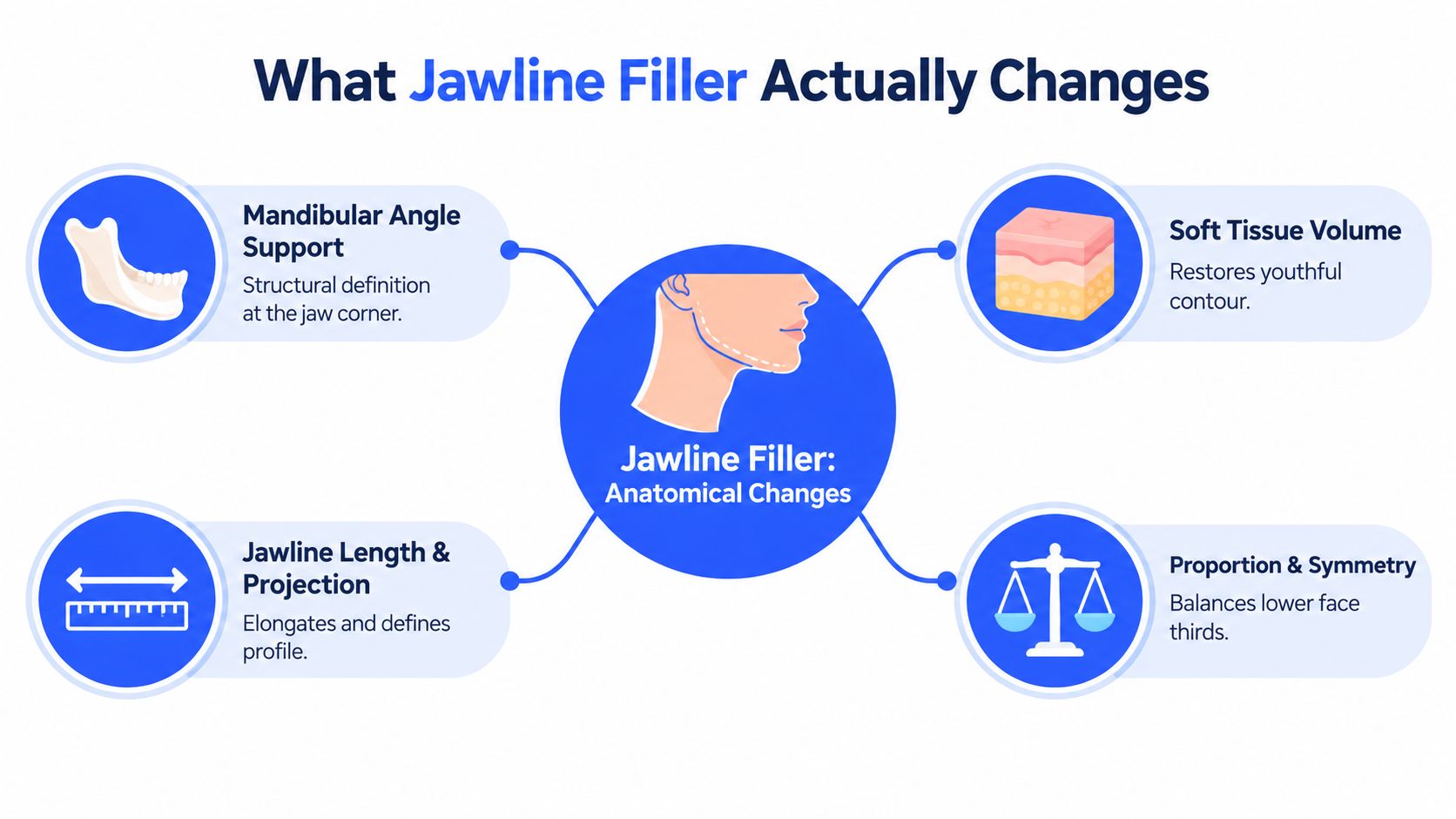
The before-and-after question
The useful question isn't “How sharp can you make my jaw?” It's “Which anatomical change would make my jawline look more defined while preserving proportion?”
A prospective 12-month study of minimally invasive jawline contouring used three-dimensional surface analysis and found that the surface-volume coefficient improved from 1.10 ± 0.2 at 14 days to 0.63 ± 0.1 at 12 months. Investigators and patients most often rated the result as “very much improved” at 3, 6, and 9 months, supporting a durable contour change rather than an effect caused only by early swelling (12-month jawline contouring study).
That evidence supports a measured expectation. Filler can refine a border, restore a dip, and improve lower-face balance. It cannot turn every soft jawline into a surgical contour.
How Injectors Build the Jawline
Jawline contouring works best as a structural build rather than a single line of product. The injector first assesses the bone, chin projection, skin movement, pre-jowl hollow, and the amount of tissue obscuring the mandibular border. Each placement should have a clear purpose in the final profile.
Deep support comes first
At the gonial angle, a needle may allow precise deep placement directly over bone. This can add support at the corner below the ear and make a blunted angle appear more defined. In the pre-jowl sulcus, deep support can replace a localized depression and reduce the visual break beside the chin.
The mandibular border is the lower bony edge running from the chin toward the angle. A cannula is often useful along this longer path because it can distribute product through a controlled track and may reduce the number of skin punctures. It doesn't eliminate risk, and the choice between cannula and needle should follow the injector's anatomical assessment rather than a fixed rule.
Surface refinement follows the framework
After deep support, an injector may use linear placement along the border to create a cleaner edge. Superficial refinement can then smooth the transition from chin to jowl. The chin-to-jowl vector describes the direction and continuity of that transition, while the gonial angle refers to the corner where the vertical and horizontal portions of the jaw meet.
The visible change should match the placement. Deep angle support changes the corner. Pre-jowl filling softens a hollow. Border refinement improves continuity. Adding product without this cause-and-effect plan can create fullness without definition.
For an overview of how facial contouring with injectables is planned, see non-surgical facial contouring with fillers.
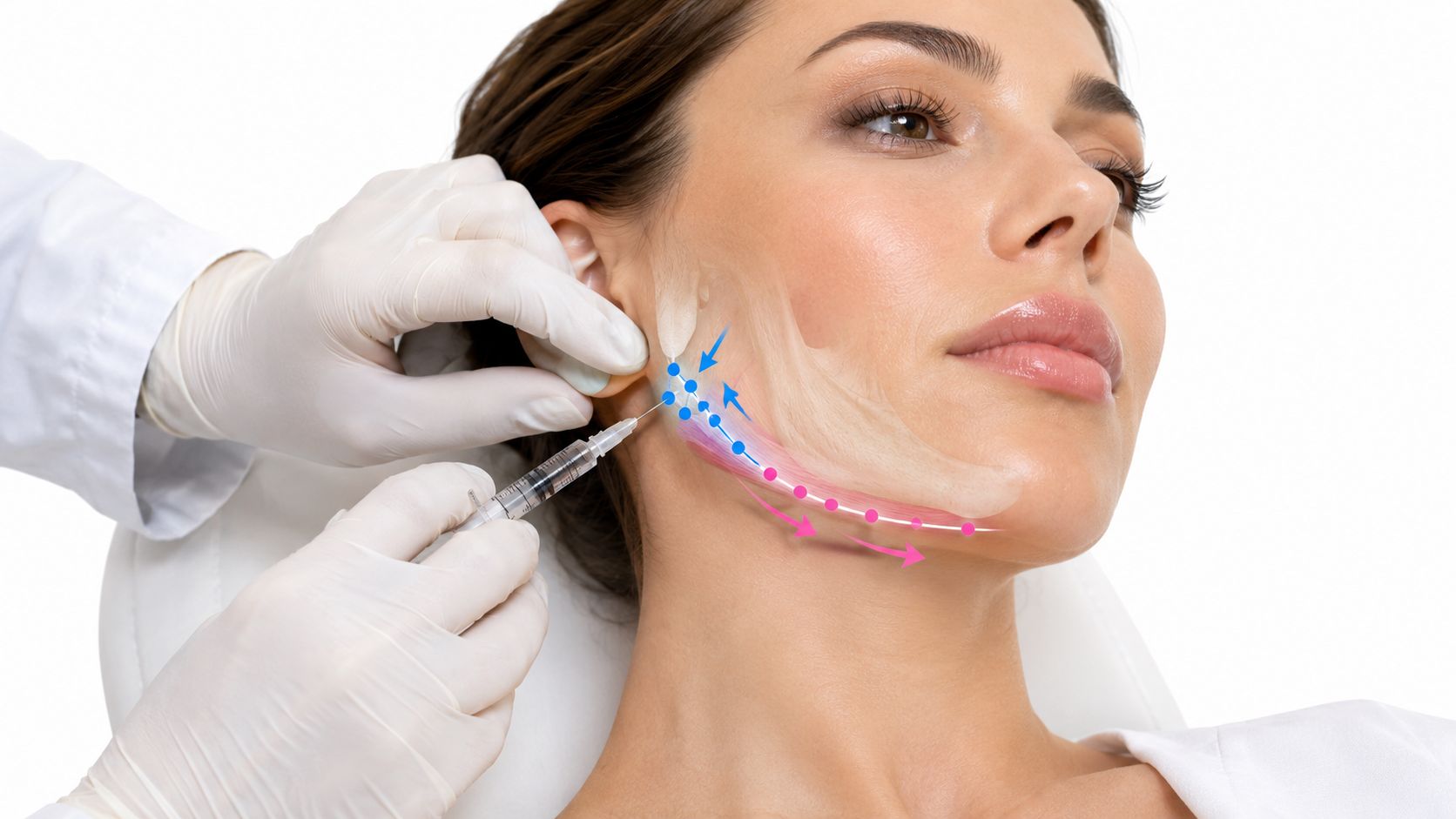
Practical rule: A visible contour change should be traceable to a specific anatomical problem. If the plan only says “add more definition,” ask where the product will go and what that placement is intended to change.
Filler Materials and How Long Results Last
The material affects the appearance, maintenance plan, and options available if the result needs correction. Hyaluronic acid filler is widely studied for jawline rejuvenation and can be dissolved with an appropriate enzyme if clinically necessary. Biostimulatory materials behave differently, so they require more patience during both treatment and evaluation.
A Cleveland Clinic review states that hyaluronic acid jawline filler typically lasts 6 to 12 months, and in some cases up to 2 years. A peer-reviewed review reports approximate duration ranges of 3 to 12 months for hyaluronic acid, 9 to 12 months for calcium hydroxylapatite, up to 2 years for poly-L-lactic acid, and more than 5 years for polymethylmethacrylate. It also identifies hyaluronic acid as the most studied filler for jawline rejuvenation, with benefits lasting up to 18 months.
Those ranges aren't guarantees. Placement depth, metabolism, facial movement, product selection, and the patient's starting anatomy all affect what remains visible in a photograph.
Jawline filler materials at a glance
| Material | Typical duration | Best for | Reversible |
|---|---|---|---|
| Hyaluronic acid | 3 to 12 months, with jawline benefits reported up to 18 months | Adjustable structural contouring and volume restoration | Yes, with appropriate clinical treatment |
| Calcium hydroxylapatite | 9 to 12 months | Firm structural support and selected deep-placement plans | No dissolving enzyme |
| Poly-L-lactic acid | Up to 2 years | Gradual, diffuse collagen-supporting volume | No dissolving enzyme |
| Polymethylmethacrylate | More than 5 years | Long-lasting correction in carefully selected cases | No dissolving enzyme |
Patients comparing jawline treatment with changes in other facial regions may find this lip and cheek filler comparison useful because movement and tissue thickness influence how different areas behave. A jawline plan shouldn't copy a lip or cheek plan.
For a broader explanation of how filler results evolve, review dermal filler results. The important booking question is not just how long a product can last, but whether its duration and reversibility fit your risk tolerance and treatment goals.
Who Is and Is Not a Good Candidate
The strongest candidate usually has a specific contour concern that filler can address. That may be a mild pre-jowl hollow, modest loss of definition along the mandibular border, a chin that needs structural support, or a soft angle that lacks projection despite reasonably good skin quality.
The less suitable candidate often wants filler to solve a problem created mainly by laxity, fat, or major skeletal proportions. A retrospective analysis found that jawline filler works best with minimal jowls and limited skin laxity. In heavier jowls or looser skin, too much product may produce little visible improvement or make the area look worse (analysis of full-face dermal filler treatment and candidacy).
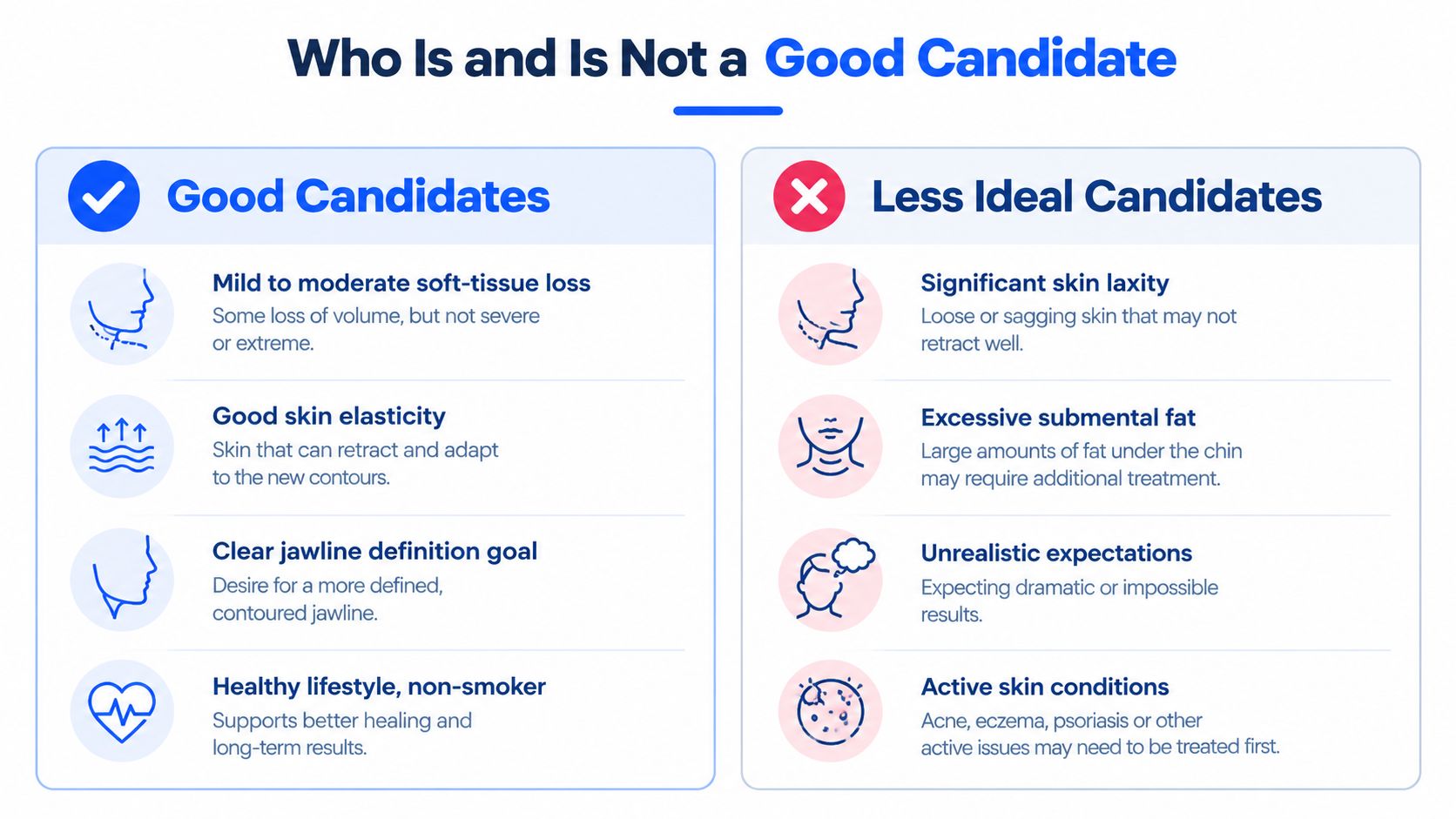
A useful comparison
More favorable starting point
- Mild to moderate soft-tissue loss: A localized hollow or softened border gives filler a defined target.
- Good skin elasticity: Skin that still retracts can display added structure more clearly.
- Specific contour goal: Refining an angle or smoothing a pre-jowl dip is more realistic than requesting a completely new face shape.
- Stable health and expectations: The patient understands that filler improves selected features and requires maintenance.
Less favorable starting point
- Significant laxity: Filler adds volume but doesn't lift hanging tissue.
- Excess submental fullness: Fat may continue to obscure the border after injection.
- Unrealistic expectations: A request for a surgical-looking result from a nonsurgical treatment creates a mismatch.
- Active skin conditions or relevant medical concerns: Treatment may need to wait or require additional medical assessment.
Pregnancy and a history of vascular complications also belong in the medical screening conversation. The key point is that more product isn't automatically more correction. The literature identifies injection site and technique as major drivers of poor outcomes, while the most severe irreversible injuries involve vascular compromise or tissue damage. Overfilling a weak foundation can create a puffy, indistinct border.
A consultation should include an assessment of bone structure, skin quality, tissue weight, and facial movement. Who qualifies for facial fillers is a useful starting point, but an in-person evaluation still determines whether jawline filler fits your anatomy.
A Realistic Timeline of Before and After Changes
The first photograph after treatment is rarely the best photograph. Early swelling can make the border look stronger, wider, or less even than it will appear once the tissue settles.
Four checkpoints
- Day 0 to 3: Swelling, tenderness, and bruising can make the contour look exaggerated. Small differences between sides may reflect the injection response rather than the final result.
- Around day 14: Swelling has usually settled enough for a more meaningful assessment. This is the point at which the injector can judge whether the border and angle are progressing as planned.
- Around month 3: The product has integrated with the surrounding tissue, and the contour typically looks more natural during facial movement. This is a useful time for consistent clinical photography.
- Around month 12: Some products are gradually metabolizing, while others may continue to provide support. A maintenance discussion should follow the patient's visible change, not an automatic calendar reminder.
The product matters. Hyaluronic acid may show gradual softening as volume declines. A biostimulatory plan may develop more progressively and may not be judged fairly immediately after treatment. Technique matters too. Deep structural support can remain visually useful even as superficial fullness changes.
A clinical study of hyaluronic-acid filler for moderate-to-severe jawline definition loss reported a 69.0% responder rate at 6 months in the treatment group versus 38.0% in controls, a mean FACE-Q improvement of 45.9 points, and a mean pre-jowl-sulcus depth change of 4.6 mm versus 2.5 mm in controls. The study reported benefits lasting up to 12 months (registration study of hyaluronic-acid filler for jawline definition).
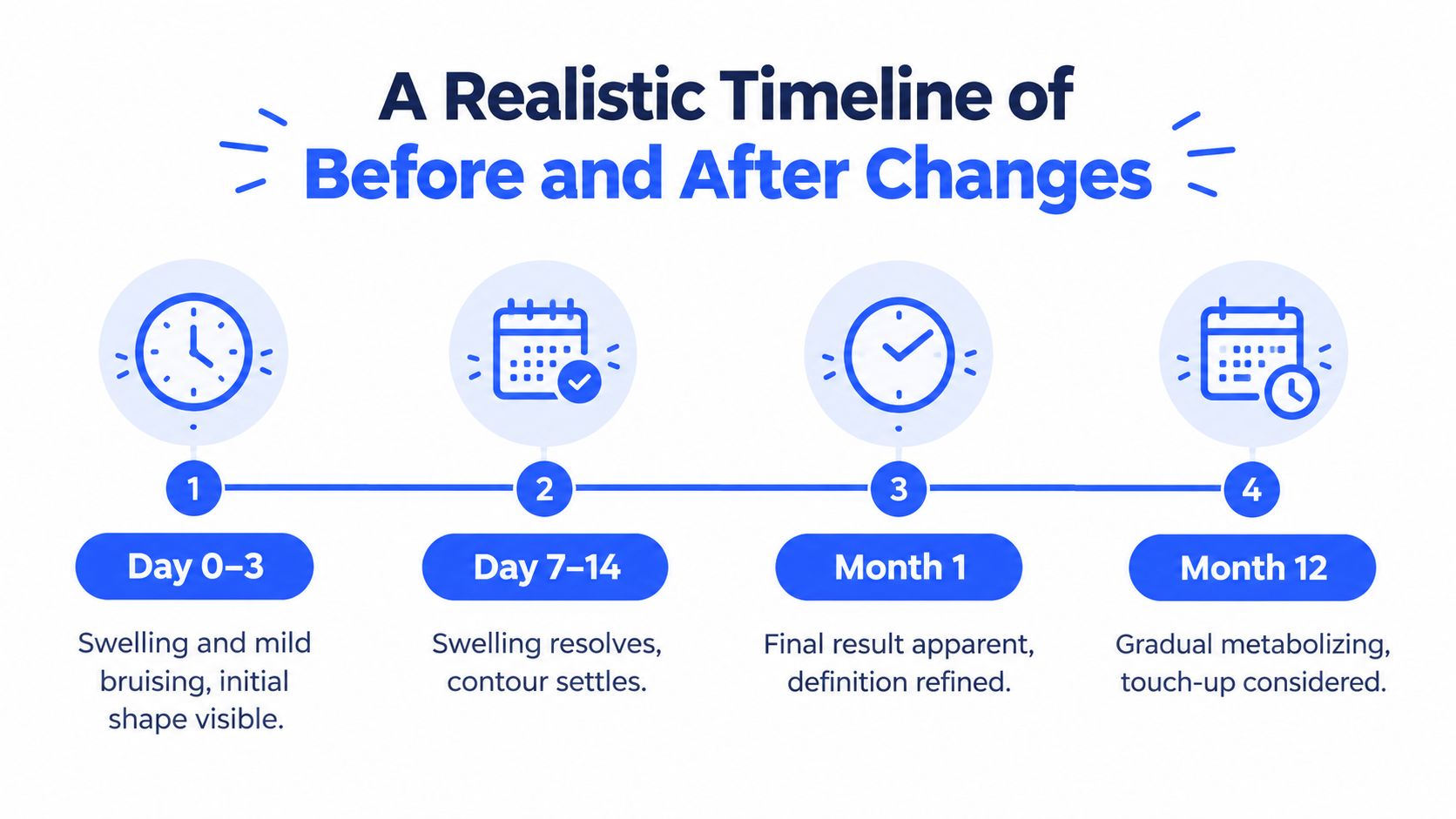
That timeline makes before-and-after comparisons more honest. Compare settled photographs taken in similar lighting and position, rather than judging the immediate post-injection image against a pre-treatment photograph.
Safety, Downtime, and FDA Guidance
Jawline filler is a medical treatment, not a routine facial. Common short-term reactions include swelling, bruising, tenderness, and temporary asymmetry. A qualified injector should explain what is expected, what requires observation, and how to reach the clinic after treatment.
The FDA states that approved dermal fillers are used in adults 22 and older for specific facial areas, including the jawline. The agency also explains that effects are usually temporary because the body breaks down the material, so repeat injections are often needed to maintain the result (FDA guidance on dermal filler use and safety).
Before treatment
- Share your medical history: Disclose allergies, medications, previous filler, prior vascular events, active skin problems, and pregnancy or breastfeeding.
- Review preparation instructions: Your injector may advise changes around alcohol, supplements, or medications that increase bruising risk. Don't stop a prescribed medicine without discussing it with the prescribing clinician.
- Confirm the product: Ask what material is being used, why it suits your anatomy, and how its risks and maintenance differ from other options.
After treatment
- Protect the area from pressure: Follow the clinic's instructions about sleeping position, massage, and facial treatments.
- Limit activities that increase heat or circulation: Your provider will tell you when to resume exercise, sauna use, and other strenuous activities.
- Contact the clinic urgently for warning signs: Blanching, escalating or severe pain, unusual skin color, or visual changes need immediate medical attention because they can signal vascular compromise.
The safest plan includes a trained medical professional who understands facial vascular anatomy, uses authentic product, documents the treatment, and has a clear emergency protocol.
Case Notes From Real Jawline Filler Treatments
A responsible clinical article shouldn't invent patient records. No verified treatment charts, consented photographs, product logs, syringe totals, downtime reports, or six-month follow-ups were supplied for named cases here, so presenting four “real” case studies with exact volumes or outcomes would create false evidence.
The table below shows the information that should appear in a genuine case note. It also demonstrates why a before-and-after image alone is inadequate. A photograph can't reliably identify injection depth, product, volume, medical history, or whether a later change came from filler, swelling, weight fluctuation, or another treatment.
Jawline filler case notes technique product volume and outcome
| Case profile | Technique and product | Volume | Downtime | 6-week result | 6-month result |
|---|---|---|---|---|---|
| Young adult seeking sharper gonial angle definition | Must be documented from the treatment record, including deep angle placement and product type | Must be documented | Must be reported by the patient | Must be assessed with standardized photographs | Must be assessed at follow-up |
| Mid-30s patient with early pre-jowl change | Must identify whether treatment used deep support, subcutaneous layering, or both | Must be documented | Must be reported by the patient | Must distinguish reduced hollow from residual laxity | Must document persistence and any refinement |
| Patient in the 50s seeking support without surgery | Must record skin laxity, tissue weight, chin projection, and selected material | Must be documented | Must be reported by the patient | Must assess whether added volume improved or merely filled the border | Must document whether the result remained proportionate |
| Patient with previous filler seeking maintenance | Must document prior product, treatment dates, examination findings, and new plan | Must be documented | Must be reported by the patient | Must assess residual product and asymmetry before adding more | Must document whether staged maintenance was appropriate |
A real case note earns its credibility from the record, not from a dramatic caption beneath a photograph.
Patients reviewing a gallery should ask whether images were taken with similar lighting, head position, facial expression, and time elapsed after treatment. They should also ask whether the provider can explain what changed anatomically. Without that context, even an attractive image says little about how the same approach would perform on another face.
Questions to Ask Before Booking
Bring a written checklist to the consultation. The answers should explain the treatment logic, not just reassure you that the procedure is popular.
Clinician experience
- How often do you treat the jawline?
- Can you show settled, consented examples with comparable anatomy?
- How do you prepare for and manage a vascular complication?
Anatomical assessment
- What is causing my lack of definition, bone structure, soft-tissue volume, laxity, fat, or a combination?
- Will you assess my chin projection, skin quality, pre-jowl sulcus, and weight stability?
- Would filler improve the issue, or would another treatment be more appropriate?
Product and treatment plan
- Which material are you recommending, and why?
- What amount do you expect to use, and could a staged plan be safer than one session?
- What change should I expect at the angle, border, chin-to-jaw transition, and pre-jowl area?
Safety and maintenance
- Is an appropriate reversal or emergency protocol available if needed?
- Who do I contact after hours?
- How long might the result remain visible for my chosen material?
- What follow-up schedule and ongoing treatment costs should I realistically plan for?
A careful consultation follows this same sequence, anatomy first, product second, safety third, and maintenance last. The practice should also explain whether its dermal filler service includes chin and jawline contouring, how it documents results, and what alternatives may fit if filler can't address the primary concern.
ProMD Health offers dermal filler consultations for facial contouring, including treatment planning around chin and jawline definition. Visit ProMD Health to review the service information and request a consultation focused on your anatomy, candidacy, and realistic before-and-after goals.