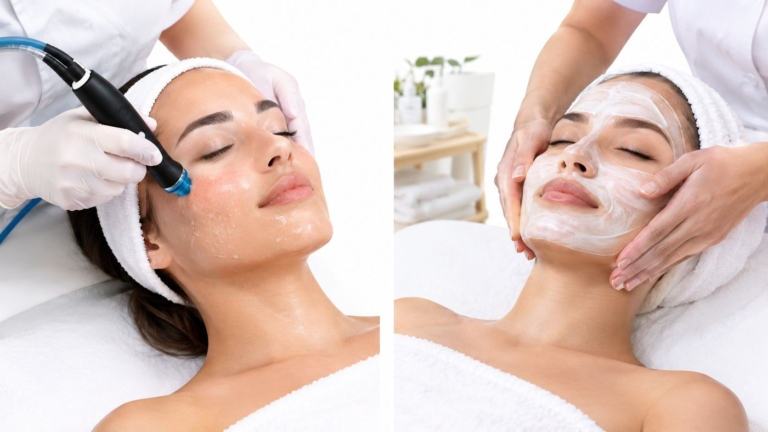
You're standing in front of the bathroom mirror, turning your face toward the window and comparing it with a stream of polished microdermabrasion facial before and after photos. One image shows an instant glow. Another promises softer lines and dramatically clearer scars. The natural question is simple: which changes could you realistically see on your own skin?
Microdermabrasion can make skin feel smoother and look fresher, especially when dullness, roughness, or mild uneven pigmentation comes from surface buildup. It isn't equivalent to deep resurfacing, and the most dramatic photograph in a gallery shouldn't become your personal forecast. The treatment method, camera angle, lighting, makeup, skin condition, treatment settings, and time between images can all change how a result appears.
A useful place to begin is ProMD Health's facial skin care services, then use a consultation to ask what the treatment is designed to improve, how your skin may look immediately afterward, and whether a different approach makes more sense for scars or pronounced wrinkles.
Table of Contents
- Setting Realistic Expectations for Your First Treatment
- How Microdermabrasion Actually Changes the Skin
- Skin Concerns That Respond to Microdermabrasion
- Reading the Before and After Timeline
- Acne Scars and What the Evidence Actually Shows
- Safety, Skin Tone, and When to Be Cautious
- Aftercare That Protects Your Before and After Results
- Who Gets the Best Before and After Results
Setting Realistic Expectations for Your First Treatment
A convincing microdermabrasion facial before and after comparison begins with photographs taken under the same conditions. Match the lighting, camera distance, facial expression, makeup status, and skin preparation as closely as possible. Bright clinical lighting after exfoliation may highlight a smoother surface, while a casual phone photo at home may show redness or texture that a polished image does not.
The most reliable expectation is improvement in surface-level concerns. A clinical study published in 2001 followed 14 patients through a 12 to 14 week treatment period. It found statistically significant improvement in roughness, mottled pigmentation, and overall appearance. Facial wrinkles did not improve significantly, and acne-scar results were inconsistent. Because the researchers combined patient assessments with tissue examination, the study offers useful clinical context, though its small sample cannot predict every patient's result. The published clinical study supports measured improvement rather than a transformation claim.
Your own goal should be specific before you assess a photograph. A consultation, such as one for facial skin care services, can help clarify what the treatment is suited to and what may require another approach.
Ask better questions before you book
Ask whether your roughness is superficial or linked to deeper scarring. For uneven color, ask whether exfoliation is appropriate for your skin and how pigment changes will be managed. Ask what you might see immediately, once the skin settles, and after a treatment series. If your goal involves pronounced wrinkles or atrophic acne scars, ask whether a peel, microneedling, laser treatment, or medical-grade skincare would address the deeper issue more directly.
A before-and-after image records one person's result under specific conditions. It is evidence to discuss, not a promised percentage improvement.
Early changes may be easier to see in reflected light than in pigmentation or texture. If the skin looks brighter but the scar remains, that difference reflects the treatment's depth, not a failed photograph. For a first appointment, gradual refinement is a more realistic forecast than dramatic correction.
How Microdermabrasion Actually Changes the Skin
Think of microdermabrasion like sanding the surface of a piece of wood. It can remove a rough outer layer and make the surface feel more even, but it won't reshape a deep groove in the wood. On skin, the treatment mechanically removes part of the stratum corneum, the outermost layer, rather than intentionally removing the viable epidermis or dermis. A clinical review of the procedure's mechanism describes abrasive particles such as alumina or sodium chloride moving across the skin while vacuum suction removes loosened tissue.
The device may use crystals or a diamond tip. Both methods create controlled surface abrasion, and suction helps clear away debris while pulling the treatment head across the skin. That physical action explains why the face may look brighter and feel smoother, but it also explains why the result is limited when the problem lies deeper.
What the camera can and cannot show
A smoother outer surface reflects light more evenly. That can make dullness, flaky roughness, and mild uneven tone appear less noticeable in a photograph. The effect can look immediate because the camera records the freshly polished surface, not because deep collagen remodeling has suddenly erased a scar or wrinkle.
The outer barrier also matters after treatment. A human skin-barrier study found that microdermabrasion substantially reduced barrier function immediately after the procedure because the stratum corneum had been removed, while the viable epidermis remained largely intact. The researchers observed increased permeability and reduced electrical resistance, which helps explain temporary sensitivity and the need for careful aftercare. The barrier-function findings support separating a visible glow from complete recovery.
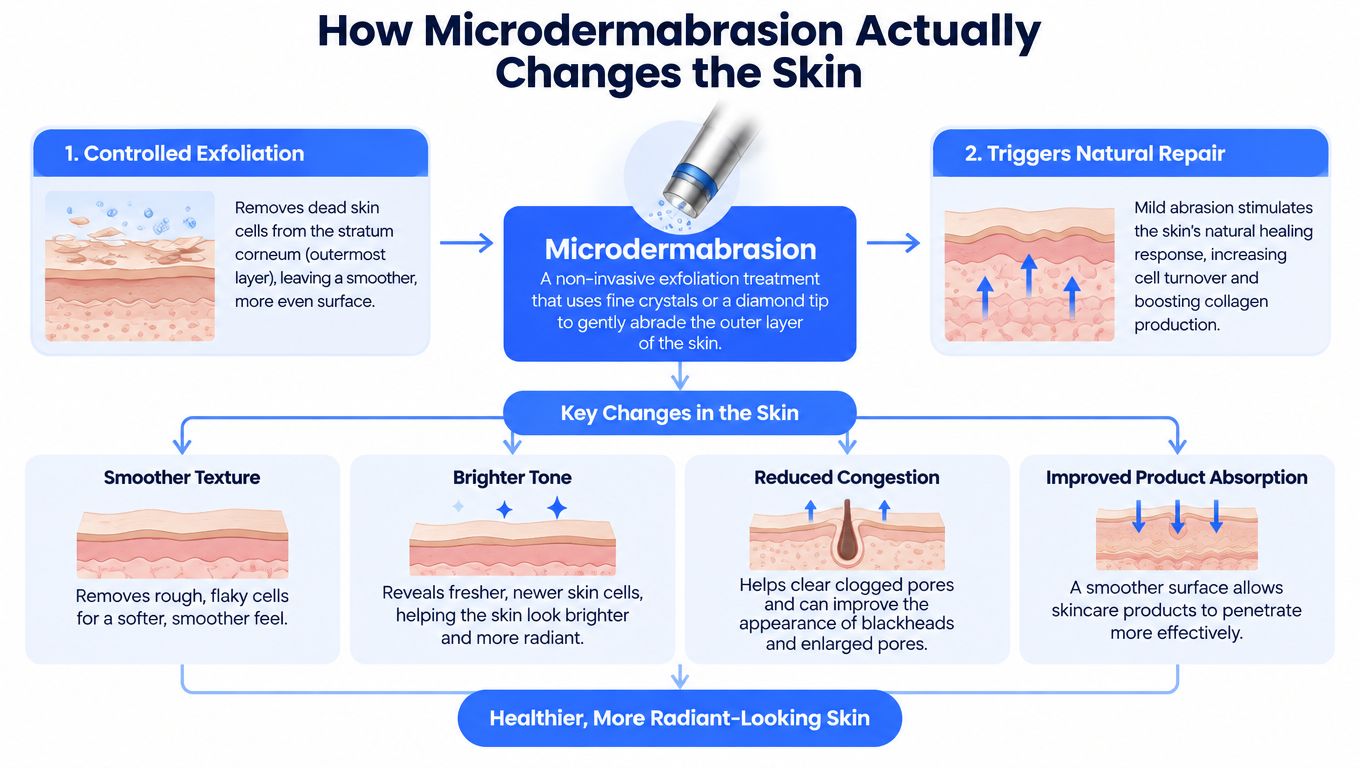
The simplest mental model is surface refinement, not deep reconstruction. That distinction prepares you to interpret the following examples without expecting every concern to respond in the same way.
Skin Concerns That Respond to Microdermabrasion
Maya's skincare routine is consistent, yet her cheeks still feel rough and her complexion looks dull in photographs. After a professional treatment series, a realistic before-and-after comparison might show smoother texture, more even light reflection, and a fresher-looking surface. Her facial contour would remain the same, and pronounced wrinkles would not be erased.
Jordan has mild mottled pigmentation linked to cumulative sun exposure. Microdermabrasion may make the tone appear more uniform when discoloration is concentrated near the outer skin layer. The earlier clinical study reported statistically significant improvement in mottled pigmentation and overall appearance. As noted earlier, those findings support modest visible improvement, not complete pigment removal.
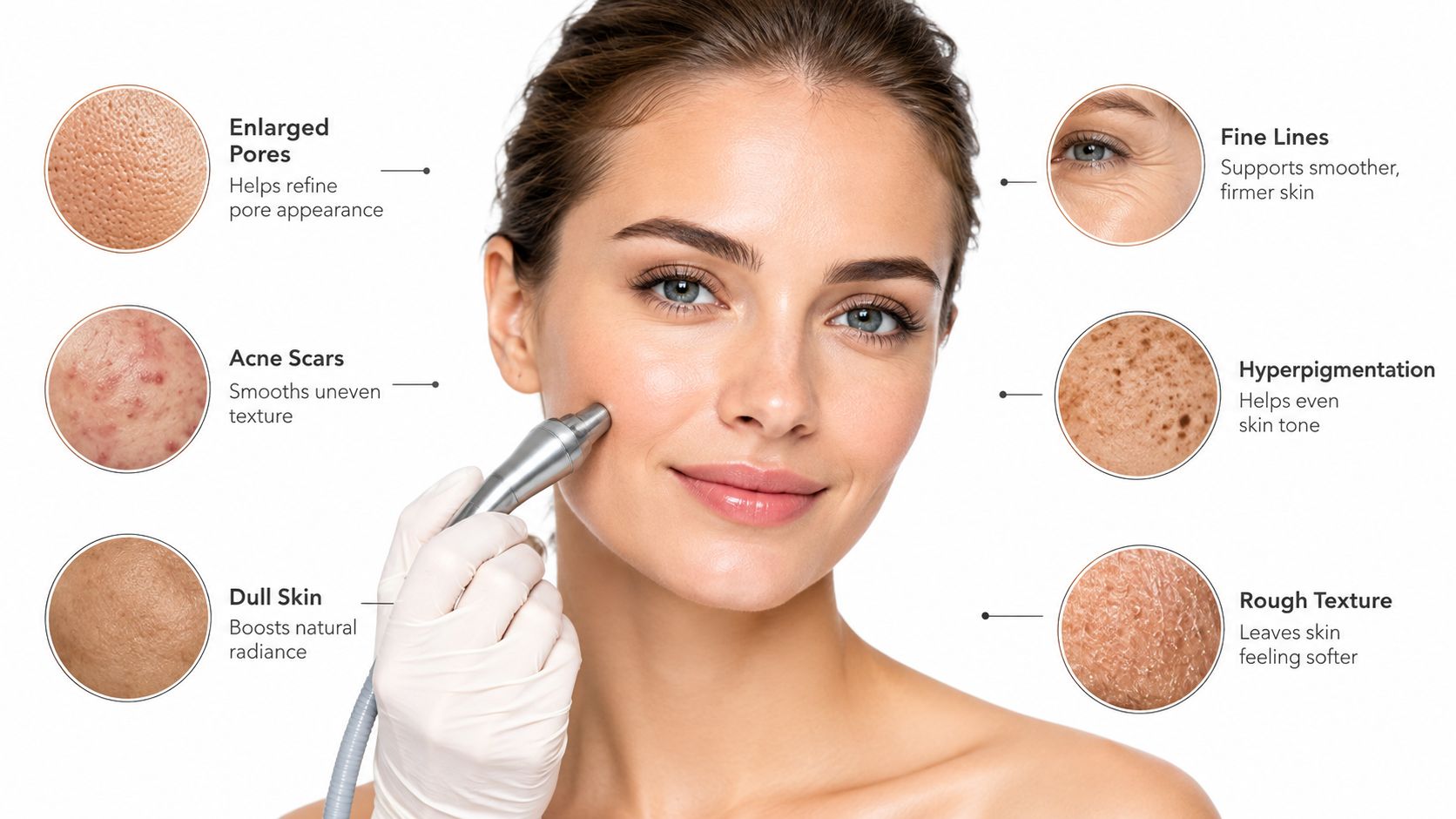
Match the concern to the likely photograph
- Dullness: The after photograph may show a brighter surface after compacted dead cells are removed. This early change is a polish, not a permanent correction.
- Rough texture: Superficial roughness may improve, leaving cheeks smoother and makeup more even. Deeper depressions remain because abrasion does not fill or rebuild lost tissue.
- Mild mottled pigmentation: Repeated treatments may produce a more even-looking tone. Pigment can persist, and inflammation and sun exposure affect how the skin responds.
- Mild post-acne discoloration: A red or brown mark may gradually look less noticeable as the surface becomes more uniform. A flat discoloration mark differs from an atrophic scar, so the expected result differs too.
- Clogged-pore appearance: Exfoliation may make surface congestion look less prominent. It is not a complete treatment for active inflammatory acne or a replacement for medical acne management.
Fine lines can appear softer after hydration and exfoliation, which makes them easy to group with rough texture in a before-and-after image. Their underlying causes are different. The foundational study did not find a statistically significant improvement in facial rhytides, so softer-looking lines should be interpreted cautiously rather than presented as wrinkle removal.
A photograph can also exaggerate small changes through lighting, angle, hydration, and skin redness. Compare images taken under similar conditions, then assess how the skin feels and behaves over time.
For general self-care context about aging concerns, you can find shower steamers for wrinkles. That information does not replace a clinical assessment of whether surface exfoliation suits your skin.
Reading the Before and After Timeline
A photograph captures one moment, while skin changes across several. Immediately after treatment, redness, warmth, tightness, tenderness, swelling, petechiae, or bruising can affect the image. Later, the skin may look calmer even though the initial glow has softened.
A prospective study followed eight volunteers with Fitzpatrick skin types II through V, assessing facial skin before treatment, 10 minutes after one diamond-tip session, and again at 48 hours. Imaging showed a thinner, less undulating stratum corneum after treatment, and subsurface imaging showed greater prominence of fibrillar collagen in the superficial dermis. VISIA analysis indicated improved facial rhytids in all participants, but measured texture and porphyrin count worsened after the single session. The study details show why an early image can look better in one respect and worse in another.
| Time Point | Visible Change | Measured Change | What the Photo Shows |
|---|---|---|---|
| Before treatment | Dullness, roughness, uneven tone, or congestion may be visible | Baseline skin condition | The starting point, which should be photographed consistently |
| 10 minutes | Fresh exfoliation, possible flush, and brighter light reflection | Thinner, less undulating stratum corneum; improved facial rhytids in the study | An immediate surface response, not a final result |
| 48 hours | The skin may appear calmer, though sensitivity can remain | Instrument readings may not move uniformly | Recovery and early settling |
| After a treatment series | Texture and tone may look progressively more refined | Improvement depends on the concern and individual response | The most useful comparison for gradual goals |
The camera also exaggerates differences when lighting changes. Compare images taken under similar conditions, and don't judge a whole treatment plan from the first post-treatment selfie.
Acne Scars and What the Evidence Actually Shows
Acne-scar photographs demand extra caution because “acne scars” can mean discoloration, shallow surface irregularity, or atrophic depressions. Microdermabrasion may polish superficial texture, but a depressed scar represents a structural change beneath the surface.
A systematic review identified only one study specifically assessing microdermabrasion for moderate-to-severe post-acne atrophic scars. In that study, 11 patients received eight sessions. 27.3% showed no improvement, 45.4% had mild improvement, 18.2% had moderate improvement, and 9.1% achieved good improvement. No participant, 0%, achieved a very good improvement rating. These figures come from the review of acne-scar treatments, not from a universal prediction for every patient. The systematic review makes the practical message clear: improvement was possible, but dramatic scar elimination was uncommon.
What comparison evidence adds
A separate randomized comparison began with 80 patients, although only 56 completed all six sessions. Among the 24 microdermabrasion completers, 16.7% showed good improvement, 67% fair improvement, 12.5% poor improvement, and 4.2% no change. Investigators reported no statistically significant difference between microdermabrasion and glycolic-acid peeling.
That result doesn't mean the treatments are identical for every person. It means the study didn't establish a statistically significant advantage between them in that comparison. For a patient with mild roughness and shallow textural irregularity, a conservative series may be reasonable. For pronounced atrophic scars, the foundational clinical study noted that deeper ablation was generally required when meaningful scar correction was the primary goal.
Scar-reading rule: A softer shadow or smoother surface in a photograph may represent modest refinement. It doesn't prove that the underlying depression has been removed.
If your main concern is depressed scarring, discuss whether SkinPen microneedling for skin revitalization or another deeper approach better matches the anatomy of the scar.
Safety, Skin Tone, and When to Be Cautious
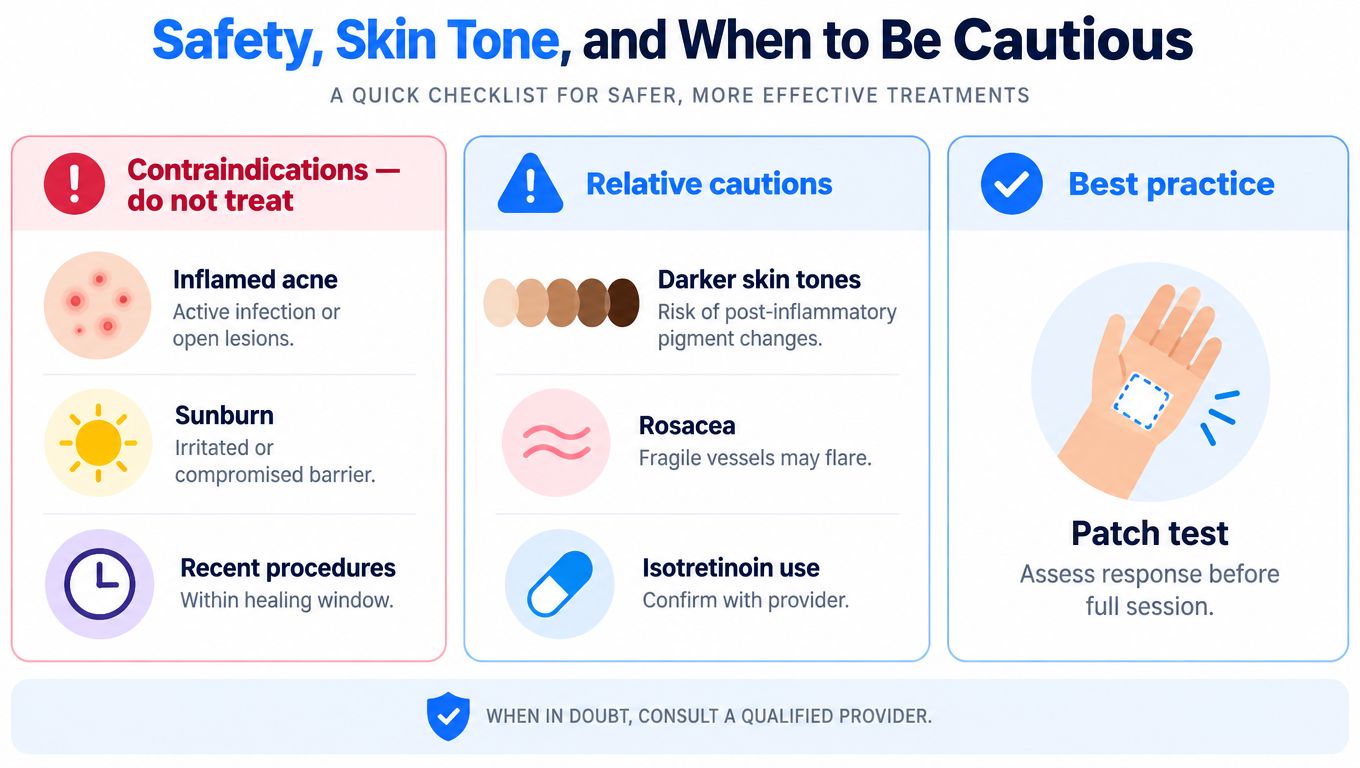
“Safe for all skin types” is too broad to guide an individual decision. NIH clinical guidance describes microdermabrasion as generally safe across Fitzpatrick skin types, but it lists active infection as a contraindication and advises caution with a history of keloids. Rosacea and telangiectasias are relative contraindications because fragile, reactive vessels may flare. The NIH clinical guidance also supports evaluating the person and the current condition of the skin, not just the treatment name.
Darker skin tones aren't automatically unsuitable for microdermabrasion. The concern is that Fitzpatrick types IV and VI may face greater risk of post-procedure hyperpigmentation, hypopigmentation, or hypertrophic scarring, particularly when inflammation, pressure, sun exposure, or aftercare aren't well controlled. A provider should discuss conservative settings, recent sun exposure, active inflammation, and how your skin has responded to past procedures.
Use a candidacy checklist
- Pause for active problems: Infection, open lesions, or a compromised barrier should be addressed before abrasion.
- Discuss vascular sensitivity: Rosacea and telangiectasias may require a different plan or postponement.
- Explain your pigment history: Tell the provider if you've developed dark marks or light patches after irritation.
- Review scar history: A tendency toward keloids or hypertrophic scarring deserves specific discussion.
- Ask about settings: Suction pressure and abrasion intensity should be selected for your skin, not copied from another person's session.
Redness, tenderness, swelling, petechiae, and bruising can occur after treatment. Severe discomfort, worsening swelling, blistering, signs of infection, or pigment changes that concern you should prompt a call to the treating clinician.
Aftercare That Protects Your Before and After Results
The first part of aftercare is barrier protection. Because microdermabrasion removes part of the stratum corneum, treated skin can temporarily allow products and environmental irritants to penetrate more readily. The human skin-barrier research described earlier found reduced barrier function, increased permeability, and reduced electrical resistance immediately after treatment, so a glowing photograph shouldn't be mistaken for fully recovered skin.
Keep the routine deliberately simple
For the early post-treatment period:
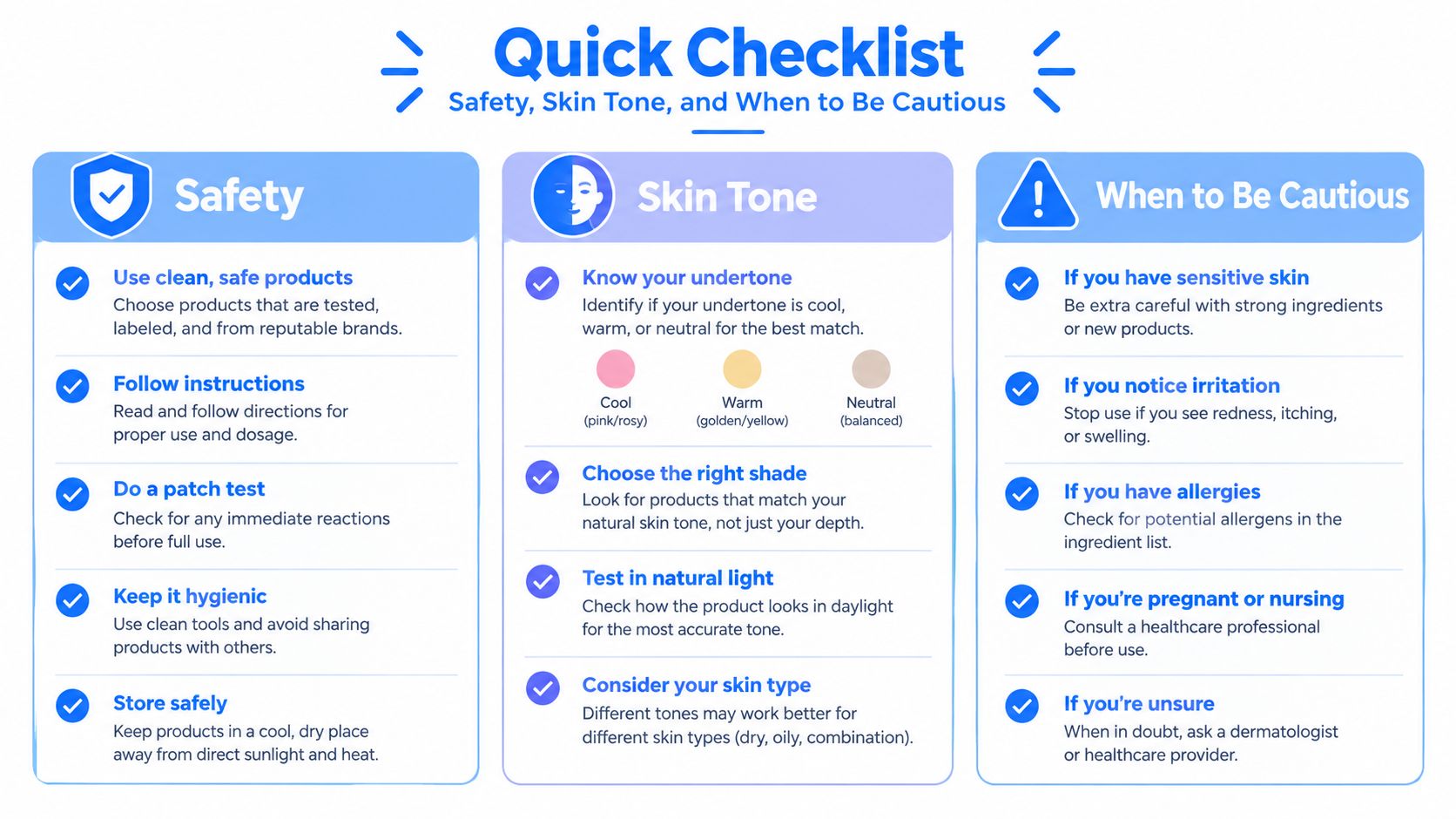
- Cleanse gently: Use a mild cleanser and lukewarm water. Don't scrub or use abrasive tools.
- Moisturize: Choose a bland, provider-approved moisturizer to reduce tightness and support comfort.
- Protect from light: Use broad-spectrum sunscreen and limit direct sun exposure, because removal of the outer barrier temporarily increases sensitivity to photodamage.
- Pause strong products: Hold retinoids, exfoliating acids, scrubs, harsh toners, and irritating acne actives until your provider says your skin is ready.
- Reduce heat and friction: Avoid activities that intensify redness, including hot environments and aggressive facial manipulation, while the skin is reactive.
Treatment planning also needs honesty about the number of visits. One clinical report cited a mean of nine treatments at a pressure setting of minus 76 mm Hg for good-to-excellent acne-scar improvement, illustrating that meaningful scar change may require a series rather than one appointment. The evidence review containing that report shouldn't be used to prescribe a schedule for everyone, but it does challenge the idea that one session can correct established scarring.
Contact your provider if pain becomes intense, swelling worsens, redness spreads, skin breaks down, or irritation lasts longer than expected. For broader resurfacing planning, you can also review ProMD Health's chemical peel information and ask whether a peel or another modality better fits your concern.
Who Gets the Best Before and After Results
The most satisfied patients usually want surface refinement. Their main concerns are dullness, rough-feeling skin, mild uneven tone, or a congested appearance rather than deep scars or pronounced wrinkles. They're also willing to judge progress over a series of appropriately spaced treatments and to protect the skin afterward.
Patients are more likely to feel underwhelmed when their goal is structural correction. Deep atrophic scars, pronounced facial rhytides, and persistent pigment may need a treatment that reaches farther into the skin or addresses a different biological process. Repeating a superficial treatment without reassessing the goal can create cost, time, and irritation without delivering the change the patient wants.
Match the tool to the problem
- Microdermabrasion: Surface exfoliation for roughness, dullness, and some uneven pigmentation.
- Microneedling: A collagen-focused option to discuss when textural irregularity is more structural.
- Chemical peels: A resurfacing category that may be considered for selected tone and texture concerns.
- Laser treatments: A category that may address certain pigment, vascular, texture, or resurfacing goals with individualized settings.
This isn't a contest between treatments. The appropriate choice depends on skin tone, inflammation, scar type, recent sun exposure, barrier condition, and the result you want photographed. ProMD Health offers microdermabrasion, facials, chemical peels, microneedling, laser treatments, and medical-grade skincare across its approved markets, with availability and treatment options confirmed by the individual office.
A consultation at an approved location such as Annapolis, Bethesda, Tysons Corner, or Washington, DC can help determine whether microdermabrasion fits your candidacy. Bring unfiltered photographs, your current skincare list, your history of pigment changes or scarring, and a clear description of the result you hope to see.
Visit ProMD Health to explore facial rejuvenation options, including microdermabrasion, and request a consultation for a personalized skin assessment. A provider can help you set realistic before-and-after goals, choose an appropriate treatment plan, and understand the aftercare needed to protect your results.