How to lose weight medically: 3 Key Paths
Why Medical Weight Loss Offers a Path Forward
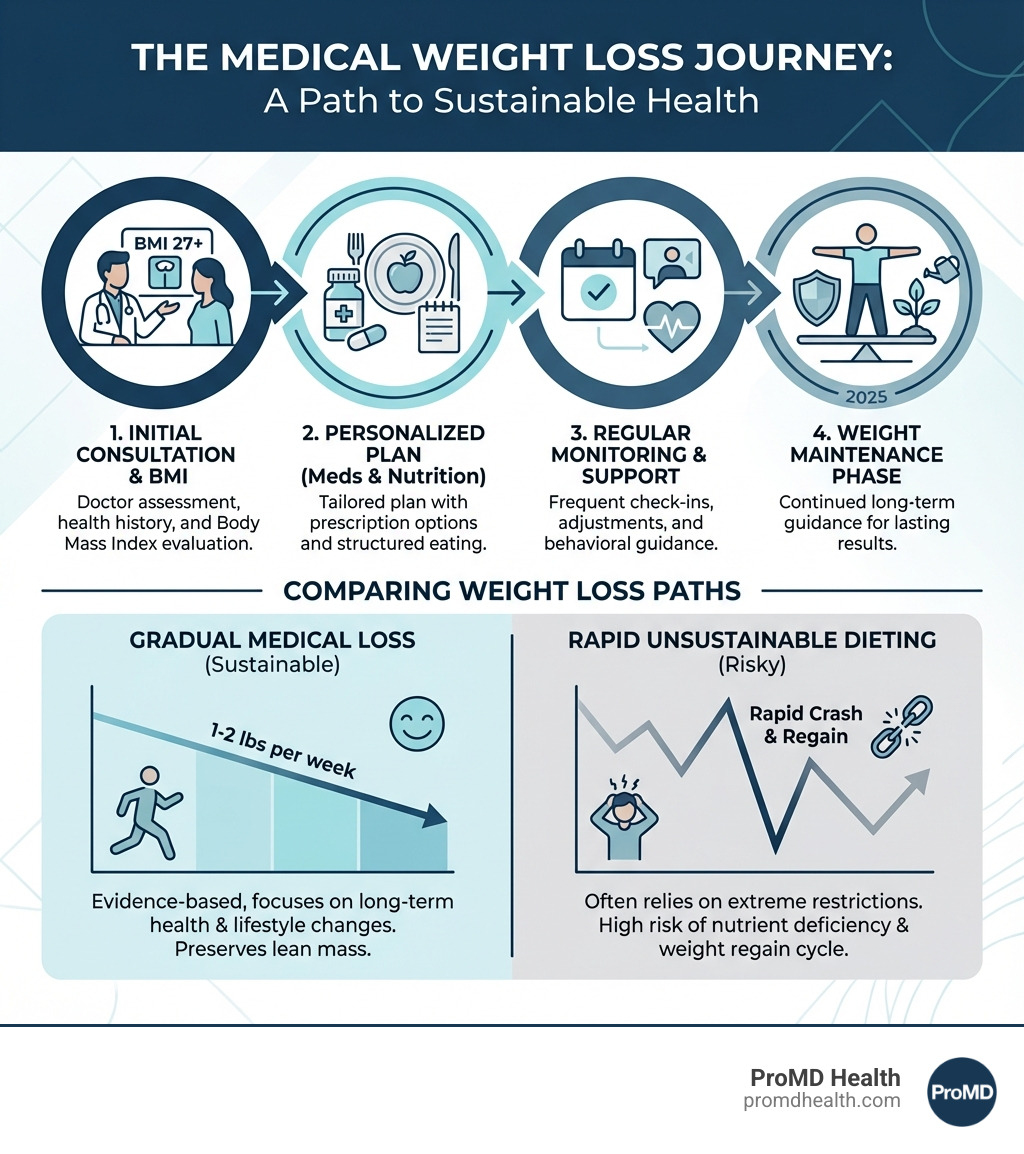
How to lose weight medically involves working with healthcare professionals who combine prescription medications, structured nutrition plans, behavioral counseling, and ongoing medical supervision to help you achieve sustainable weight loss. Unlike fad diets or over-the-counter supplements, medical weight loss programs are evidence-based and custom to your individual health needs.
Medical weight loss options include:
- Prescription medications (GLP-1s, appetite suppressants, fat absorption blockers)
- Physician-supervised meal replacement programs (nutrient-dense shakes, bars, and structured plans)
- Calorie-controlled eating plans with registered dietitian support
- Behavioral counseling for stress, sleep, and habit formation
- Non-surgical procedures (such as intragastric balloons for eligible candidates)
- Bariatric surgery for individuals with BMI over 35 or BMI over 30 with serious health conditions
We understand how difficult weight loss can be. Even with the best of efforts, managing your weight can involve frustrating ups and downs, and can even feel hopeless at times. Nearly 3 in 4 U.S. adults have overweight or obesity, and many people struggle despite trying numerous diet and exercise programs. That’s where medical weight loss makes a difference.
Medical weight loss programs go beyond generic advice. They provide personalized treatment plans designed by board-certified physicians and registered dietitians who consider your medical history, current medications, lifestyle challenges, and specific health goals. This team-based approach addresses the complex factors that contribute to weight gain—including genetics, hormones, medications, and metabolic conditions—rather than simply telling you to “eat less and move more.”
The results speak for themselves. Patients on prescription weight-loss medications typically lose 10 percent of their body weight within 6 months. Even modest weight loss of 5-10% can significantly improve blood pressure, cholesterol, and blood sugar levels, reducing your risk for chronic diseases like heart disease and type 2 diabetes.
As Scott Melamed, President and CEO of ProMD Health with a Master’s degree in Biotechnology from Johns Hopkins University and extensive research background in metabolic health, I’ve seen how to lose weight medically transforms lives when approached with scientific rigor and compassionate care. Our mission is to provide you with the medical expertise, advanced treatments, and ongoing support you need to achieve lasting results.
Is Medically Supervised Weight Loss Right for You?
Starting on a weight loss journey is a significant step, and for many, a medically supervised program offers the best chance for success. But how do you know if it’s the right path for you? We consider several factors to determine candidacy, ensuring that our approach is safe, effective, and custom to your unique health profile.
The Body Mass Index (BMI) is a crucial tool healthcare professionals use to assess your risk for weight-related diseases. While not a perfect method, it provides a useful starting point. You can calculate your BMI using our BMI calculator. Generally, if your BMI is 30 or above, you are considered to have obesity. If your BMI is 27 or greater and you have serious medical problems linked to obesity, such as high blood pressure, type 2 diabetes, or heart disease, you may also be a candidate for medical weight loss.
Many individuals come to us after trying various weight loss methods on their own without lasting success. This is often because weight gain is complex, influenced by genetics, hormones, medications, and lifestyle factors that go beyond simple diet and exercise. If you’ve been struggling to lose weight and keep it off, a medically supervised program can provide the tools and support you need.
Our goal is to help you not just lose weight, but to improve your overall health and quality of life. Losing even a modest 5% of your body weight can lead to significant health benefits, such as lowering blood pressure, blood sugar, and cholesterol levels. If you’re ready to explore a science-backed approach to your health, we’re here to help you get Getting Started with Weight Management.
Understanding Your Eligibility
To determine your eligibility for our medically supervised weight loss programs, we conduct a thorough assessment. For instance, for a Calorie Controlled Plan, you generally qualify with a BMI of 32 or above. However, eligibility for other plans, including prescription medications, is determined by a doctor after a comprehensive review of your individual needs and medical history.
This assessment includes:
- Medical history review: We look at your past and present health conditions, identifying any obesity-related issues.
- Current medications: We evaluate how your current prescriptions might interact with weight loss treatments or contribute to weight fluctuations.
- Doctor’s assessment: Our board-certified physicians will work with you to understand your health status and determine the most appropriate course of action.
- Setting realistic goals: We help you set achievable weight loss goals, typically aiming for an initial loss of 5% to 10% of your starting weight within the first six months. This gradual, steady pace (about 1 to 2 pounds a week) is more likely to lead to sustainable results.

The Core Components of a Successful Medical Weight Loss Plan
A successful medical weight loss plan is a multifaceted journey, not a quick fix. It integrates several key components, all working together under professional guidance to create sustainable change. At ProMD Health, we believe in a holistic, personalized approach to help you achieve your goals and truly Look Your Best with a Medical Weight Loss Program.
Our team, including physicians and registered dietitians, plays a pivotal role in designing and overseeing your personalized plan. We provide the expertise, accountability, and continuous support necessary for long-term success.
Nutrition: The Foundation of Your Plan
Nutrition is the cornerstone of any effective weight loss strategy. Our medical weight loss programs emphasize structured, healthy eating designed to create a calorie deficit while ensuring you receive essential nutrients.
We offer various nutritional approaches:
- Calorie-controlled plans: These plans involve carefully managing your daily caloric intake based on your individual metabolic needs and weight loss goals. We help you choose a variety of healthy food and drinks to create balanced meals.
- Meal replacement plans: In a medically supervised context, meal replacement plans use nutrient-dense shakes, soups, or bars to replace some or all of your daily meals. These plans offer a structured way to control calories and portions while ensuring adequate nutrition. They can be particularly effective for rapid initial weight loss and for helping you learn hunger and fullness cues without the complexity of traditional meal preparation.
- Food and liquid meal replacement plans: Some programs combine both food and liquid meal replacements, offering flexibility while maintaining strict calorie control.
The difference between a calorie-controlled plan and a meal replacement plan often lies in the structure and initial intensity. Calorie-controlled plans focus on teaching you how to make healthy food choices from whole foods within a set calorie budget. Meal replacement plans offer a more simplified, pre-portioned approach, which can be easier to adhere to and often leads to faster initial weight loss, helping to build momentum and reinforce positive habits.

Exercise and Activity
Physical activity is a vital complement to nutritional changes. It not only burns calories but also improves cardiovascular health, builds muscle mass, and boosts mood. Our plans encourage increasing physical activity gradually and sustainably.
We recommend aiming for at least 150 minutes per week of moderate-intensity aerobic physical activity, such as brisk walking or cycling. This can be broken down into shorter, manageable sessions throughout the week. The key is to find activities you enjoy and can consistently incorporate into your life. Whether it’s structured exercise or integrating more movement into your daily routine, every step counts. Our Promd Fit program can help you find enjoyable ways to stay active.
Behavioral Counseling and Support
Weight loss isn’t just about diet and exercise; it’s also about understanding and changing behaviors. Our programs integrate robust behavioral counseling and support to address the psychological aspects of eating and activity.
This includes:
- Group support sessions: These sessions provide a safe space to share experiences, learn from others, and build a supportive community. They often focus on nutrition education, strategies for overcoming challenges, and maintaining motivation.
- One-on-one counseling: Our experts work with you individually to identify triggers, develop coping mechanisms for stress eating, improve sleep hygiene, and set realistic goals.
- Stress management: Learning healthy ways to manage stress is crucial, as stress can often lead to unhealthy eating patterns.
- Sleep hygiene: Adequate sleep plays a significant role in appetite regulation and metabolism.
- Developing healthy habits: We help you build lifelong habits for successful weight management, focusing on consistency and self-awareness.
This comprehensive approach ensures that you’re not just losing weight, but also developing the mental and emotional resilience to maintain your progress. This is one of the key Benefits of Weight Management.
Exploring Your Options: How to Lose Weight Medically
When exploring how to lose weight medically, you’ll find a range of evidence-based options beyond traditional diet and exercise. These medical interventions are designed to provide additional support for individuals who need it, either due to significant weight-related health issues or when lifestyle changes alone haven’t been sufficient. Our goal at ProMD Health is to help you Shed Pounds with Medical Weight Loss through the most appropriate and effective means for your unique situation.
How to Lose Weight Medically with Prescription Medications
Prescription weight loss medications are a powerful tool in a medically supervised program. They are typically considered for individuals with a BMI over 30, or a BMI over 27 with serious weight-related medical problems. These medications work in various ways:
- Appetite suppression: Many medications work by affecting brain chemistry to reduce hunger signals, making you feel less hungry.
- Increased fullness (satiety): Other drugs help you feel fuller faster and for longer periods after eating, leading to reduced calorie intake.
- Fat absorption blocking: Some medications, like orlistat, work in the digestive tract to block a percentage of the fat you eat from being absorbed by your body (around 30% for orlistat).
Potential Benefits and Expected Weight Loss:
When combined with lifestyle changes, prescription weight-loss drugs can lead to significant results. Patients typically lose 10 percent of their body weight within 6 months. Studies show that taking these drugs for a year can mean a loss of total body weight of 3% to 12% more than that lost with lifestyle changes alone. Losing even 5% to 10% of your total body weight can lead to important health benefits, such as improved blood pressure, blood sugar, and cholesterol levels.
Potential Side Effects and Long-Term Implications:
Like all medications, weight loss drugs can have side effects. Common mild side effects include nausea, constipation, and diarrhea, which often improve over time. More serious side effects are rare but are carefully monitored by our medical team.
The long-term implications involve continued use under medical supervision. If a drug helps you lose weight and you don’t experience severe side effects, your provider might suggest long-term use. However, if you haven’t lost at least 5% of your body weight after 3-6 months at the full dose, your provider will likely reassess your treatment plan. Weight regain can occur if medications are stopped without sustained lifestyle changes. We prioritize educating you on Prescription medications to treat overweight and obesity and the The Future of Weight Loss: Unlocking the Power of GLP-1 Medications & Metabolic Health.
How to Lose Weight Medically with Structured Nutrition
Structured nutrition plans, particularly physician-supervised meal replacements and calorie-controlled whole food plans, are a highly effective way to lose weight medically.
- Physician-supervised meal replacements: These programs involve replacing some or all of your regular meals with specially formulated shakes, bars, or soups. They are designed to be nutritionally complete while being precisely calorie-controlled. This approach simplifies food choices, reduces decision fatigue, and helps you learn about portion sizes and hunger cues. Patients on these programs typically lose 10 to 15 percent of their body weight. Our SlimLife Boost program is an example of a structured nutritional approach.
- Calorie-controlled whole food plans: These plans focus on eating regular, healthy meals prepared from whole, unprocessed foods, but with a strict calorie target. Our registered dietitians work with you to create personalized meal plans that fit your preferences and lifestyle, ensuring you burn more calories than you consume.
Here’s a quick comparison:
| Feature | Calorie-Controlled Whole Food Plan | Meal Replacement Plan |
|---|---|---|
| Primary Goal | Education on healthy eating, sustainable habits | Rapid, controlled weight loss, portion control |
| Food Source | Whole, unprocessed foods | Pre-portioned shakes, bars, soups |
| Structure | Guided food choices within calorie limits | Replaces meals with specific products |
| Learning | Portion control, food preparation, mindful eating | Hunger/fullness cues, calorie awareness |
| Initial Weight Loss | Gradual | Often faster |
| Flexibility | High, once principles are learned | Lower, relies on specific products |
| Insurance Coverage | Visits often covered; food products typically out-of-pocket | Visits often covered; food products typically out-of-pocket |
Non-Surgical Interventions
Beyond medications and structured nutrition, other non-surgical options may be available for certain candidates. One example is the intragastric balloon, a temporary device placed in the stomach to reduce its capacity and promote feelings of fullness. The average weight loss for patients with the gastric balloon is about 10 percent of their body weight. This is a temporary solution, typically removed after six months, and requires strong commitment to lifestyle changes for sustained results.
Candidacy for these non-surgical options, like other medical weight loss treatments, is determined by your physician based on your BMI and overall health. For instance, individuals with a BMI of 30 or greater may be considered. We can discuss various Non-Surgical Weight Loss Options during your consultation.
The Journey and Beyond: Practicalities and Long-Term Success
Losing weight is a significant achievement, but maintaining that weight loss is where the real challenge often lies. At ProMD Health, we are committed to supporting you not just during your active weight loss phase, but also in the long term, helping you truly Get Lasting Results: Medically Supervised Weight Loss.
Our programs are designed with long-term success in mind, focusing on developing sustainable habits and providing ongoing support to prevent weight regain. This includes:
- Weight maintenance programs: For those who have reached their weight loss goals, we offer dedicated maintenance programs. These typically involve continued monitoring, weekly weigh-ins, and group participation to reinforce healthy behaviors.
- Ongoing support: Our team remains available to provide guidance, address challenges, and help you adapt your strategies as your needs evolve. This continuous connection is crucial for navigating life’s ups and downs without reverting to old habits.
The goal is not just to reach a certain number on the scale, but to accept a healthier lifestyle that you can maintain for years to come.
Costs, Insurance, and Getting Started
Understanding the practical aspects of medical weight loss is important.
- Insurance coverage: Generally, visits with our medical professionals, including physicians and registered dietitians, are covered by most insurance plans. Coverage for prescription weight loss medications can vary significantly depending on your individual insurance plan and its specific formulary. We recommend contacting your insurance provider to understand your benefits.
- Out-of-pocket costs: Some aspects of the program, such as specialized meal replacement products, may not be covered by insurance and would be an out-of-pocket expense. We provide clear information on all costs upfront.
Scheduling an appointment: Taking the first step is easy. You can schedule an appointment by contacting our office directly. Depending on your individual health insurance specifications, a referral from your primary care physician may be required for your initial visit. Our team can guide you through this process. You can find more information or reach out to us through our Find a Doctor page.
Frequently Asked Questions about Medical Weight Loss
We understand you likely have many questions about how to lose weight medically. Here are answers to some of the most common inquiries we receive:
How much weight can I realistically expect to lose?
The amount of weight you can expect to lose varies based on the type of program, your starting weight, and your adherence to the plan. Experts recommend an initial weight-loss goal of 5% to 10% of your starting weight within 6 months. For example, if you weigh 200 pounds, losing 10-20 pounds would be a realistic initial target.
With prescription weight loss medications, patients typically lose an average of 10 percent of their body weight within 6 months. Taking these drugs for a year can mean a loss of total body weight of 3% to 12% more than that lost with lifestyle changes alone. For those on physician-supervised meal replacement programs, a loss of 10 to 15 percent of body weight is common. Our programs are designed to help you achieve these results safely and effectively.
Are the results from medical weight loss permanent?
The results of medical weight loss can be long-lasting, but permanence depends heavily on your commitment to long-term habit changes and ongoing support. While medical interventions can kickstart weight loss and address underlying physiological factors, weight regain is possible if healthy lifestyle practices are not maintained.
Our programs emphasize developing sustainable habits in nutrition, exercise, and behavior. We offer long-term support options, including weight maintenance programs and group sessions, to help you steer challenges and prevent weight regain. The goal is to equip you with the tools and knowledge for a healthier lifestyle for life, making your results as permanent as your commitment to your well-being.
What are the most common side effects of weight loss medications?
The most common side effects of prescription weight loss medications are generally mild and temporary. These can include:
- Nausea
- Constipation
- Diarrhea
These symptoms often subside as your body adjusts to the medication. Our physicians carefully monitor you for any side effects and can adjust dosages or recommend strategies to manage discomfort. Serious side effects are rare, and our medical team will discuss all potential risks and contraindications with you before starting any medication. Your safety and comfort are our top priorities throughout your treatment.
Conclusion: Your Prescription for a Healthier Future
Starting on a journey to lose weight medically is an investment in your health, well-being, and future. It’s a science-backed, personalized approach that recognizes the complexities of weight management and offers effective solutions custom to your individual needs. From physician-supervised nutrition plans and prescription medications to comprehensive behavioral support, we provide the tools and expertise to help you achieve sustainable results.
At ProMD Health, we are dedicated to helping you open up the many Benefits of Weight Management and live a healthier, more vibrant life. Our team of experts in Annapolis, Arlington, Ashburn, Bel Air, Bethesda, Columbia, Easton, Fort Lauderdale, Hutto, Lafayette, Lewes, Timonium, Tysons Corner, Washington, Wellington, Westminster, Maryland, Virginia, Florida, Texas, Colorado, Delaware, and District of Columbia is ready to support you every step of the way.
If you’re ready to take control of your health and explore a medical path to weight loss, we invite you to connect with us. Take the first step towards a healthier you.
Learn more about our comprehensive Weight Management services.