A patient sits across from me, points to brown patches on one cheek, then rubs the rough skin across her forehead. She wants brighter, smoother skin and asks the question I hear constantly: “Which is better, IPL or a chemical peel?”
That question sounds straightforward, but it usually starts the consultation in the wrong place. Brown spots, visible redness, clogged pores, dull texture, and post-acne marks may appear together, yet they aren't the same diagnosis. IPL and chemical peels work through different mechanisms, so the right choice depends on what's driving the appearance of the skin, not which treatment sounds more powerful.
Before choosing, ask your provider to identify the main target: pigment, vascular redness, acne, texture, or a combination. If melasma or recurring facial pigmentation is part of the picture, a resource such as XO's melasma treatment guide can help you understand why pigment disorders require more careful planning than a simple “brightening” treatment. For localized discoloration, you can also review ProMD Health's information on chemical peels for hyperpigmentation.
Table of Contents
- The Patient Walking in With Sun Spots and Dull Skin
- How Each Treatment Works on the Skin
- Side-by-Side Comparison Across the Decision Criteria
- What the Clinical Numbers Show
- Matching the Treatment to the Patient Profile
- Sequencing and Combining Treatments in Practice
- What to Ask in the Consultation Before You Choose
The Patient Walking in With Sun Spots and Dull Skin
The patient with brown patches on one cheek and roughness on the forehead often assumes one treatment should correct everything at once. That's understandable. Both IPL and chemical peels are associated with brighter, more even-looking skin, but the similarity ends there.
I look first at the color. Are the brown areas discrete sun spots, diffuse melasma, post-inflammatory hyperpigmentation, or something that needs medical evaluation before treatment? Then I look at the surface. Is the forehead rough because of dehydration, retained dead skin cells, clogged pores, acne, or a broader photoaging pattern?
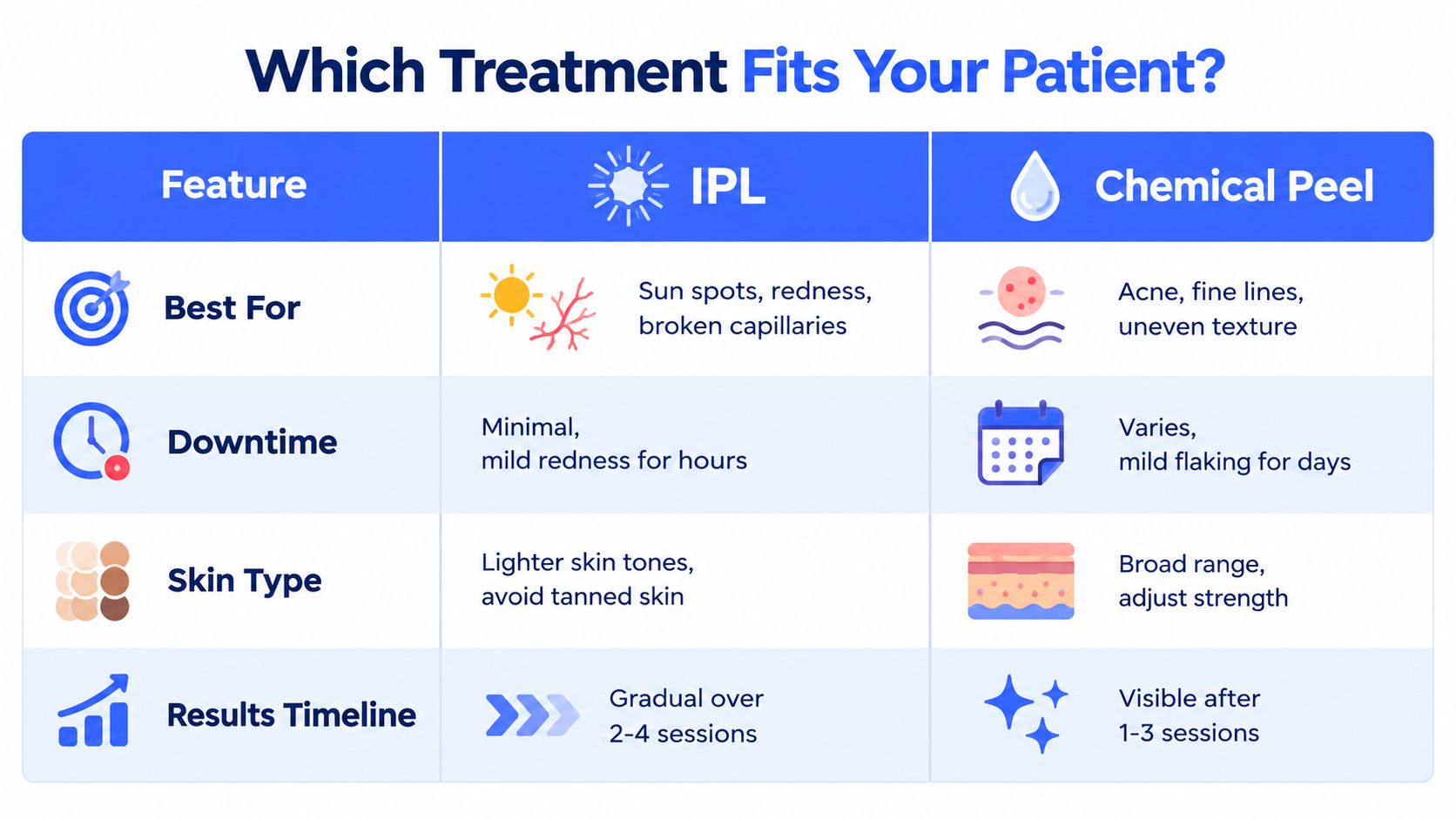
Those answers change the recommendation. IPL is generally considered when pigment and vascular color are prominent, particularly visible sun-related discoloration, facial redness, or small vessels. A peel is often more logical when the leading complaint is roughness, congestion, dullness, acne, or superficial uneven texture.
Practical rule: Don't choose the procedure before identifying the problem. Choose the procedure that matches the problem.
A patient with brown spots and diffuse redness may be a reasonable IPL candidate, provided her skin history and current sun exposure support safe treatment. A patient with oiliness, comedones, and a gray, rough surface may get a cleaner first result from a professionally selected peel. Someone with both concerns may need a phased plan rather than a forced either-or decision.
The consultation should also address skin tone, tanning, pigment history, medications, and tolerance for recovery. A treatment that looks efficient on paper can be the wrong choice if it increases the risk of prolonged discoloration or irritation.
The useful question isn't “Which treatment is universally better?” It's “Which treatment addresses the dominant diagnosis with the most reasonable risk and recovery for my skin?”
How Each Treatment Works on the Skin
A patient with sun spots and dullness is asking two separate questions: what is causing the visible change, and whether the treatment should target the skin's color or its surface. IPL and chemical peels answer those questions through different mechanisms.
IPL uses filtered light
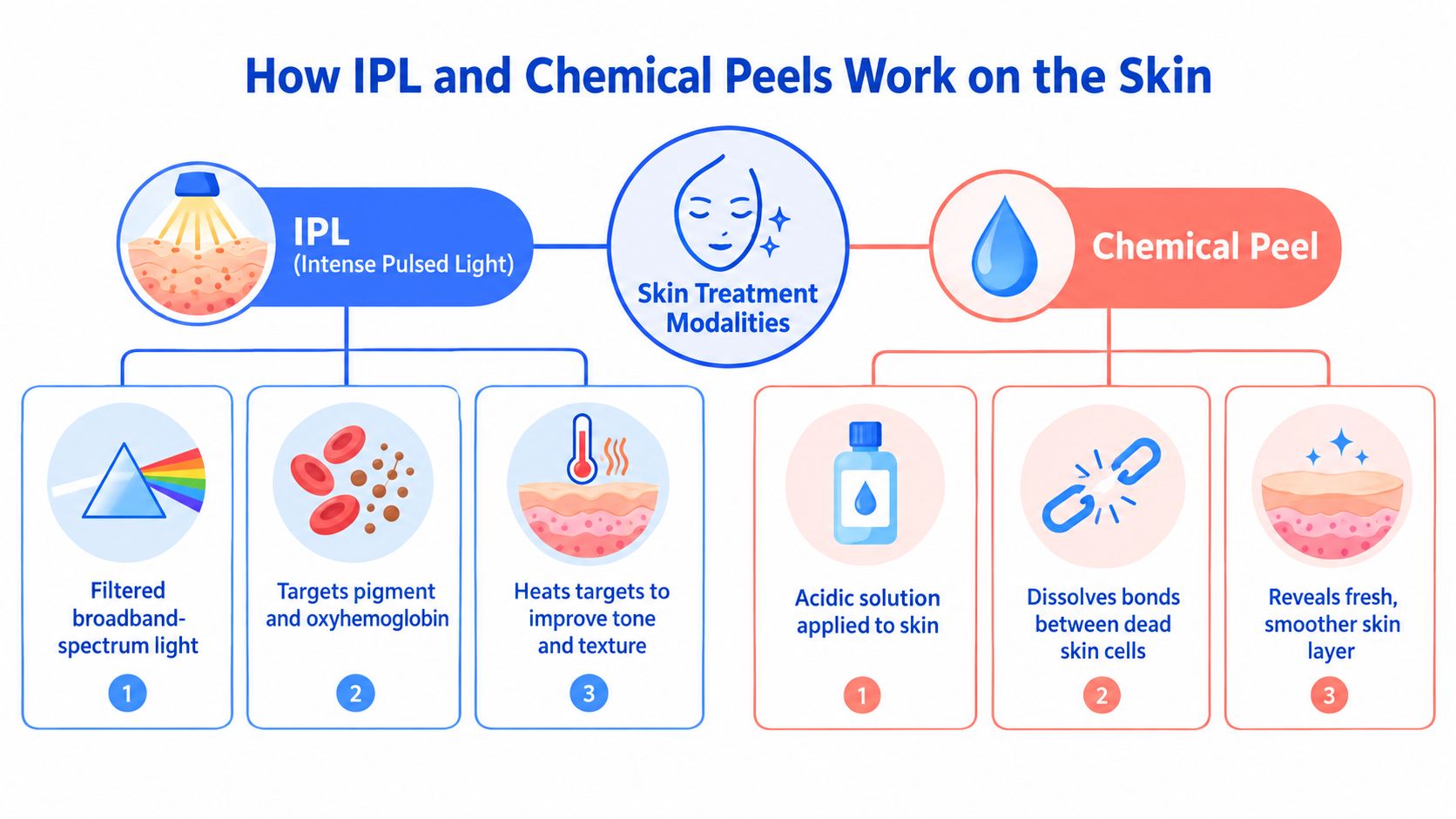
Intense pulsed light, or IPL, uses filtered broad-spectrum light. Pulses are absorbed by selected targets, especially melanin in pigment and oxyhemoglobin in blood vessels. The resulting heat affects those targets while the treatment is configured to limit unnecessary injury to surrounding tissue.
Filters control which wavelengths reach the target and how they act. One published acne protocol used a 530–1,200 nm filter once weekly for six weeks, and 80% of participants reported a significant reduction in lesion count at treatment's end. That result belongs to one study, not every IPL patient, but it shows why wavelength range, settings, and scheduling matter. Read the published acne protocol study on filtered IPL for the study details.
IPL is used for photoaging, lentigines, telangiectasia, erythema, and inflammatory acne redness. It does not exfoliate the surface. Light energy heats selected chromophores, then the body gradually clears or remodels the treated targets. This makes IPL the more direct mechanism when unwanted color is the main complaint.
Chemical peels create controlled exfoliation
A chemical peel applies an acid solution to create a controlled injury. Depending on the formulation, concentration, and protocol, it loosens bonds between superficial skin cells or reaches deeper layers. Common categories include alpha hydroxy acids, beta hydroxy acids, and trichloroacetic acid. The ingredient name alone does not determine the peel's depth.
The controlled injury triggers wound healing and allows smoother surface skin to appear as treated layers shed. Peels are commonly chosen for acne, comedones, superficial dyschromia, dullness, and texture refinement. They address the surface directly, so they often make more sense when roughness or congestion outweighs discrete pigment.
A “medium-depth peel” means more than stronger exfoliation. It describes a deeper controlled injury and a different recovery expectation. For context on device-based resurfacing rather than surface exfoliation, see what to expect from SmartXide Tetra.
The distinction is straightforward: IPL targets selected color beneath or within the skin, while a peel changes the surface through controlled chemical injury. For a further explanation of how light treatments differ from laser procedures, consult ProMD Health's IPL and laser treatment comparison.
Side-by-Side Comparison Across the Decision Criteria
The phrase “IPL vs chemical peel” becomes more useful when you compare the decisions that affect real treatment planning.
IPL vs Chemical Peel at a Glance
| Criterion | IPL | Chemical Peel |
|---|---|---|
| Mechanism | Filtered broad-spectrum light targets pigment and vascular color | Controlled chemical exfoliation and injury renews the surface |
| Primary concerns | Sun-related pigment, redness, telangiectasia, vascular photoaging, some inflammatory acne redness | Acne, comedones, superficial dyschromia, dullness, and texture |
| Typical treatment exposure | Studies have used repeated courses, often within a range of 3 to 7 sessions; a facial rejuvenation review reported a mean exposure of 4.29 sessions in its published review | The number depends on acid, depth, diagnosis, and response. One PIH evidence review reported an average of five peel treatments |
| Recovery | Often limited surface shedding, but redness and pigment changes remain possible | Superficial peels may heal quickly; deeper peels produce more visible scaling and longer recovery |
| Sun restrictions | Careful sun avoidance is important before and after treatment, especially when pigment is the target | Sun protection is essential while the treated surface heals and sensitivity remains elevated |
| Fitzpatrick skin considerations | Fitzpatrick III–V skin requires conservative settings and careful counseling about pigmentary change | Acid choice, concentration, depth, and skin response must be adjusted carefully |
| Course result | Gradual improvement in selected pigment, redness, and photoaging features | Smoother surface, improved texture, and superficial pigment or acne improvement |
The session row is often misunderstood. IPL is usually a course treatment, not a one-visit correction. A facial rejuvenation review covering 16 studies and 637 participants found protocols ranging from 3 to 7 sessions, although the review also found low methodological quality in nine studies and no consensus on optimal IPL parameters. That uncertainty matters because settings and diagnosis influence the result.
Peels offer more variation than many patients realize. A superficial peel and a medium-depth peel aren't interchangeable appointments. The American Academy of Dermatology reports that a superficial “lunchtime” peel may heal in about one day, while a deep peel can require 2–3 weeks of home recuperation, with scaling commonly lasting 3–7 days. The AAD's chemical peel guidance explains the recovery differences.
The darker-skin row deserves special attention. Neither treatment is automatically off-limits, but Fitzpatrick III–V skin shifts the risk discussion. The provider must assess tanning, prior pigment reactions, active inflammation, and the likelihood of post-treatment hyperpigmentation before choosing settings or peel depth.
No row makes one option universally better. Each answers a different priority: pigment and redness, surface renewal, recovery time, skin type, or tolerance for a treatment series.
What the Clinical Numbers Show
The evidence supports a targeted recommendation, not a universal winner. For a patient with sun spots and dullness, the useful question is which endpoint matters most: acne severity, pigment, redness, or surface renewal.
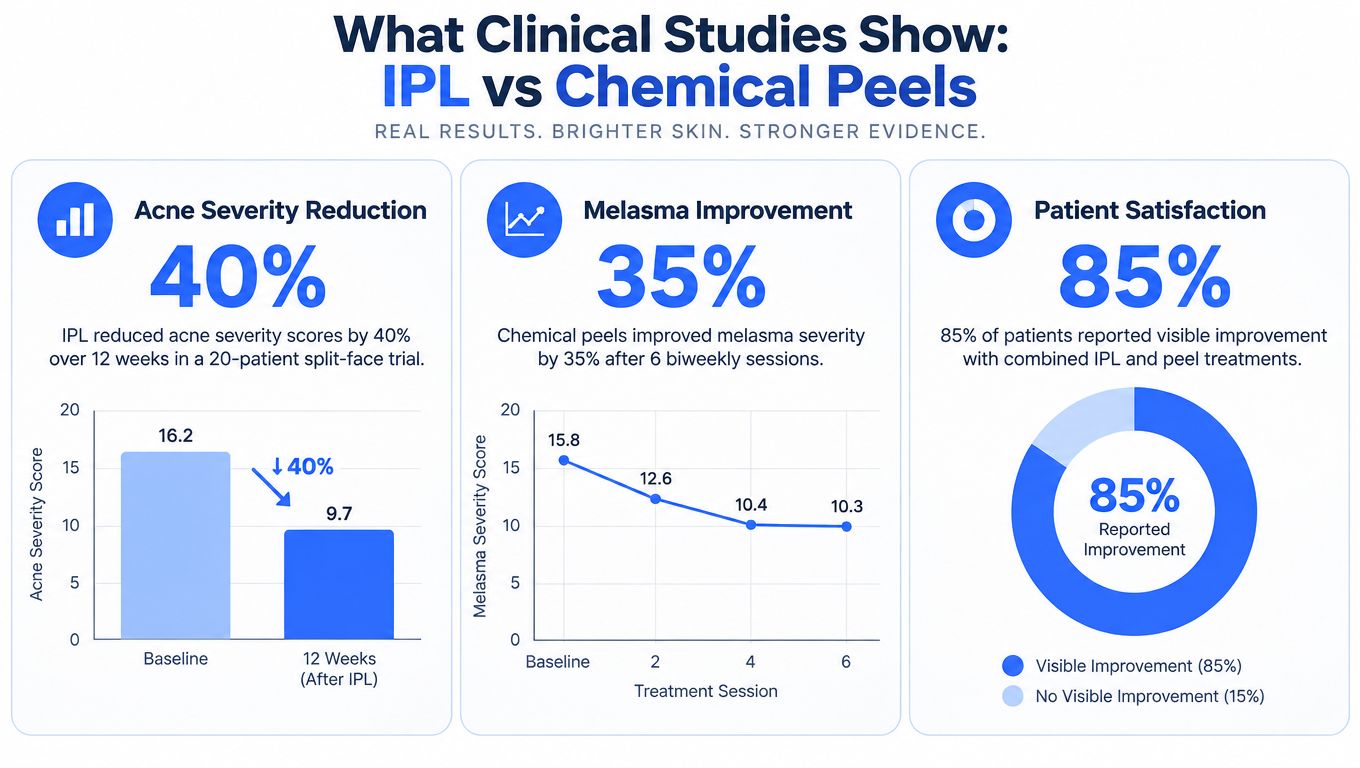
In a 20-patient split-face acne study, six IPL sessions reduced the acne-severity score by 54.4%, from a mean baseline of 24.8 to 11.3. The chemical-peel side improved by 34.4%, from 23.6 to 14.7. The difference between sides was statistically significant, with a reported t-value of 4.632. The full acne comparison is published here.
That finding supports IPL for the specific protocol tested. It does not show that IPL outperforms every chemical peel. The study used one beta-hydroxy-acid regimen, a small sample, and acne severity as its endpoint. It did not establish superiority for acne scarring, recurrence prevention, or every patient profile.
Pigment evidence needs careful interpretation
A 2024 systematic review of PIH in skin of colour synthesized evidence from 48 studies involving 1,356 participants. The IPL evidence included two studies with 85 Asian patients classified as Fitzpatrick III–V, with treatment requiring between 3 and 8 sessions. After two months, 13 patients achieved more than 50% PIH reduction on a five-point grading scale.
A separate assessment of 60 IPL-treated patients rated 35% as “very improved,” 43% as “improved,” and 18% as “unaltered.” That meant 78% received at least some investigator-rated improvement. The review also included 123 chemical-peel participants. Partial pigment reduction occurred in 67% of peel-treated cases, 33% showed no reported response, and the reported mean resolution time was 28 days. The systematic review provides the full PIH evidence context.
These figures do not establish that IPL is safer or more effective for every darker skin type. The IPL studies were small, while peel outcomes varied with acid, concentration, and skin characteristics. A consultation must match the treatment to the pigment pattern and the patient's reaction history.
Redness is a separate endpoint
In a hospital-based retrospective study of 33 patients with acne-induced post-inflammatory erythema, mean erythema scores fell from 2.57 ± 0.66 to 1.21 ± 0.48 after IPL. Eleven patients, or 33.33%, were rated as having excellent improvement, while 15, or 45.45%, were rated as having good improvement. Temporary erythema, hyperpigmentation, and hypopigmentation were reported, and all resolved during follow-up. The erythema study is available here.
The practical conclusion is clear. IPL has a meaningful role when vascular redness is central, while peels remain highly useful for controlled surface renewal. Read every percentage alongside the protocol, patient group, endpoint, and stated limitations.
Matching the Treatment to the Patient Profile
The strongest recommendation comes from the patient profile, not the treatment menu.
Persistent redness and visible vessels
If the dominant concern is facial redness, broken capillaries, or a rosacea-like vascular pattern, IPL is usually the more logical first discussion. Its light-based mechanism can target vascular color in a way a chemical exfoliant cannot.
That doesn't make IPL automatically appropriate. Active flares, recent tanning, photosensitizing medications, and a history of pigment complications must be reviewed first. The provider should also explain that redness improvement and pigment improvement are related but distinct outcomes.
Fitzpatrick III–V skin with pigment concerns
For deeper skin tones, I focus less on the promise of a brightening result and more on how the plan controls inflammation. Peel depth, acid selection, concentration, pretreatment, and aftercare can matter more than choosing a stronger treatment.
IPL may still be considered, but parameter selection becomes critical. The PIH review described evidence in Fitzpatrick III–V patients and specifically supports counseling about repeated treatments and careful settings rather than assuming a single aggressive session will solve the problem.
The darker the skin tone, the less acceptable a casual treatment plan becomes. Diagnosis and pigment history must drive the settings.
Acne, congestion, and oil
When comedones, oil, and superficial acne are the main complaints, I often start the conversation with a salicylic or glycolic peel. Controlled keratolysis and exfoliation directly address the surface conditions that contribute to congestion.
IPL becomes more compelling when inflammatory acne, redness, and residual pigment coexist. The split-face evidence suggests that IPL can perform well in a defined acne protocol, but a provider still needs to distinguish active lesions from brown marks, red marks, and textural scarring.
Dullness, roughness, and fine photoaging lines
Texture-first patients often expect IPL to polish the surface. It can improve broader photoaging features, but it isn't a chemical exfoliant. If the skin looks dull because of retained surface cells, congestion, or mild roughness, a peel may give the more direct response.
If mottled pigment and vascular color dominate the photoaging pattern, IPL may be the better first move. When both are present, combination care makes more sense than forcing one treatment to solve unrelated problems. ProMD Health offers IPL, laser treatments, chemical peels, Hydrafacial, and medical-grade skincare within its aesthetic services, so the final plan can be built around the diagnosis rather than a single procedure.
Sequencing and Combining Treatments in Practice
A combined plan should be phased, not improvised. I don't recommend stacking two irritating modalities because both appear on the treatment menu.
One common sequence starts with a superficial peel to improve surface congestion or dullness. After the skin has recovered, the provider may introduce IPL for residual pigment or vascular redness. The exact interval depends on the peel depth, the patient's response, current sun exposure, and the settings planned for the light treatment.
Another sequence begins with IPL when the primary issue is photoaging color, diffuse redness, or visible sun-related pigment. A provider may then use carefully timed superficial peels between IPL sessions to address texture and maintain surface renewal.
A realistic treatment calendar
A practical plan usually includes:
- Diagnosis first: Decide whether pigment, redness, acne, or texture is the main treatment target.
- One active variable at a time: Avoid same-day combination unless the treating clinician has a specific, medically appropriate protocol.
- Recovery built in: Schedule around scaling, redness, travel, events, and sun exposure rather than treating recovery as an afterthought.
- Consistent protection: Use the prescribed post-treatment routine and avoid unnecessary ultraviolet exposure.
- Local verification: Confirm which laser and peel services are available at the chosen office because treatment availability can vary by location.
Some acids can increase photosensitivity, and recent tanning can alter the safety profile of both peels and light-based procedures. Patients should disclose every active product, medication, recent sun exposure, and previous reaction before the appointment.
For practical aftercare guidance, review ProMD Health's care instructions after IPL. A phased plan can extend across several months, but the calendar should be adjusted according to skin response rather than locked to an arbitrary schedule.
What to Ask in the Consultation Before You Choose
Bring a complete list of current medications, previous isotretinoin use, recent sun exposure, prior lasers or peels, and your tolerance for visible recovery. Don't minimize a history of hyperpigmentation or say you “tan easily” without explaining how your skin reacts after irritation.
Ask these questions directly:
- What diagnosis are you treating? Pigment, vessels, acne, texture, or more than one?
- Why this modality? Ask what IPL can address in your case and what a peel would address differently.
- How many sessions are realistic? Request milestones rather than a vague promise of dramatic improvement.
- What happens if both treatments are options? Ask which comes first and why.
- What are the main pigment risks for my skin tone? The answer should include prevention and aftercare.
- What downtime should I plan for? Ask about redness, scaling, makeup, exercise, and sun exposure.
- What is the payment arrangement? ProMD Health operates on a cash-pay model, so don't assume insurance coverage or reimbursement for aesthetic services. Raise cost and payment questions directly with the practice.
Be cautious if the first visit bundles several aggressive modalities, promises universal results, or skips questions about tanning, medications, and prior reactions. A good plan sounds specific. It names the diagnosis, explains the trade-off, and gives you a reasoned sequence.
ProMD Health offers IPL, laser treatments, chemical peels, Hydrafacial, and medical-grade skincare for patients addressing pigment, redness, acne, and uneven texture. Visit ProMD Health to explore available services and schedule a consultation built around your skin's actual concerns.