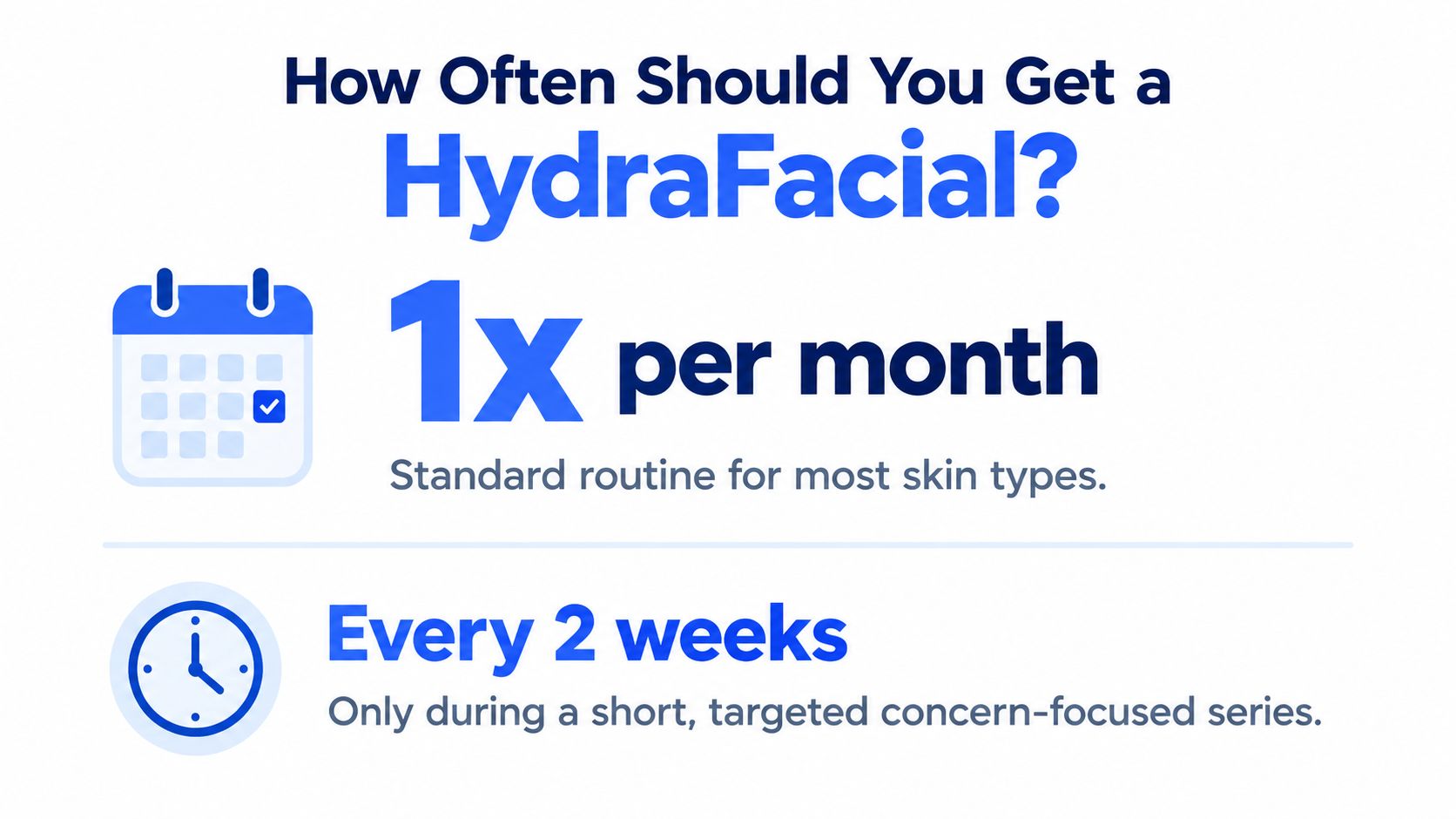
For general maintenance, get a HydraFacial once per month. Every two weeks may be appropriate only during a short, condition-specific corrective series, and weekly treatment isn't justified for most skin types.
The counterintuitive point is that the most frequently studied schedule isn't the default schedule. A small acne study examined six clarifying treatments spaced two weeks apart, while maintenance-oriented research evaluated visits roughly four weeks apart. Those protocols answer different clinical questions, so choosing an interval requires more than copying the shortest gap between appointments.
Table of Contents
- The Short Answer About Treatment Frequency
- What the Clinical Evidence Actually Shows
- How Skin Type and Concern Level Change the Schedule
- Monthly Maintenance Versus Tiered Corrective Plans
- When to Postpone Your Next Treatment
- Building Your Personalized Treatment Protocol
The Short Answer About Treatment Frequency
For most adults, the practical starting schedule is one HydraFacial every four weeks. That is the interval most often recommended for routine upkeep, especially when the goal is hydration, smoother texture, or a fresher look rather than active correction. Skin does not behave like a countertop that gets better the more often you polish it. After a treatment, your provider needs time to see whether your skin looks calm, balanced, and comfortable before repeating exfoliation and extraction.
A shorter interval can make sense, but only for a different reason. In a small acne protocol, visits were spaced every two weeks for a defined corrective series, not as a default plan for everyone. That distinction matters because treatment goals change the schedule. Maintenance and correction are not the same job.
Weekly treatment is usually too frequent for typical skin. HydraFacial includes exfoliation plus suction-based extraction, so doing it again before the skin has settled can create more irritation without clear proof of better long-term results. If your skin is dry, stings easily, flushes readily, or already feels tight after treatment, the right move is often to wait longer, not book sooner.
The baseline to remember
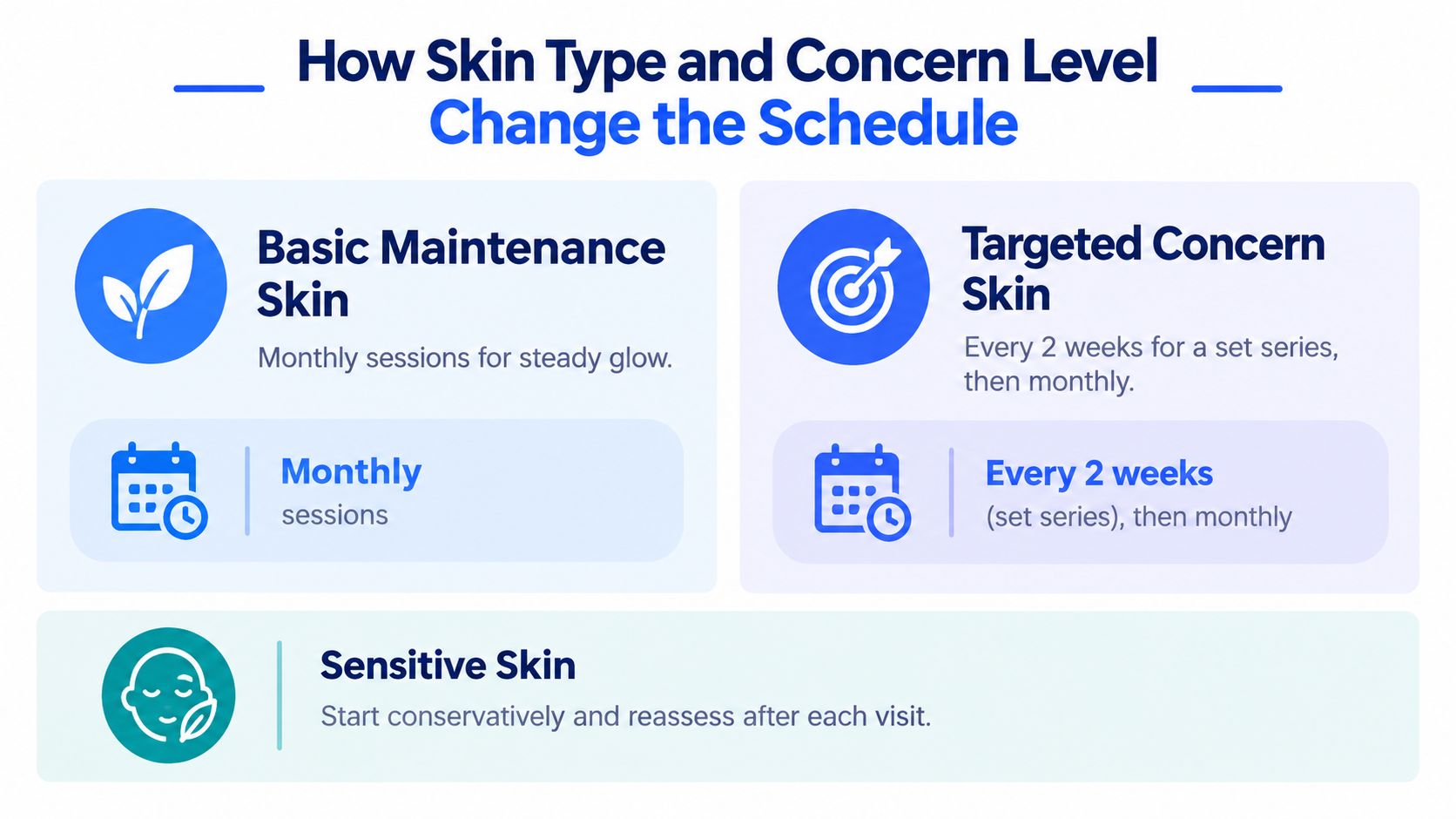
- General maintenance: Start with one session every four weeks.
- Targeted acne or congestion plan: A provider may use every two weeks for a time-limited corrective series.
- Dry, sensitive, rosacea-prone, or retinoid-treated skin: Choose a more conservative interval and reassess after each visit.
- Active irritation or compromised skin: Postpone treatment rather than following the calendar.
That last point gets missed in a lot of consumer advice. If you have visible irritation, a damaged barrier, an unusually strong reaction to your last visit, or skin that has not yet returned to baseline, postponing is often more sensible than forcing a preset schedule.
For a straightforward overview of what the procedure includes, see ProMD Health's HydraFacial treatment overview.
The short version is simple. Monthly is the default for maintenance. Every two weeks fits some corrective plans. Weekly is rarely justified.
What the Clinical Evidence Actually Shows
The strongest evidence doesn't identify one universal cadence. Instead, it shows that researchers have used different schedules for different goals.
The acne-focused protocol
The clearest repeated-treatment example comes from a 12-week, multicenter, open-label study of 20 adults with mild-to-moderate acne vulgaris. Participants were scheduled for six clarifying treatments, with approximately 14 days between visits, to address congestion and lesion burden over the study period (published details of the acne study).
That design matters. The participants weren't just maintaining an already stable complexion. They were following an active clarifying plan for a defined concern. The study also wasn't randomized, wasn't blinded, and didn't include a no-treatment or alternative-treatment control. It therefore shows that a two-week interval has been clinically investigated for a narrow acne indication, not that every patient should receive HydraFacial twice a month.
The maintenance-oriented protocol
A registered clinical study planned three HydraFacial treatments 28 days apart, with approximately 30 participants representing Fitzpatrick skin types I through VI. The final assessment was planned for day 85, with attention to facial hydration, moisturization, and skin-barrier outcomes (the registered study protocol).
This roughly four-week schedule is more consistent with maintenance thinking. It also illustrates why treatment intervals can differ according to the outcome being measured. A hydration and barrier-focused protocol isn't interchangeable with an acne-clearing series, even when both use the same broad treatment category.
Earlier research adds context, not a universal rule
An earlier 2008 hydradermabrasion study involved 20 women aged 34 to 56 who received six facial treatments spaced 7 to 10 days apart. One group received hydradermabrasion with a polyphenolic antioxidant serum, while the comparison group applied the same serum manually (the 2008 hydradermabrasion study).
A 2024 prospective study of facial photodamage also evaluated six biweekly DiamondGlow hydradermabrasion procedures over 12 weeks. Participants used a topical serum twice daily at home, so the findings can't be assigned to the in-office procedure alone (the 2024 photodamage study).
Together, these studies explain why published schedules range from about one to four weeks. They don't prove that one interval is right for every formulation, device, skin condition, or patient.
How Skin Type and Concern Level Change the Schedule
A useful schedule starts with the condition of your skin, not the date on the calendar. HydraFacial includes exfoliation and extraction, so your provider should consider barrier status, sensitivity, active skincare, and the concern being treated.
Start with the skin barrier
The American Academy of Dermatology's general exfoliation guidance is straightforward: the method and intensity should influence frequency, and more aggressive exfoliation should happen less often (AAD exfoliation guidance). A monthly interval is therefore a conservative starting point for many patients, especially when the goal is maintenance rather than active correction.
Dry or sensitive skin may need longer between treatments. Rosacea-prone skin, seasonal dryness, recent irritation, or concurrent retinoid and exfoliating-product use can all make a four-week interval too short. In those situations, your provider may wait until the skin feels comfortable, looks calm, and has recovered its normal barrier function.
Then identify the treatment objective
If your primary concern is mild acne, oiliness, or congestion, a clinician may consider a short series closer together. The two-week acne protocol described above provides a studied example, but it shouldn't be converted into a standing schedule without reassessment.
Pigmentation and texture concerns also require caution. A HydraFacial may be one component of a broader plan, but increasing frequency isn't automatically the best way to address uneven tone. Irritation can make discoloration more difficult to manage, particularly when patients combine several exfoliating or resurfacing approaches.
Practical rule: If your skin is still stinging, unusually tight, persistently red, or visibly peeling when the next appointment arrives, the calendar shouldn't overrule the skin.
Use a response-based adjustment
After each visit, pay attention to comfort, dryness, redness, breakouts, and how long the perceived benefit lasts. If the skin responds well, a provider may maintain the interval. If the barrier becomes reactive, spacing should increase rather than intensify.
For patients deciding between treatment types, HydraFacial versus a chemical peel can be a useful discussion point. The right choice depends on the desired depth, the skin's current tolerance, and how other treatments fit into the plan.
Monthly Maintenance Versus Tiered Corrective Plans
A recurring monthly appointment and a corrective series serve different purposes. Maintenance aims to preserve a comfortable, hydrated appearance over time. A corrective plan clusters visits for a defined concern, then deliberately widens the interval once the provider has assessed the response.
Consider three common situations.
An adult with oily, congested skin may begin with a clinician-directed series at closer intervals if the skin tolerates it. The objective is to address a current problem, not to establish twice-monthly HydraFacials forever. Once congestion and irritation are reassessed, the plan may transition to monthly maintenance or another treatment strategy.
A professional preparing to improve the appearance of sun-related texture may choose a measured series, but the provider still needs to account for concurrent peels, lasers, or active skincare. More visits don't guarantee better correction, and overlapping procedures can increase irritation.
Someone with rosacea-prone skin may be better served by a slower maintenance rhythm. The provider may prioritize barrier comfort, use a gentler approach, and postpone sessions during flares. In this setting, consistency means respecting recovery, not forcing a fixed appointment pattern.
| Schedule Type | Interval | Best For | Duration |
|---|---|---|---|
| Maintenance schedule | Approximately every four weeks | General hydration, texture, and cosmetic glow | Ongoing, with reassessment |
| Corrective series | Approximately every two weeks when clinically appropriate | A defined acne, oiliness, or congestion concern | Short, planned series |
| Conservative schedule | Longer than four weeks when needed | Dry, sensitive, reactive, or seasonally compromised skin | Until tolerance and goals are reassessed |
The important transition is the handoff from correction to maintenance. A provider should define what will be measured, such as lesion activity, irritation, dryness, or pigment changes, and decide whether the next interval should stay the same, lengthen, or stop.
A corrective series is a temporary strategy. It shouldn't quietly become an automatic long-term routine.
This tiered approach also prevents a common misunderstanding. A study that investigates repeated treatments over a limited period doesn't establish that continuing the same frequency indefinitely adds benefit. Maintenance should be earned through observed tolerance and meaningful goals, not assumed because an initial series was reasonable.
When to Postpone Your Next Treatment
A HydraFacial should be timed around skin readiness, not the calendar. Even though downtime is usually light, treatment can still provoke redness, stinging, itching, or inflammation, and it is meant for intact skin. Medical guidance also supports postponing after sunburn or during active infection, and manufacturer safety information says it should not be used for severe inflammatory acne (medical safety considerations for HydraFacial).
That point matters because a postponed visit is not a failed routine. It is the skin-care version of skipping a workout on an injured ankle. Recovery comes first, and treatment works better when the barrier is calm.
Before you confirm your next appointment, pause if any of these apply:
- Active rash or infection: Reschedule and get clinical advice instead of treating inflamed or infected skin.
- Cold sore outbreak: Wait until the area has healed, then discuss timing with your provider, especially if outbreaks tend to recur.
- Open wound or significant sunburn: Injured skin is not an appropriate treatment surface.
- Severe inflammatory acne: Seek medical evaluation rather than using a cosmetic clarifying treatment in place of acne care.
- Persistent post-treatment irritation: Ongoing redness, stinging, itching, tightness, or peeling should be assessed before another session. If you are unsure whether aftercare played a role, review what to avoid after a HydraFacial before booking again.
- Recent procedure in the same area: Coordinate timing after lasers, peels, injections, or other resurfacing treatments rather than stacking procedures on your own.
The reason for caution is simple. Vulnerable skin reacts less predictably. Broader guidance on resurfacing procedures notes that pigment changes can happen after more aggressive treatments, especially in darker skin tones, and that cold sores may reactivate in people with a history of them (Mayo Clinic guidance on dermabrasion risks). That does not prove a routine HydraFacial carries the same risk profile. It does show why skin tone, barrier status, and medical history should shape timing.
Fever, illness, or feeling run down also justify a delay. Cosmetic care can wait until you are well.
Skipping one session because your skin is compromised is safer than trying to preserve a calendar streak.
Patients using retinoids, acne medicines, or other active products should give their provider a full list before treatment. The same applies if another procedure is planned nearby on the calendar. Good scheduling is not about doing more. It is about choosing the next session when your skin can benefit from it.
Building Your Personalized Treatment Protocol
A practical consultation should produce more than a date for the next facial. Bring a list of current products, prescriptions, recent procedures, skin reactions, and the concern you want to improve. Then ask your provider to explain whether the proposed plan is maintenance, a short corrective series, or a combination of both.
Use four questions to make the plan concrete:
- What interval matches my current barrier condition?
- What result will determine whether we repeat, delay, or stop?
- Which products or procedures should I pause or separate?
- What symptoms mean I should contact the office before my next visit?
For general maintenance, monthly treatment is a defensible starting point. A shorter interval should have a defined reason, a limited scope, and a reassessment point. The available evidence remains small, protocols differ, and results from one formulation or device can't automatically be generalized to every HydraFacial treatment.
Between professional visits, gentle cleansing, appropriate moisturization, and sun protection can support a consistent routine. If you want a calming, non-procedural way to care for your skin between appointments, this simple home spa routine offers practical self-care ideas without replacing individualized medical guidance.

ProMD Health provides HydraFacial among its spa services, so a consultation can connect your treatment goal with skin assessment, product use, and timing around other aesthetic care. Book only when your skin is intact and comfortable, and ask for a protocol that explains both the next visit and the point at which the schedule should change.
Visit ProMD Health to discuss whether HydraFacial fits your skin goals and whether monthly maintenance or a short corrective series makes sense. A ProMD Health provider can review your current skincare, recent procedures, and skin response before recommending your next treatment interval.