Female hormone optimization: #1 Ultimate Guide
Why Female Hormone Balance Matters for Your Health and Well-being
Female hormone optimization is a comprehensive approach to restoring your body’s hormones to optimal functional levels, helping you reclaim energy, mental clarity, stable mood, and overall vitality. Here’s what you need to know:
What is Female Hormone Optimization?
- A personalized process that goes beyond simple hormone replacement to achieve optimal hormonal balance
- Focuses on key hormones including estrogen, progesterone, testosterone, DHEA, and pregnenolone
- Uses bioidentical hormones that match your body’s natural hormones
- Combines medical treatment with lifestyle modifications for best results
Who Benefits from Hormone Optimization?
- Women experiencing perimenopause (typically starting in the 40s, but sometimes as early as the 30s)
- Women in menopause (average age 51) or post-menopause
- Those with symptoms like fatigue, weight gain, mood swings, low libido, hot flashes, or brain fog
Your hormones dictate a significant portion of your daily life. From the moment you wake up to when you fall asleep, hormones like estrogen, progesterone, and testosterone influence your energy levels, mood, metabolism, sleep quality, and sexual function. Your endocrine system—the network of glands that produces and distributes these hormones—regulates far more than just reproduction. It affects your bone density, cardiovascular health, cognitive function, and even your risk for conditions like heart disease and Alzheimer’s.
As women age, hormone levels naturally decline. DHEA levels drop by approximately 2% per year after age 30. Testosterone levels decrease gradually over time. Most women become perimenopausal around age 47, though some experience symptoms starting in their mid-thirties. This decline isn’t just about aging—it directly impacts your quality of life and long-term health.
Compared to premenopausal women, postmenopausal women face higher blood pressure, liftd LDL cholesterol, increased triglycerides, and markers of chronic inflammation. HDL cholesterol levels drop significantly after menopause. Heart disease remains the leading cause of death in American women. These changes aren’t inevitable consequences you have to accept.
The good news? Nearly one-third of women who use hormone therapy now choose bioidentical hormones—and for good reason. Bioidentical hormone replacement therapy uses hormones identical to those your body naturally produces, offering a safer, more effective alternative to conventional synthetic hormone replacement.
I’m Scott Melamed, President and CEO of ProMD Health, where my background in biotechnology from Johns Hopkins University and years of clinical research experience drive our mission to provide evidence-based, personalized female hormone optimization solutions. Our approach combines advanced diagnostic testing with customized treatment plans to help women restore hormonal balance and reclaim their vitality.
Understanding Hormonal Imbalance: Signs, Symptoms, and Key Players
Your body operates like a finely tuned orchestra, with hormones serving as the conductors. When these conductors work in harmony, every instrument—every organ system—plays its part beautifully. But when they fall out of sync? The music becomes discordant, and you start feeling the effects in ways that can disrupt your entire day.

At ProMD Health, we see women every day who describe feeling “off” in ways they can’t quite explain to their regular doctors. It’s not just about hot flashes or missed periods. It’s the persistent fatigue that coffee can’t fix, the brain fog that makes you forget why you walked into a room, and that nagging sense that you just don’t feel like yourself anymore.
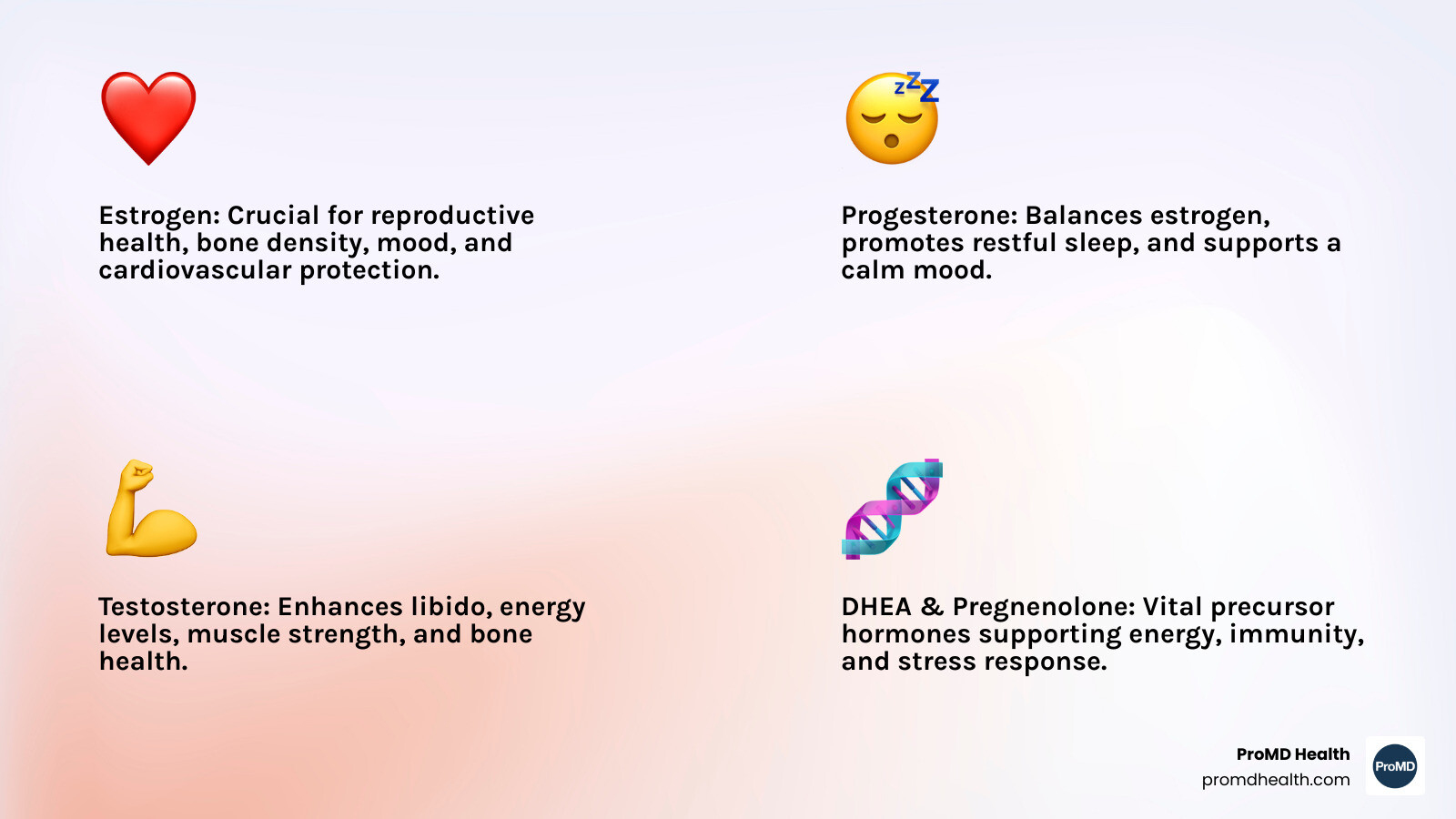
Estrogen often gets called the primary female hormone, and for good reason. It influences far more than just your reproductive system—it affects your bone density, cognitive function, and even protects your cardiovascular health by maintaining healthy cholesterol levels. When estrogen declines, the effects ripple through your entire body.
Progesterone works as estrogen’s balancing partner, regulating your menstrual cycles and supporting pregnancy. When progesterone levels drop, you might notice mood swings that seem to come out of nowhere or find yourself tossing and turning at night when you used to sleep soundly.
Here’s something that surprises many women: testosterone isn’t just a male hormone. You need it too, though in smaller amounts. It’s critical for maintaining muscle mass, bone density, libido, and that overall sense of vitality. Many women experience low testosterone during perimenopause, after menopause, and even after childbirth—which helps explain why some new mothers struggle with energy and mood beyond typical postpartum challenges.
DHEA (Dehydroepiandrosterone) serves as a “parent hormone”—a precursor your body uses to create other hormones like estrogen and testosterone. Your DHEA levels typically peak in your 30s and then decline by approximately 2% per year. That steady decline adds up over time.
Pregnenolone stands at the very beginning of the steroid hormone cascade. Derived from cholesterol, it can be converted into all other steroid hormones, including DHEA, progesterone, and estrogen. A significant reduction in pregnenolone often begins when women reach their early 30s, setting the stage for broader hormonal changes down the road.
When these hormones fall out of their optimal range—whether due to aging, genetics, stress, diet, or lifestyle factors—your body sends clear signals that something’s wrong. You might experience persistent fatigue that rest doesn’t cure, unintended weight gain (especially around your midsection) despite eating the same way you always have, or mood swings that leave you feeling irritable, anxious, or depressed without obvious cause.
Low libido or vaginal dryness can strain intimate relationships. Hot flashes and night sweats can disrupt your sleep and leave you exhausted. Speaking of sleep, many women with hormonal imbalances find themselves struggling to fall asleep or stay asleep through the night. Brain fog, memory lapses, and difficulty concentrating can make you feel like you’re losing your edge at work or in daily life.
Some women notice irregular, heavy, or uncomfortable periods, while others experience hair thinning or skin changes they can’t attribute to anything else. These aren’t just minor inconveniences—they’re your body’s way of telling you that female hormone optimization might help restore your quality of life.
Understanding these symptoms is the first step toward regaining your balance. If you’re experiencing several of these signs, you’re not imagining things, and you’re certainly not alone. For more insights into what you might be experiencing, explore our resources on Common Questions About a Hormonal Imbalance.
The Stages of Hormonal Change
Hormonal shifts are a natural part of every woman’s life cycle, but “natural” doesn’t mean you have to suffer through them. Understanding these stages helps us take a proactive approach to protecting your health.
Perimenopause is the transitional phase leading up to menopause, and for many women, it’s the most turbulent time. It typically begins in your 40s, though we’ve seen symptoms start as early as the mid-thirties. On average, women become perimenopausal about 4-5 years before menopause, around age 47. During this phase, your hormone production—especially estrogen and progesterone—becomes erratic and unpredictable, like a radio signal that keeps cutting in and out.
Menopause officially arrives after 12 consecutive months without a menstrual period. The average age for menopause is 51, though it varies significantly from woman to woman. Once you’re past menopause, you enter post-menopause, where hormone levels remain consistently low.
These hormonal changes carry significant health implications that extend far beyond uncomfortable symptoms. Compared to premenopausal women, postmenopausal women face notably higher blood pressure, increased levels of LDL (“bad”) cholesterol, total cholesterol, triglycerides, and markers of chronic inflammation. Meanwhile, HDL (“good”) cholesterol levels drop significantly. These cardiovascular changes help explain why heart disease remains the leading cause of death for American women.
The decline in estrogen also accelerates bone density loss, increasing your risk of osteoporosis and fractures. Strong bones aren’t just about preventing falls in your later years—they’re about maintaining your independence and quality of life for decades to come.
Perhaps most concerning for many women is the cognitive impact of hormone loss. Research shows a connection between neuronal degeneration and hormone loss, including an increased risk of dementia, Alzheimer’s disease, and Parkinson’s disease. Estrogen stimulates the degradation of beta-amyloid, a toxic protein linked to Alzheimer’s. This is why so many women report brain fog and memory issues during hormonal transitions—it’s not just stress or aging, it’s your hormones.
At ProMD Health, we address these complex hormonal shifts with a comprehensive, personalized approach. We don’t just treat symptoms; we work to optimize your hormones and protect your long-term health. Learn more about how we help women steer these transitions through our Services: Hormone Imbalance.
The Comprehensive Guide to Female Hormone Optimization
Navigating hormone therapy can be overwhelming, but at ProMD Health, we’re here to guide you every step of the way. Our approach to female hormone optimization is designed to be both comprehensive and personalized, ensuring you receive the best possible care for your unique needs.
Diagnosis and Treatment Planning
Our process begins with a thorough evaluation of your health. We use a combination of advanced diagnostic tools to get a complete picture of your hormonal landscape:
- Blood Tests: These provide a snapshot of your hormone levels at a specific moment in time.
- Saliva Tests: These can measure the amount of hormones that are actively available for your body to use.
- Urine Tests: These offer a comprehensive view of your hormone levels and how your body is metabolizing them over a 24-hour period.
We combine these test results with a detailed discussion of your symptoms, medical history, and lifestyle to create a personalized treatment plan. Unlike traditional hormone replacement therapy (HRT), which often uses a one-size-fits-all approach, our goal is to restore your hormones to their optimal levels, not just within a “normal” range. This personalized approach is what sets us apart and allows us to help you feel your absolute best. To learn more about our process, visit How Does Hormone Optimization Work?.
What are Bioidentical Hormones?
At ProMD Health, we use bioidentical hormones in our hormone optimization therapy. These are hormones that are chemically and molecularly identical to the ones your body produces naturally. Here’s why that’s important:
- Bioidentical vs. Synthetic Hormones: Traditional HRT often uses synthetic hormones or hormones derived from animal sources, which can have a different molecular structure than your own. Bioidentical hormones, on the other hand, are derived from plant sources and are an exact match to your body’s hormones.
- Why They Are Preferred: Because they are identical to your natural hormones, bioidentical hormones are thought to work more effectively and with fewer side effects. In fact, they are the preferred choice for many women seeking hormone therapy. For more information, check out our page on Bioidentical Hormone Replacement Therapy and our article on 3 Things to Know About Bio-Identical Hormone Replacement Therapy.
Choosing Your Hormone Delivery Method
We offer several different ways to administer hormone therapy, and we’ll work with you to choose the method that best fits your lifestyle and needs.
| Method | How it works | Pros | Cons | Typical dosing cadence |
|---|---|---|---|---|
| Pellets | Tiny bioidentical hormone implants placed just under the skin | Consistent levels; convenient; long-lasting | Requires a brief in-office procedure; not adjustable until the next insertion | Every 3–5 months (varies by individual) |
| Creams/Gels | Transdermal application absorbed through the skin | Easy to use; flexible dosing; may avoid first-pass liver metabolism | Daily use; potential for transfer to others if not fully absorbed | Daily |
| Pills/Capsules | Oral bioidentical hormones swallowed and absorbed via the GI tract | Simple and familiar; precise dosing | Some hormones undergo first-pass liver metabolism; must remember daily dosing | Daily |
| Injections | Intramuscular or subcutaneous injections of specific hormones | Rapid onset; adjustable dosing | Requires needles; potential for level fluctuations between doses | Typically weekly to biweekly (varies by protocol) |
Your ProMD Health provider will explain the trade-offs for each approach and help you select the method that aligns with your goals, medical history, and lifestyle.
Potential Risks and Important Considerations
Hormone therapy is medical care and should be personalized and monitored. Key points to understand:
- Evidence and historical context: Findings from the Women’s Health Initiative (WHI) with specific oral, non-bioidentical formulations highlighted increased risks for some women, including cardiovascular events and breast cancer. Risks vary by hormone type, dose, route, timing of initiation, and individual risk factors. See summary data at The Women’s Health Initiative study findings.
- Route and formulation matter: Transdermal estradiol and micronized progesterone may have different risk profiles than older, synthetic or oral formulations. Your regimen will be custom to your health needs and risk tolerance.
- Endometrial protection: If you have a uterus and use systemic estrogen, appropriate progesterone is important to protect the uterine lining. Your provider will determine the right dosing schedule.
- Contraindications and precautions: Certain conditions (for example, active or history of hormone-sensitive cancers, unexplained vaginal bleeding, active liver disease, or recent thromboembolic events) may preclude or alter therapy. A thorough history and ongoing screenings are essential.
- Monitoring: Regular follow-ups, symptom check-ins, and periodic labs help ensure you remain in an optimal range. Age-appropriate screenings (such as mammography and pelvic exams) should continue per guidelines.
- Quality sourcing: When compounded medications are used, we prioritize reputable pharmacies. You can verify PCAB-accredited compounding pharmacies via PCAB accreditation information. FDA-approved products are used when available and appropriate.
At ProMD Health, we aim to maximize benefits while minimizing risk through careful selection of formulation and route, appropriate dosing, and close monitoring.
A Holistic Approach: Lifestyle and Natural Support

At ProMD Health, we believe that true wellness comes from a holistic approach. While hormone therapy is a powerful tool, it’s most effective when combined with a healthy lifestyle. Here’s how you can support your body’s natural balance:
Diet and Nutrition: A balanced diet is key to hormonal health. Focus on whole foods, lean proteins, and healthy fats. Certain foods, like those rich in phytoestrogens (e.g., soy, flaxseeds) and cruciferous vegetables (e.g., broccoli, cauliflower), can be particularly beneficial. These foods can help regulate estrogen levels and support your body’s natural detoxification processes.
Exercise: Regular physical activity is essential for both physical and mental well-being. A combination of strength training and cardiovascular exercise can help you maintain a healthy weight, reduce stress, and improve your mood.
Stress Management: Chronic stress can wreak havoc on your hormones. Incorporating stress-reducing practices like meditation, yoga, or deep breathing exercises into your daily routine can make a significant difference.
Sleep Hygiene: Quality sleep is crucial for hormone regulation. Aim for 7-9 hours of uninterrupted sleep each night. Creating a relaxing bedtime routine and avoiding screens before bed can help improve your sleep quality.
The Benefits of Female Hormone Optimization
By combining hormone therapy with a healthy lifestyle, you can experience a wide range of benefits, including:
- Increased Energy: Say goodbye to that afternoon slump and hello to sustained energy throughout the day.
- Improved Mood: Balance your hormones and you’ll likely find that your mood stabilizes, reducing irritability and anxiety.
- Better Sleep: Enjoy deeper, more restful sleep, waking up refreshed and ready to take on the day.
- Improved Libido: Reclaim your sex drive and enjoy a more fulfilling intimate life.
- Weight Management: A balanced hormonal system can make it easier to maintain a healthy weight and reduce stubborn body fat.
- Healthier Skin and Bones: Estrogen plays a vital role in skin elasticity and bone density. Optimizing your hormone levels can lead to healthier, more youthful-looking skin and stronger bones.
At ProMD Health, we’re committed to helping you achieve these benefits and more. Our personalized approach to hormone optimization is designed to help you look and feel your best, both inside and out. Learn more about how we can help you reduce the effects of aging and regain your equilibrium.
Your Path to Balance: The ProMD Health Approach
At ProMD Health, we understand that every woman’s journey is unique. That’s why we’ve developed a comprehensive and personalized approach to female hormone optimization. Our goal is to help you feel your best, both inside and out.
Who Can Benefit?
Our hormone optimization programs are designed for women at all stages of life, including:
- Perimenopause: If you’re in your late 30s or 40s and experiencing symptoms like irregular periods, mood swings, or brain fog, we can help you steer this transition with ease.
- Menopause: For women who have reached menopause, we can help alleviate common symptoms like hot flashes and night sweats, while also protecting your long-term health.
- Post-menopause: We also work with women who are post-menopausal to ensure their hormone levels remain balanced, supporting their overall well-being.
Not sure if hormone therapy is right for you? Our team can help you determine if you’re a good candidate. Learn more about our services.
The ProMD Health Process
Our process is designed to be thorough, personalized, and effective. Here’s what you can expect when you choose ProMD Health for your hormone optimization journey:
- Initial Consultation: We’ll start with a comprehensive consultation to discuss your health history, symptoms, and goals. This is our chance to get to know you and understand your unique needs.
- Comprehensive Lab Testing: We use advanced testing methods to get a clear picture of your hormone levels. This allows us to create a treatment plan that is custom specifically to you.
- Personalized Treatment Plan: Based on your test results and individual needs, we’ll develop a personalized treatment plan that may include bioidentical hormone therapy, supplements, and lifestyle recommendations.
- Ongoing Monitoring and Adjustments: We’ll work with you to monitor your progress and make any necessary adjustments to your treatment plan. Our goal is to ensure you’re always feeling your best.
What to Expect from Your Treatment
While every woman’s experience is different, many of our patients start to see improvements within a few weeks of starting treatment. You may notice increased energy, improved mood, better sleep, and a reduction in other symptoms. Over time, you’ll continue to see improvements in your overall health and well-being. We’re here to support you every step of the way on your journey to a healthier, happier you. Learn more about what to expect from hormone optimization therapy.
Frequently Asked Questions about Hormone Optimization
We understand you may have questions about hormone optimization. Here are some of the most common ones we hear:
How do I know if I have a hormonal imbalance?
Symptoms like persistent fatigue, unexplained weight gain, mood swings, and sleep disturbances can all be signs of a hormonal imbalance. However, the only way to know for sure is through comprehensive testing. At ProMD Health, we use advanced diagnostic tools to get a clear picture of your hormone levels and create a personalized treatment plan.
Is hormone optimization safe?
When administered by a qualified professional, bioidentical hormone replacement therapy (BHRT) is a safe and effective treatment for hormonal imbalances. Unlike synthetic hormones, bioidentical hormones are molecularly identical to the ones your body produces naturally, which can reduce the risk of side effects. We also carefully monitor our patients to ensure their treatment is both safe and effective.
How is this different from what my regular doctor offers?
While your primary care physician can provide general health advice, they may not have the specialized knowledge and experience to effectively treat hormonal imbalances. At ProMD Health, our team of experts focuses specifically on hormone optimization. We use a comprehensive, personalized approach that combines advanced testing, bioidentical hormone therapy, and lifestyle recommendations to help you achieve optimal health and well-being. We don’t just treat symptoms; we address the root cause of your health concerns.
Conclusion: Reclaim Your Vitality and Well-being
Don’t let hormonal imbalances hold you back from living your best life. With the right approach, you can restore your body’s natural balance and feel like yourself again. At ProMD Health, we’re dedicated to helping you achieve your health and wellness goals through personalized, evidence-based care.
Our team of experts will work with you to create a customized treatment plan that addresses your unique needs and helps you feel your best. We offer a range of services, including bioidentical hormone replacement therapy, to help you regain your energy, improve your mood, and improve your overall quality of life.
If you’re ready to take control of your health and start feeling like yourself again, we’re here to help. Contact us today to learn more about our hormone optimization services and schedule a consultation. Let us help you on your journey to a healthier, happier you.