Customized wellness program: Unlock 2025 Success
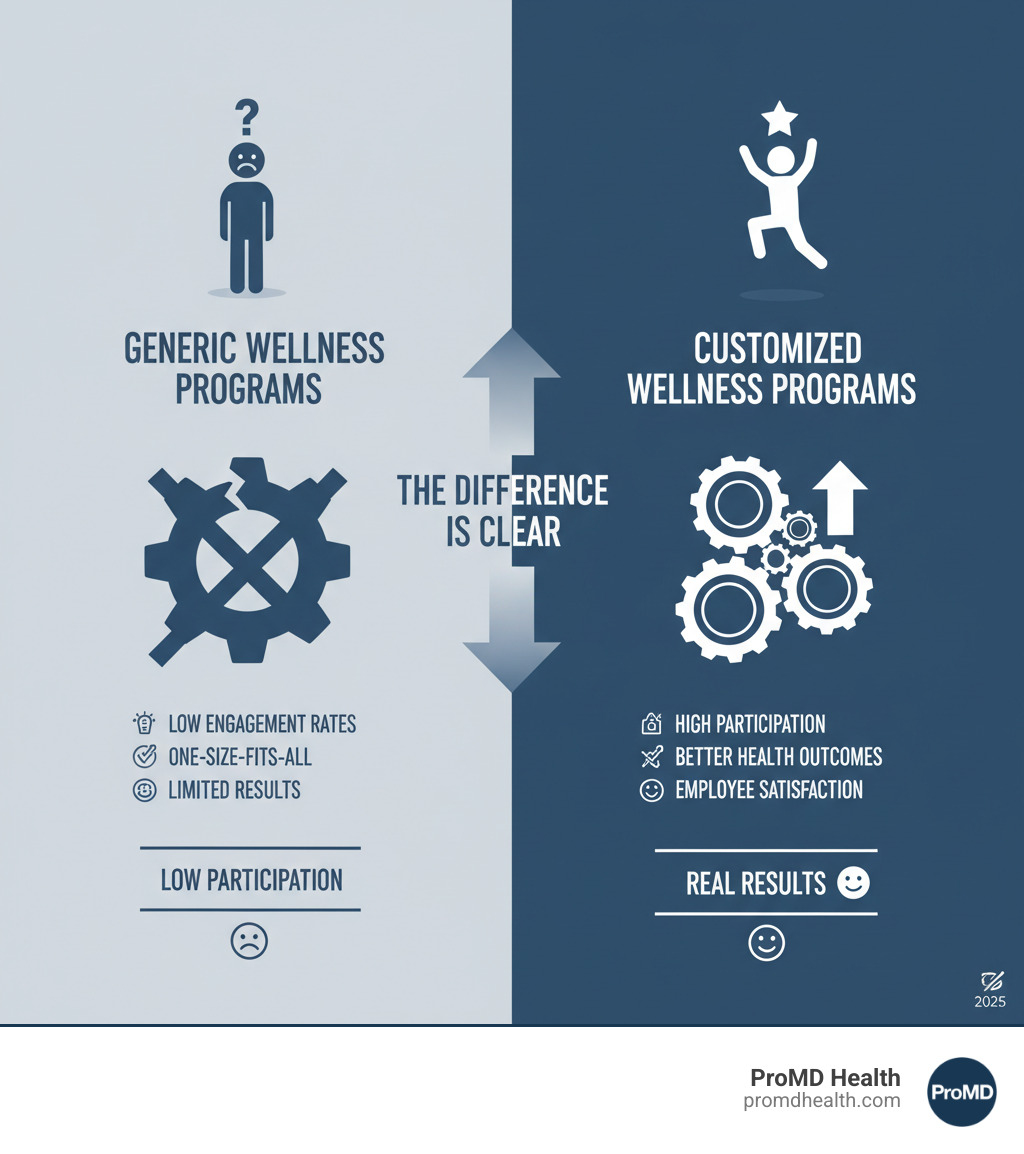
Why One-Size-Fits-All Wellness Programs Fall Short
A Customized wellness program is a custom approach to health that addresses your unique needs, goals, and lifestyle—unlike generic programs offering the same solution to everyone. These personalized plans can include everything from fitness and nutrition to mental health support, all designed specifically for you.
Key Benefits of Customized Wellness Programs:
- Higher Engagement: Programs matching your interests are 92% more likely to see active participation.
- Better Health Outcomes: Personalized approaches lead to measurable improvements in weight, energy, and chronic condition management.
- Cost Savings: Targeted wellness reduces healthcare costs by addressing specific risk factors.
- Flexibility: Programs adapt to your schedule, preferences, and life stage.
- Real Results: Studies show 54% of participants achieve health goals with customized programs, far outpacing generic offerings.
What’s the difference between a 63-year-old worried about hormone changes and a 22-year-old struggling with energy levels? Everything. Yet most wellness programs treat them exactly the same—and that’s why they fail.
Over 90% of business leaders know employee well-being impacts performance. But the old approach of identical seminars and gym memberships doesn’t work. Research shows that when employees are unhappy at work, absenteeism increases by nearly 40% and health expenses escalate by 50%.
Your workforce isn’t generic, so your wellness benefits shouldn’t be either. A customized approach addresses your specific concerns—not a checklist for an “average” person who doesn’t exist.
As Scott Melamed, President and CEO of ProMD Health, I’ve seen how personalized interventions—from novel drug development to customized wellness programs—deliver dramatically better outcomes. My background in biotechnology and clinical research confirms that true wellness requires understanding each person’s unique biology, lifestyle, and goals.
The “Why”: Unpacking the Benefits of Personalized Wellness
When a wellness program is designed specifically for you, you use it. That’s the core difference between traditional wellness and a Customized wellness program, and the benefits are significant.
What Employees Gain from Personalization
When a wellness program acknowledges your specific situation—chronic fatigue, weight management, or low energy—you feel seen. This isn’t just psychology; it’s science. Psychological research from the Center for Self-Determination Theory shows that autonomy in healthcare choices boosts motivation. People take ownership because the journey reflects their individual needs.
The results are powerful. One children’s hospital saw a 92% employee participation rate in its personalized program. More importantly, biometric screenings led to 399 participants receiving immediate medical attention for previously unknown health issues. Personalization doesn’t just engage; it saves lives.
When employees access resources that resonate, they become proactive about their health. Job satisfaction improves because they feel their employer genuinely cares about their well-being as individuals.
Why Employers Should Care
Investing in personalized wellness is smart business. Companies that prioritize employee health see measurable returns: productivity increases, morale improves, and retention strengthens.
The numbers are compelling. Positive work cultures are more productive, and personalized wellness is a cornerstone of that culture. With 36% of benefits costs tied to chronic conditions, proactive interventions can dramatically reduce healthcare expenses.
Supported employees also take fewer sick days and are more engaged at work, directly benefiting the bottom line. Furthermore, personalized programs work equally well for remote, hybrid, and in-office employees, respecting diverse lifestyles and boosting your employer brand to attract top talent.
The Win-Win Reality
A Customized wellness program is a true win-win. Employees get support that addresses their individual health goals, while employers build a more engaged, productive workforce and reduce healthcare costs. It sends a clear message: “We see you as a person, and your well-being matters.” That message builds loyalty that no generic program can match.
Designing a Successful Customized Wellness Program
Creating a Customized wellness program that works means listening, learning, and building something that fits real lives. What energizes a 25-year-old in Ashburn is different from what a 55-year-old manager in our Bethesda office needs. By understanding your people, you can design a program they will actually use.

Step 1: Assessing Unique Employee Needs
Before designing, you must understand your audience. This requires detective work using several tools.
- Surveys, Health Risk Assessments (HRAs), and focus groups reveal what matters to your specific workforce. They uncover daily struggles, health goals, and the stories behind the data.
- Biometric screenings provide objective health markers like blood pressure and cholesterol, helping catch problems early. At one hospital, these screenings flagged 399 participants who needed immediate medical attention.
- Manager feedback identifies team-level stress and support needs. However, managers need support too, as a Gallup study found only 35% are engaged in their own jobs.
Generational differences are also critical. Generation X (born 1965-1980) often juggles aging parents and kids, facing stress and weight management challenges. Meanwhile, Deloitte’s Global 2022 Gen Z and Millennial survey shows younger workers prioritize mental health support, preventive care, and financial wellness. A single program cannot effectively serve both groups.
Finally, consider remote and hybrid work arrangements. Team members in Annapolis, Arlington, Columbia, Fort Lauderdale, Hutto, Lafayette, Lewes, Timonium, Tysons Corner, Washington, Wellington, Westminster, and beyond need programs that meet them where they are, with virtual options and digital access.
Step 2: Building the Core Components
With a clear understanding of employee needs, you can build a holistic Customized wellness program.
- Physical health support should be varied: group fitness, solo activities, team challenges, and Personalized Weight Management plans. Advanced options like The future of weight loss with GLP-1 medications offer medical solutions that work with the body’s natural processes. Nutritional counseling and healthy eating workshops are also valuable.
- Mental wellness is a priority, especially for younger generations. Offer mindfulness apps, meditation workshops, stress management seminars, and access to digital mental health counseling.
- Financial well-being workshops on budgeting, retirement planning, and debt management reduce a major source of stress, improving overall health.
- Social connection is vital, as research shows strong social networks improve health. Team-based challenges and well-being buddy systems create community and accountability.
The key is offering meaningful choices. When people can select what resonates with them, engagement follows.
Step 3: Fostering an Inclusive and Supportive Culture
A great program will fail without a supportive culture, which starts with leadership.
- Leadership buy-in is critical. When executives participate in wellness activities, it signals that prioritizing health is for everyone.
- Wellness champions and peer-to-peer coaching create a grassroots network of support and accountability that feels authentic, not corporate.
- Accessibility for all means designing for different physical abilities, cultural backgrounds, and language preferences. For our teams across Maryland, Virginia, Florida, Texas, Colorado, Delaware, and the District of Columbia, remote worker inclusion with virtual options is essential.
- Clear communication and recognizing achievements keep wellness visible and motivate continued progress.
Step 4: Overcoming Common Implementation Challenges
Anticipate and address obstacles head-on.
- Low engagement signals a mismatch. Personalize offerings based on continuous feedback.
- Budget constraints can be managed by starting with high-impact, low-cost virtual initiatives and scaling up.
- Privacy concerns are non-negotiable. Be transparent about data use and adhere to all privacy regulations to maintain trust.
- Lack of leadership support can be overcome by demonstrating clear ROI and tangible benefits.
- Pilot programs reduce risk and allow for refinement before a full-scale launch.
- Use incentives that your specific workforce values, and track ROI and Value on Investment (VOI) to secure ongoing support.
The Role of Technology and Data in Personalization
Imagine Netflix-level personalization for your health. That’s what modern technology enables for a Customized wellness program. Technology is the engine that makes personalization possible at scale, delivering experiences that adapt to each individual.
Leveraging Technology for a Customized Wellness Program
The right tech transforms wellness into an ongoing, personal experience.
- Mobile apps and wellness platforms act as a 24/7 wellness hub for tracking progress, joining challenges, and accessing resources on your schedule.
- Telehealth consultations have revolutionized access to care, allowing our teams across Maryland, Virginia, Florida, Texas, Colorado, Delaware, and the District of Columbia to meet with specialists, including for Longevity & Functional Medicine, from anywhere.
- Virtual coaching provides one-on-one support from fitness, nutrition, or mental health experts who adapt guidance based on your real-time progress.
- AI-driven recommendations analyze health data to suggest what you need, when you need it. At ProMD Health, we use AI simulation to create truly personalized results for patients.
- Gamification elements like points, badges, and leaderboards make wellness fun and boost participation. Platforms with these features see nearly 50% of members visit 4+ times per week.
- Progress tracking via wearables and apps provides visibility into your health journey, turning abstract goals into concrete, achievable milestones.
Measuring Success and Return on Investment (ROI)
Measuring the success of a Customized wellness program requires a holistic view of individual and organizational impact.
- Participation rates are the first indicator. Personalized programs consistently achieve high engagement, like the 92% rate mentioned earlier.
- Health outcomes are crucial. We track biometric data changes (blood pressure, weight, cholesterol) and find that 54% of members achieve positive health goals.
- Employee satisfaction surveys provide the human side of the data, revealing how people feel about their journey and what they need next.
Business impact is measured through improved productivity metrics, drops in absenteeism data, and healthcare cost reduction. Since 36% of benefits costs are tied to chronic conditions, proactive wellness delivers significant ROI.
Finally, we consider Value on Investment (VOI)—the harder-to-quantify benefits like improved morale, stronger company culture, and improved employer brand. This data creates a continuous feedback loop, making the program smarter with every interaction.
Frequently Asked Questions about Customized Wellness Programs
How is a customized program different from a standard corporate wellness plan?
Standard corporate wellness plans are generic, offering the same gym discount or health seminar to everyone. It’s a one-size-fits-all approach that rarely fits anyone perfectly.
A Customized wellness program is the opposite. It tailors activities, resources, and goals to each individual’s unique health data, lifestyle, and preferences. For example, one employee might get a personalized Weight Management program with nutritional counseling, while a colleague focuses on mental health support through virtual therapy.
The result is dramatically higher engagement—92% participation versus the typical 20-30% for generic programs. When people feel seen and supported, they participate and achieve real, measurable results.
How can a business ensure its customized wellness program is inclusive for a diverse workforce?
Inclusivity requires intentional action. It starts with understanding your people through assessments like surveys and focus groups, ensuring every voice—from our Annapolis office to a remote worker in Texas—is heard.
Next, offer a wide variety of options that respect different physical abilities, cultural backgrounds, and personal interests. This includes providing resources in multiple languages and ensuring digital accessibility.
For a distributed workforce like ours across Maryland, Virginia, Florida, and beyond, virtual care and digital resources are essential for equitable access. Finally, foster an inclusive culture through leadership buy-in and open channels for continuous feedback, ensuring the program evolves with the needs of your diverse team.
What’s the best way to measure the success of a wellness initiative?
Measuring success requires a multi-faceted approach that looks beyond simple participation numbers.
- Engagement Metrics: Track how many employees are actively using the program, completing challenges, and accessing resources. High engagement is the first sign of a successful program.
- Health Outcomes: Monitor tangible improvements in biometric data (blood pressure, weight, cholesterol) and self-reported well-being through surveys. Customized programs show that about 54% of members achieve positive health goals.
- Employee Feedback: Use satisfaction surveys to gather qualitative insights. This tells you the story behind the numbers and highlights the program’s perceived value.
- Business Impact: Analyze data on reduced absenteeism, increased productivity, and lower healthcare costs. A successful Customized wellness program will show a clear return on investment in these areas.
By combining these metrics, you get a complete picture of the program’s impact on both individual lives and organizational health.
Your Journey to Personalized Wellness Starts Here
Personalization is the key to wellness that actually works—not just in a brochure, but in real life. The old, one-size-fits-all approach leads to low engagement and wasted resources. A Customized wellness program recognizes you as an individual, meeting you where you are, whether you’re 25 or 65, working remotely or in an office.
This personalized approach is an investment in people that pays dividends. Healthier, happier employees are more engaged and productive, leading to reduced healthcare costs and a stronger company culture. It’s a win-win for individual lives and organizational success.
At ProMD Health, our practice is built on the belief that “Your Health, Your Way” is a commitment. We understand your health journey is unique. Whether you’re concerned with signs of aging, struggling with weight management, or simply want to feel more energized, we create personalized solutions designed for you.
We leverage advanced technology, including AI simulation, and combine it with a deep understanding of individual needs. We don’t use cookie-cutter approaches; we listen and create customized plans that fit your life and deliver measurable outcomes.
Ready to experience what truly personalized wellness feels like? Take the first step towards a healthier, more vibrant you by exploring a personalized Weight Management program. Find how our customized solutions can transform not just how you look, but how you feel—because when wellness is custom to you, everything changes.