
Massaging a ridge above your lip or immediately booking filler dissolving may sound like practical advice. Neither is a reliable first step. Before acting, sort what you're seeing by timing and location, because temporary swelling, filler placed outside the intended area, and filler that later moves can look similar but need different responses.
Understanding lip filler migration causes starts with a less dramatic question than whether your filler has gone wrong: What's creating the fullness? An examination, treatment records, and sometimes imaging can help answer that without blaming your aftercare or assuming a particular product caused the problem.
Table of Contents
- Lip Filler Migration Signs and Likely Causes
- When Filler Trouble Is an Emergency
- Telling Filler Migration From Normal Swelling
- How Lip Movement and Pressure Shift Filler
- Injection Choices That Raise or Lower Risk
- How Ultrasound and Exam Confirm Filler Location
- Confirm the Assessment Before You Book
Lip Filler Migration Signs and Likely Causes
Lip filler migration means product moving away from the spot where it was injected. It's a recognized but uncommon complication, not something most patients experience. A visible ridge alone doesn't establish that movement occurred.
Start with timing. Fullness that develops immediately and gradually improves fits a different pattern from a contour that stays fixed or becomes more noticeable later. Then identify the location: the skin above the colored lip border, a discrete lump within the lip, or uneven fullness on one side.
Symptoms, likely causes and what to check
The possibilities below guide a conversation, not a diagnosis. More than one contributor may be present.
| What You Notice | Most Likely Cause | What to Ask the Injector |
|---|---|---|
| Upper-lip fullness that stays after early swelling settles | Filler sitting above the intended plane or spreading along tissue planes | Where exactly was the product placed, and how much was used? |
| Puffy band above the lip line that does not change | Product shifted upward with lip movement, or early water retention still present | Was the area reassessed at follow-up, and was it swelling or a persistent contour? |
| Firm lump that can be felt on the lip | Clumped gel or product in an unintended compartment | Can the deposit be felt or imaged, and where is it? |
| Asymmetry that grows over weeks or months | Uneven volume or repeated pressure on one side | Was one side treated differently or massaged more? |
| Lumps or contour changes appearing months or years later | Persistent filler, repeated sessions or delayed inflammation | How many sessions were done, and which filler type was used? |
| Sudden pain, pale or mottled skin, or any vision change | Possible vascular occlusion, which is a different emergency | Seek emergency care now rather than booking a routine review |
For persistent upper-lip fullness, ask about placement before assuming later movement. For a puffy band, establish whether it's changing; for a firm lump, ask whether the clinician can locate a discrete deposit. Increasing asymmetry calls for a comparison of treatment on each side, while delayed changes require a complete history rather than just the latest appointment.
Published frequency estimates describe different groups: a review of 53 published lip cases found migration in 9 of 82 complications, approximately 11% of complications in that selected sample, not 11% of patients; a 2026 dermal-filler review puts migration at up to 1% of cases; and a GoodRx clinical explainer describes estimates of 1% to 8% in facial areas other than the lips.
For another patient-facing explanation of visible patterns, lip filler guidance from Beverly Wilshire Aesthetics can help you prepare questions. Bring pre-treatment photographs, each session's date and product name, and a description of the aftercare you followed. Those details help an injector investigate overlapping causes, but they don't replace an in-person examination.
When Filler Trouble Is an Emergency
Severe or unusual pain, pale or mottled skin, dusky lip color, or any vision change after filler needs immediate medical attention. Don't treat these as ordinary migration or wait to see whether the shape improves.
Migration describes displaced material. Vascular occlusion means blood flow is obstructed, potentially because filler entered a blood vessel. The distinction matters because interrupted circulation can damage tissue, and involvement of vessels supplying the eye or brain can cause catastrophic injury.
What to do immediately
- Contact the injector immediately. Describe the symptoms, when they started, and whether they're progressing. State clearly if your skin color, sensation, or vision has changed.
- Go to emergency care for any vision change, numbness, or severe pain. Don't delay emergency care while waiting for the clinic to return a message.
- Don't wait for a routine appointment. A scheduled aesthetic follow-up isn't an appropriate response to suspected loss of blood supply.
- Bring the product name and treatment date. Take the treatment record if it's readily available, but don't postpone leaving to find paperwork.
The FDA's dermal-filler advisory panel document recorded 157 of 411 reported vascular events, or 38%, in the lips and perioral area, the most frequently represented region. These are reported-event statistics, not the probability that an individual lip treatment will cause occlusion or migration.
Safety rule: A change in appearance accompanied by significant pain, abnormal skin color, or visual symptoms needs urgent assessment, not home correction.
For suspected occlusion involving hyaluronic acid filler, a treating clinician may use hyaluronidase, an enzyme that breaks down that filler, as part of an emergency treatment protocol. The clinician must assess circulation and determine treatment promptly; this isn't something to arrange as an elective cosmetic adjustment.
Stable fullness without emergency symptoms still deserves a clinical review, but it follows a different assessment pathway. Our explanation of dermal filler side effects provides additional context for discussing treatment-related concerns. When urgent symptoms are present, prioritize immediate care over reading or comparing photographs.
Telling Filler Migration From Normal Swelling
Any fullness above the lip line is often labeled migration. That interpretation skips an important possibility: the volume may be swelling, or the filler may have been placed there initially.
Hyaluronic acid attracts water, and early edema can obscure the intended contour. An imaging-focused perspective in Cureus also describes how filler can track along tissue planes, making appearance alone an unreliable way to determine its location or how it arrived there.
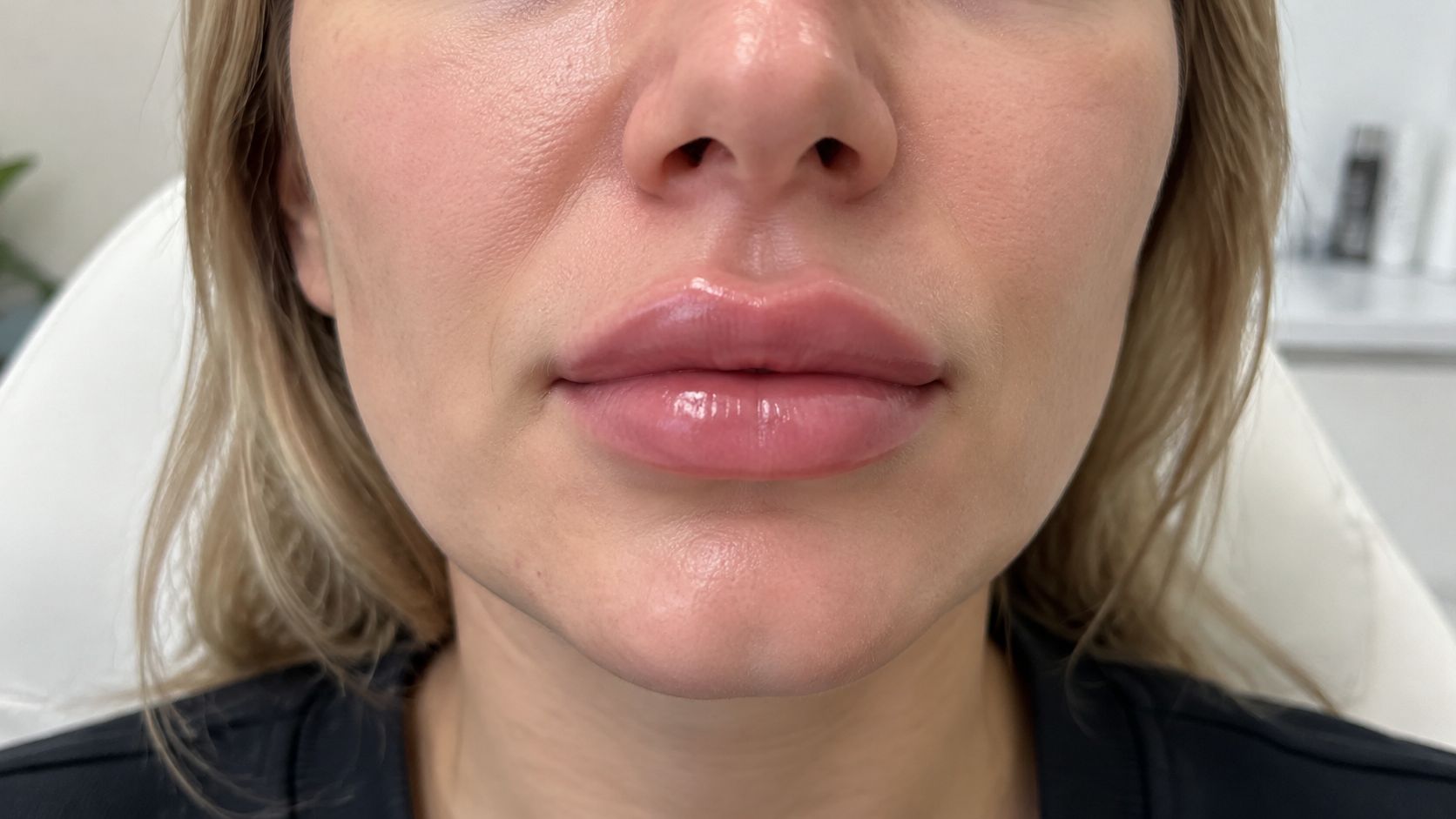
Two similar appearances with different explanations
Consider a hypothetical patient returning three days after treatment with fuller, tender, slightly firm lips. If the swelling is gradually improving and there are no warning signs, temporary edema is a reasonable possibility. That example isn't a deadline for recovery, and tenderness shouldn't be dismissed if it's severe or worsening.
Now consider someone returning six weeks after treatment with a firm band above the lip line that looks unchanged from the first week. That history raises the possibility of initial malposition, meaning product deposited outside the intended location, rather than later migration. Neither the timing nor the photograph proves which occurred.
Our lip filler day-by-day guide can help you document the recovery pattern. Use it to describe changes to your clinician, not to assign yourself a diagnosis.
Questions that separate the possibilities
- Change over time: Is the fullness decreasing, fluctuating, or staying fixed?
- Texture: Does the area feel diffusely puffy or like a defined deposit?
- Movement: Does its shape change when you smile or bring your lips together?
- Original placement: Was the product placed superficially or outside the intended tissue plane?
These observations help the clinician choose what to examine. They aren't home tests that reliably distinguish gel from swelling.
A band above the lip border shows where the contour is unusual. It doesn't establish whether filler moved there.
Self-massage can change the area before it's been assessed and may redistribute product. Immediate dissolving can also be inappropriate when the visible problem is still settling swelling or the product's location is uncertain. Unless you're following individualized instructions from the treating clinician, leave the area alone and arrange a review.
How Lip Movement and Pressure Shift Filler
Think of filler as a gel pillow inside a flexible sleeve. When someone squeezes the sleeve, the gel experiences pressure and may shift toward a less resistant space. It's a useful analogy for mechanical forces, although living lip tissue is more complex and filler doesn't always move.
The orbicularis oris is the ring-shaped muscle around the mouth. Talking, eating, smiling, and puckering repeatedly stretch, compress, and shear the tissues containing filler, particularly in the upper lip. A 2025 narrative review of filler migration identifies muscle activity, injection technique, filler type, treatment volume and frequency, massage, and lymphatic spread as interacting contributors.
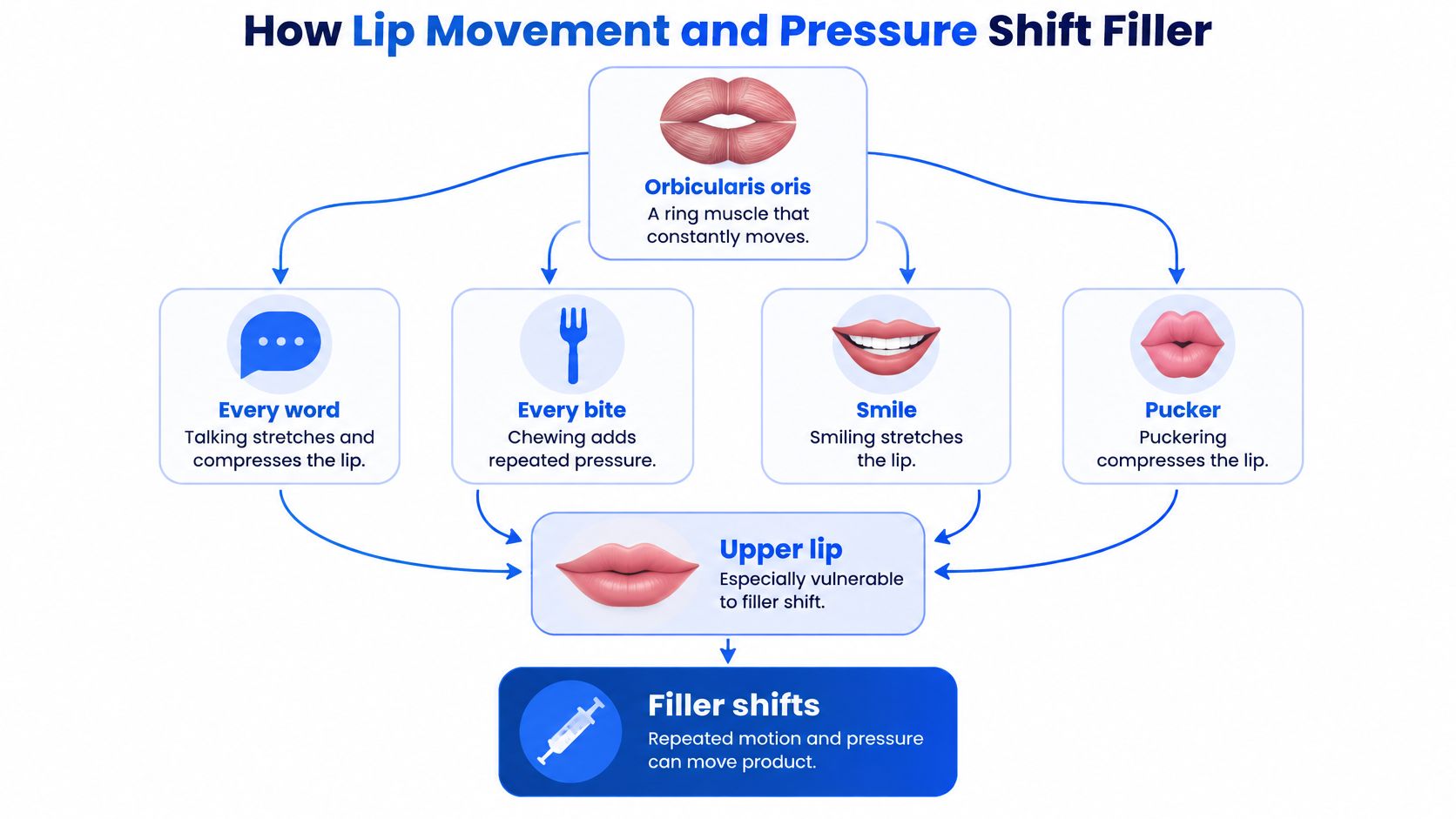
How several pressures can combine
Say someone has residual filler and receives another treatment to restore definition. If the new gel is deposited in a poorly suited plane, ordinary lip movement acts on material that already has an easier route into adjacent tissue. Vigorous massage could add another source of pressure.
That doesn't mean talking or smiling caused the complication. Normal movement is unavoidable, and a treatment plan should account for it. Patients shouldn't feel responsible for keeping their lips unnaturally still.
Several contributors can coexist:
- External manipulation: Firm, repeated massage can redistribute gel rather than smooth its surface.
- Cumulative treatment: Repeated sessions can add material where earlier filler remains.
- Tissue pathways: Connected planes may permit movement beyond the intended compartment.
- Product persistence: Permanent fillers remain longer, allowing more time for displacement to occur or persist.
Why the visible pattern differs
Lymphatic spread is another proposed route by which material may reach tissue beyond its original injection site. It isn't something a patient can identify from a photograph, and it shouldn't be assumed whenever a lip looks puffy.
Depending on where material sits, the visible result may be upper-lip fullness, a mustache-shaped band, a palpable lump, asymmetry, or fullness above the vermilion border, the boundary between the colored lip and surrounding skin. Those appearances don't reveal the force that produced them.
The cause often remains uncertain even after a careful history. Anatomy, dose, placement, persistence, and mechanical stress interact, so a single explanation such as poor aftercare or the wrong brand is usually too simplistic. Assessment should investigate those contributors without assigning blame.
Injection Choices That Raise or Lower Risk
The most useful pre-treatment conversation is about where, how, and how much, not just the name on the syringe. Injection choices influence how gel sits within mobile tissue and whether it can spread beyond the intended contour.
Plane means the tissue layer receiving the product. Placement should reflect regional anatomy and the filler's rheology, its flow, firmness, and deformation characteristics. Too superficial or too deep isn't an absolute measurement shared by every lip; it means inappropriate placement for that anatomy, product, and treatment objective.
The FDA's dermal-filler guidance emphasizes an injector's familiarity with anatomy around the treatment site and avoidance of blood vessels. A clinician should be able to explain the planned approach in terms you understand.
Treatment choices and their effect on migration risk
| Treatment Choice | Effect on Migration Risk | Question to Ask |
|---|---|---|
| Large volume in one session | Raises hydraulic pressure and makes spread more likely | What total volume is planned, and why that amount? |
| Injection too superficial | Leaves product exposed to motion and compression | At what depth is the product placed for this area? |
| Vertical injection direction | Associated with more spread than horizontal injection in recent ultrasound data | Which injection direction is used for the lips, and why? |
| Fast delivery or high pressure | Pushes gel outward before it stabilizes | How slowly is the product delivered? |
| Vigorous massage after treatment | Redistributes gel along tissue planes | What aftercare is advised, and what should be avoided? |
| Permanent instead of temporary filler | Stays in tissue longer, so any shift persists | Which filler type is recommended, and what is the reason? |
| Repeated sessions placed close together | Stacks product and adds mechanical stress | How long is the interval between sessions? |
What a tailored plan should explain
A conservative, staged approach gives the clinician opportunities to reassess before adding volume. It doesn't remove every risk, but it avoids treating a desired syringe amount as more important than tissue capacity. Small deposits, slow delivery, low pressure, and limited manipulation are practical controls.
Injection direction also deserves context. An association between vertical injection and spread doesn't establish that every vertical technique is unsuitable or that horizontal placement guarantees safety. Depth, anatomy, product, and the treatment objective still matter.
Our guide to different lip filler shapes can help you describe your aesthetic goal. Bring that goal to the consultation without assuming that a named shape requires a fixed technique or volume.
Before consenting: Ask how the injector adapted the plane, amount, and delivery method to your lips and any existing filler.
Brand choice alone can't compensate for unsuitable placement. A clear explanation should connect the product's properties to the tissue layer and intended result, while acknowledging that careful treatment reduces rather than eliminates risk.
How Ultrasound and Exam Confirm Filler Location
Assessment works best as an ordered process, not an automatic scan or immediate decision to dissolve. The clinician first needs to establish what was injected, where it was intended to sit, and how the contour changed.
Treatment records can identify product type, volumes, injection points, and dates. Comparable photographs help distinguish a pre-existing asymmetry from a new contour, especially when several practitioners have treated the area.
From records to examination
During the physical examination, the clinician gently palpates the lips and surrounding tissue, compares symmetry, and watches the area during facial expression. A visible ridge may be easy to identify while the depth of the material creating it remains unclear.
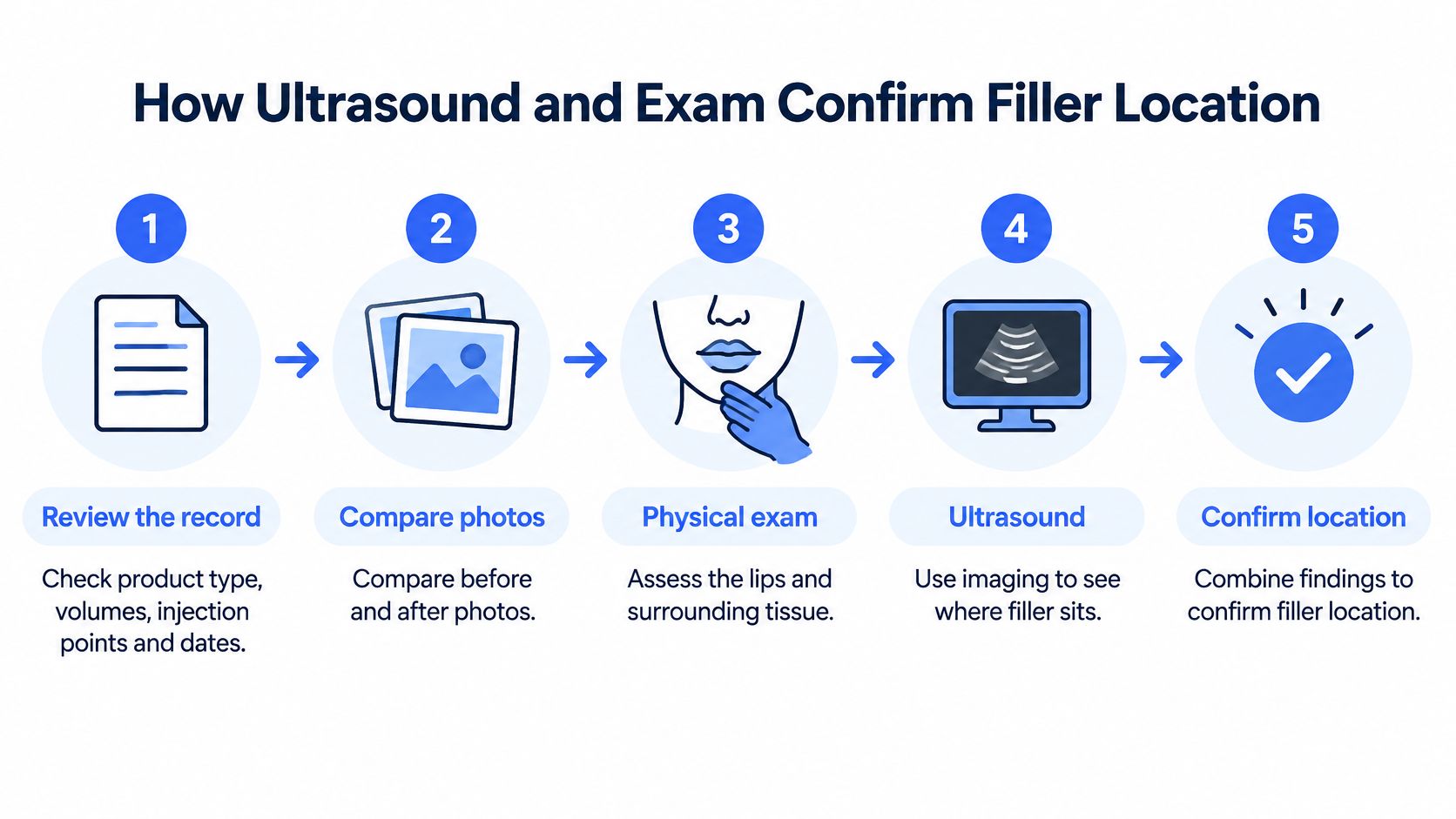
High-frequency ultrasound can help locate filler and show spread between tissue planes when examination leaves uncertainty. A 2026 ultrasound study detected spread beyond the intended injection site in 52% of treated patients, 27 of 52, with spread more common after vertical injections, 73% or 22 of 30, than horizontal injections, 24% or 5 of 21.
Those findings describe that study's treated group and imaging endpoint, not a general population rate of visible lip-filler complications. Imaging-detected spread and a patient-noticed cosmetic problem aren't interchangeable measures.
Assessment methods and what they show
| Assessment Method | What It Shows | Main Limit |
|---|---|---|
| Record review and pre-treatment photos | Product type, volumes, injection points and contour over time | Requires accurate records and consistent photo angles |
| Clinical exam by an experienced injector | Contour, asymmetry, palpable lumps and movement with expression | Cannot always show depth or the exact location of a deposit |
| High-frequency ultrasound | Filler position and spread between tissue planes | Needs a trained operator and access to the equipment |
| MRI | Deep distribution of hyaluronic acid filler | Not a routine first step for lip concerns |
The sequence should end with a plan that matches the findings. Observation may suit swelling that's clearly settling, while confirmed misplaced hyaluronic acid filler may be treated with enzyme dissolving. Hyaluronidase doesn't dissolve every filler type, so product identification matters.
A corrective plan may also include a staged waiting period before considering further filler. Imaging can help locate material, but it doesn't automatically establish when it moved or which contributing factor was responsible. The clinician combines the record, examination, and imaging rather than asking any one method to provide every answer.
Confirm the Assessment Before You Book
If fullness, firmness, or asymmetry persists beyond the early swelling phase, book an in-person assessment rather than repeatedly pressing the area or waiting indefinitely. A stable cosmetic concern doesn't need the same response as an emergency, but it still deserves a clear explanation and follow-up plan.
Gather your treatment dates, product names, number of sessions, and available before-and-after photographs. Include previous dissolving treatments and any changes in discomfort, skin color, or sensation. If you don't have the records, request them from the treating clinic rather than guessing.
Questions worth bringing
- Placement: Where was the product deposited, and what tissue plane was intended?
- Assessment: What can the physical examination establish, and what remains uncertain?
- Imaging: Would ultrasound change the treatment decision, and where could it be arranged if needed?
- Options: Is observation appropriate, or is there a reason to consider correction?
- Future treatment: What needs to settle or be clarified before adding anything else?
A useful consultation should distinguish what the clinician can confirm from what remains a possibility. Don't feel pressured to agree to dissolving or another injection before you understand the working diagnosis, alternatives, and limitations.
Product fit and booking details
At ProMD Health, we offer dermal fillers Voluma, Restylane, and Restylane Lyft. These aren't interchangeable recommendations for every lip concern; the relevant discussion is which product, if any, fits your anatomy and situation, and why. Existing filler should be considered before planning additional treatment.
We operate on a cash-pay model, and ProMD services are not covered by insurance. Before booking, ask about the cost of the assessment and any proposed corrective treatment, and confirm whether the selected office can provide the assessment you need. Don't assume imaging or every corrective procedure is available at every location.
ProMD Health offers dermal filler consultations to discuss your anatomy, previous treatment, and concerns about persistent lip fullness or unevenness. Visit ProMD Health to schedule an in-person consultation with a provider who can examine your lips and explain appropriate next steps.


