You can spend months losing weight and still stand in front of the mirror wondering why your lower abdomen hasn't "caught up." The scale may be lower, your clothes may fit differently, and yet the fold you're seeing can feel soft, hang lower, or look deflated in a way that doesn't match the number you expected. That mismatch is where belly fat vs loose skin gets confusing, because the eye can't tell which tissue is driving the shape.
Table of Contents
- Why the Mirror Cannot Answer This on Its Own
- The Three Tissues That Shape Your Midsection
- The Pinch Test and What It Can and Cannot Tell You
- Belly Fat vs Loose Skin at a Glance
- When the Cause Is Deeper Than Skin or Fat
- Non-Surgical Options and What They Can Realistically Do
- Surgical and Procedural Options for Stubborn Cases
- Your Next Step and How to Put It All Together
Why the Mirror Cannot Answer This on Its Own
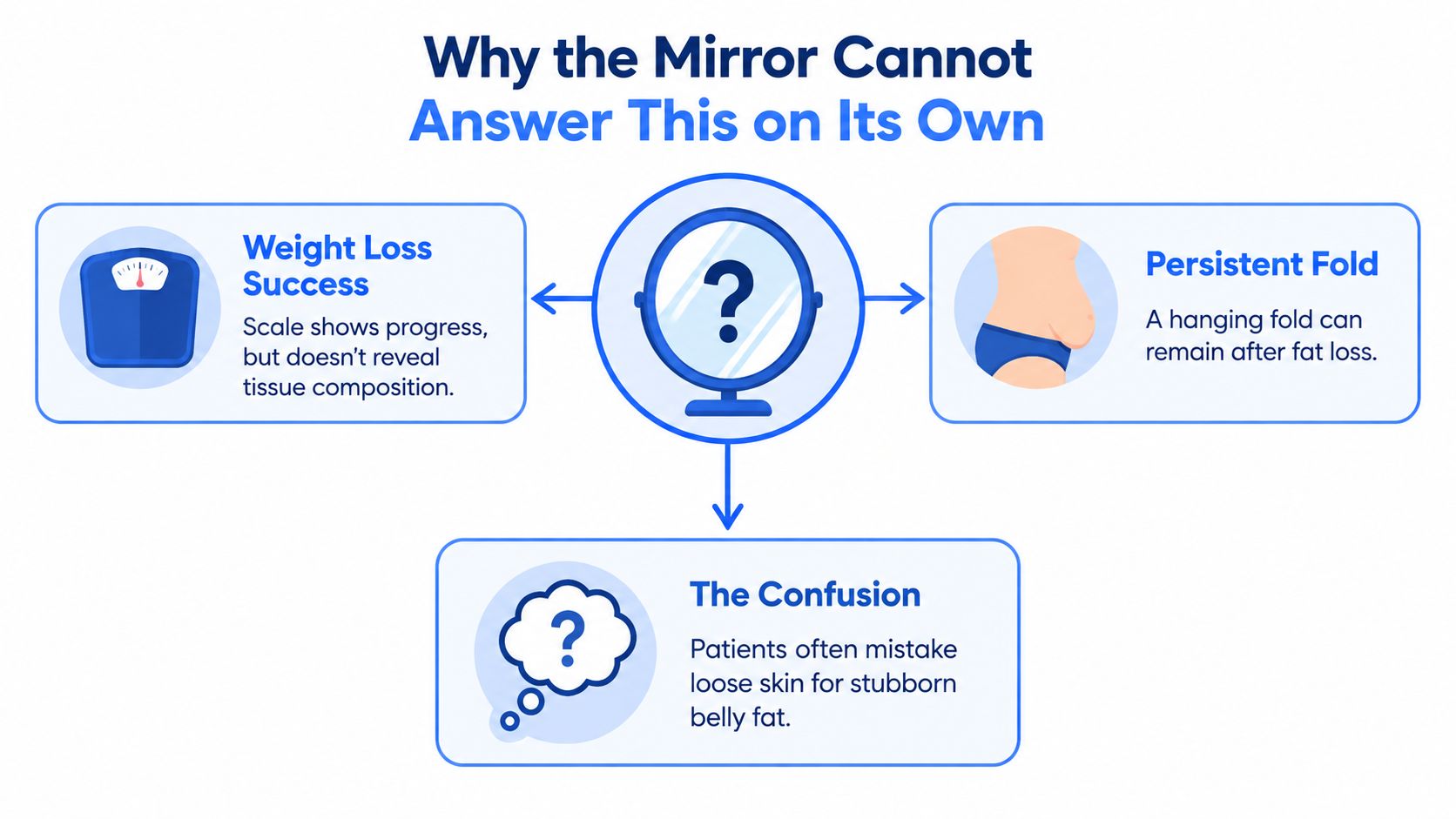
The first mistake people make is treating the mirror like a diagnostic tool. A flatter-looking abdomen can still hide subcutaneous fat, visceral fat, or a stretch of loose skin, and those can overlap in the same person. A second mistake is assuming a hanging fold means “I still have belly fat,” when the outside layer may be mostly skin with very little thickness underneath.
A third mistake is using waist size alone to guess what's happening. Waist circumference is useful, but it captures more than one compartment, so it can't separate what sits under the skin from what sits deeper around the organs. A person can look smaller after weight loss and still have deeper abdominal fat, while another person can look rounder because of redundant skin after the volume beneath it changed.
That's why a bedside view needs context, not just confidence. If you want a simple primer on body-composition measurement, Strive Workout Log on body composition is a practical place to start, especially if you're trying to understand what the scale can't show. The right question isn't “What do I see?” It's “What tissue is making the shape?”
Practical rule: If the abdomen looks different in the mirror, that doesn't tell you whether the change is health-related, contour-related, or both.
The Three Tissues That Shape Your Midsection
Think of the abdomen as layered. The skin is the outer envelope, the fat beneath it is the cushion, and the deeper abdominal fat sits around the organs. When people say “belly fat,” they often mean the whole picture, but medically that's too broad to be useful.
Subcutaneous fat is the layer just under the skin, the part you can usually pinch. Visceral fat is deeper, inside the abdominal cavity around organs. Loose skin is different from both, because it's the excess outer envelope left behind when the skin has stretched and lost some recoil.
That distinction matters because the health implications aren't the same. Visceral fat has a stronger association with cardiometabolic risk than subcutaneous fat, while loose skin is mainly a structural issue unless it's causing irritation, hygiene problems, or discomfort. A person can have a relatively modest waist and still carry deep abdominal fat, or have little remaining fat but a draping fold of skin after major weight loss.
A simple way to remember it is this:
- Skin is the cover.
- Subcutaneous fat is the cushioning layer right under the cover.
- Visceral fat is the deeper volume that changes the abdomen from the inside.
A soft abdomen isn't automatically “fat,” and a hanging fold isn't automatically “just skin.” Mixed cases are common.
Once you separate those layers, the rest of the conversation gets much clearer. You stop asking whether the whole belly is one thing and start asking which layer is dominant, which layer affects health, and which layer would respond to treatment.
The Pinch Test and What It Can and Cannot Tell You
The pinch test is useful only if you treat it as a rough screen, not a diagnosis. Stand relaxed, then gently pinch the lower abdomen, sides, and upper abdomen. A thick, cushioned fold that feels springy and changes with weight trends more toward subcutaneous fat, while a thin, wrinkled, draping fold points more toward loose skin.
Posture matters. Try the same pinch while standing and then while reclining, because gravity can make loose skin look more obvious and can also change how much tissue you can grasp. If you feel a firm bulge that stays prominent but there's very little pinchable tissue on top, that can suggest deeper visceral volume, although you still can't confirm that by touch alone.
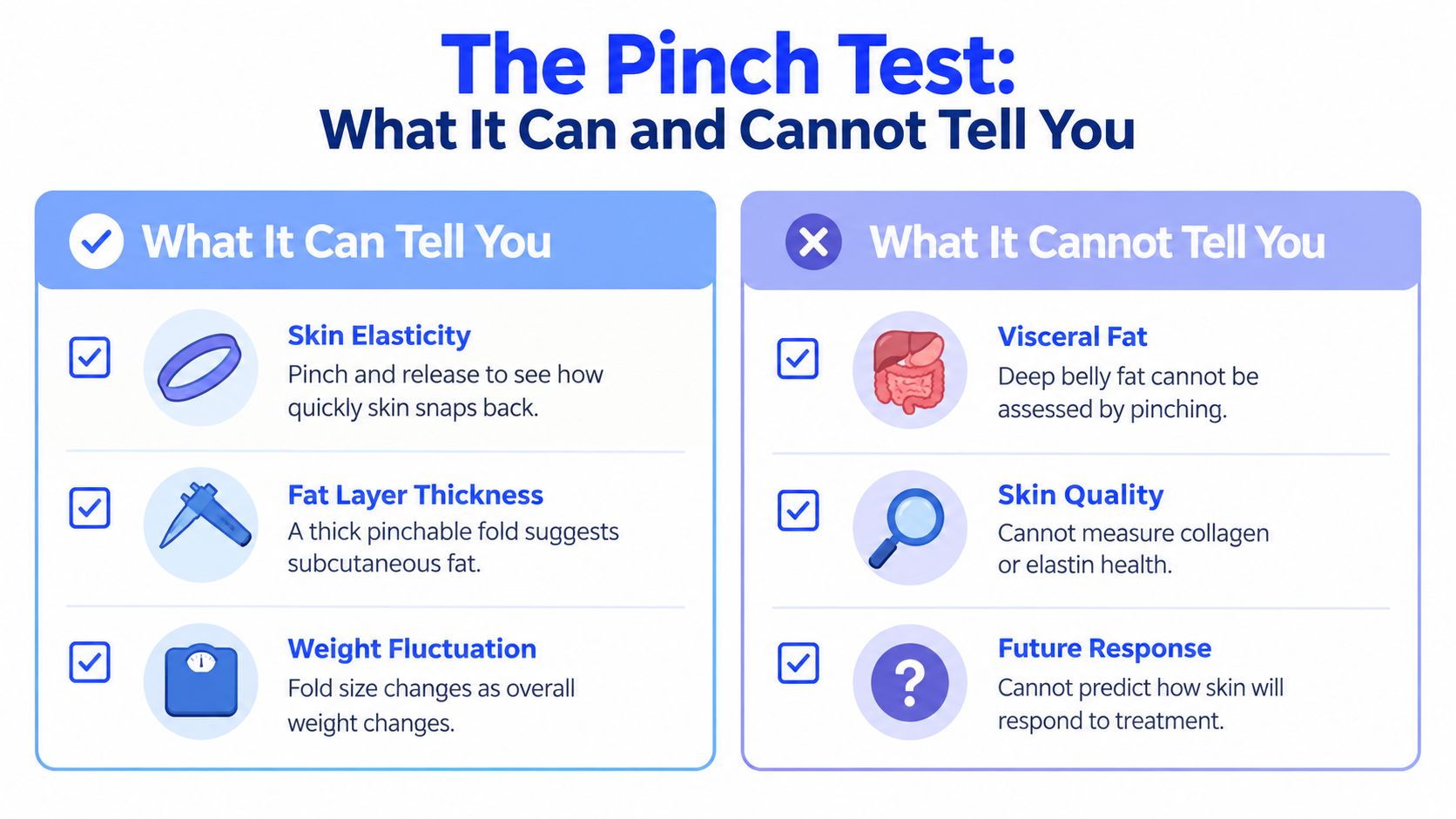
What the pinch test can't do is just as important. It can't rule in or rule out visceral fat, muscle separation, or a hernia. It can't measure collagen quality, and it can't predict how your skin will respond after weight stabilizes or treatment begins.
Bottom line: If the fold feels thin and hangs, loose skin is more likely. If it feels thicker and changes with body weight, fat is more likely. If the abdomen is firm and prominent with little pinchable tissue, deeper evaluation matters.
That's why the pinch test is best used as a clue. It helps you decide whether the main issue is likely volume, laxity, or both, but it doesn't replace a proper assessment when the abdomen doesn't look or feel straightforward.
Belly Fat vs Loose Skin at a Glance
The easiest way to separate the two is to compare what you feel, what you see, and what changed recently. Belly fat tends to feel cushioned and fuller, while loose skin tends to feel thin, wrinkled, and drapey. After weight loss, the mixed case is common, a person may still have some residual subcutaneous fat under a fold of skin that never fully recoiled.
| Feature | Belly Fat | Loose Skin |
|---|---|---|
| Feel | Thicker, softer, more cushioned | Thin, wrinkled, draping |
| Pinch test | Usually thicker and more substantial | Often thin and easy to lift |
| Change with weight | Often changes with overall weight trend | May remain even after weight drops |
| After pregnancy or major weight loss | Can coexist with stretched skin | Common when the skin has lost recoil |
| Main concern | Can reflect health risk when deeper fat is involved | Mostly a contour and texture issue |
| Best mental model | Volume under the skin | Extra skin envelope on top |
A helpful clue is how the abdomen behaves when you move. Fat usually changes its appearance more with overall body weight, while loose skin tends to stay visible even after the scale drops. If the surface looks deflated, folds when you stand, or wrinkles when you bend, that leans toward skin laxity.
A lot of readers get stuck because they compare themselves to a person who has the same waist measurement but a completely different tissue pattern. Two people can share the same circumference and still have very different internal risk, because one may carry deeper abdominal fat and the other may mainly have an extra envelope of skin.
When the Cause Is Deeper Than Skin or Fat
Some abdominal bulges shouldn't be treated as a cosmetic question first. A progressive or firm bulge, pain, a swelling that changes with coughing or straining, unexplained weight change, or postpartum abdominal separation deserves medical evaluation. Those signs can overlap with hernia, diastasis recti, bloating, or fluid-related distension, and the shape alone won't sort them out.
A normal BMI doesn't rule out deeper abdominal fat, either. The CDC reports that 40.3% of adults in the United States had obesity during August 2021 through August 2023, with 39.2% of men and 41.3% of women affected, and 9.4% of adults had severe obesity (CDC data brief). That's one reason a mirror can't answer the health question by itself, because someone may look only moderately sized and still carry an unhealthy amount of visceral volume.
If the goal is risk reduction, the abdomen is only part of the picture. Blood pressure, lipids, and glucose patterns can matter more than the visual shape of the belly. If you're trying to understand why abdominal fullness can persist despite lifestyle changes, how to reduce PCOS belly is useful context for the metabolic side of the problem.
If the bulge is painful, changing, or associated with coughing, straining, or postpartum changes, stop guessing and get examined.
The practical move is simple. When the abdomen is soft and stable, you can think contour. When it's firm, progressive, painful, or tied to other symptoms, you need evaluation before any aesthetic plan makes sense.
Non-Surgical Options and What They Can Realistically Do
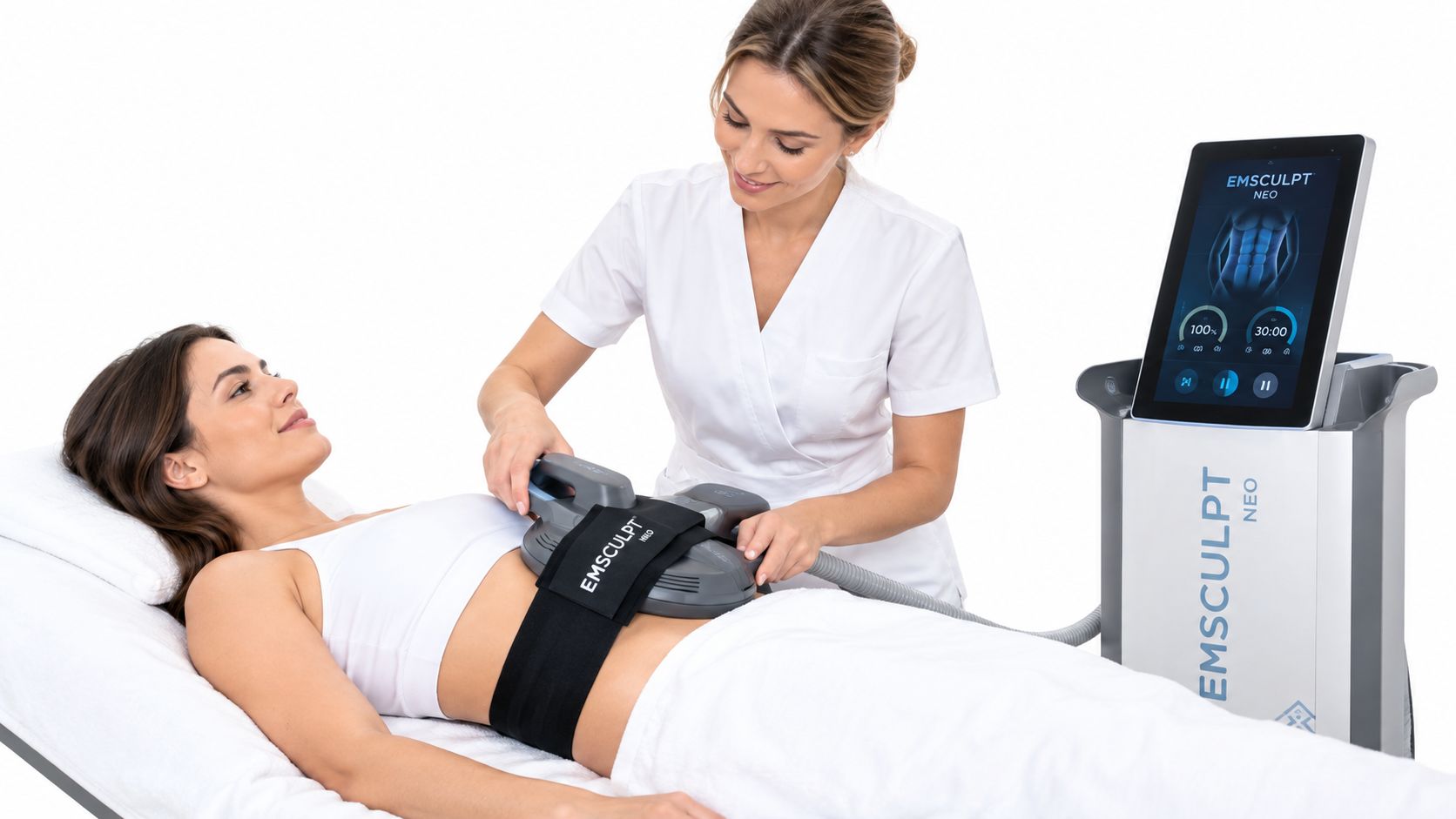
Start with the tissue you want to change. Medically supervised weight management can reduce overall adiposity, including abdominal fat, but it does not selectively remove one visible pocket or contract a large amount of loose skin. Emsculpt NEO (Emsculpt NEO body contouring) serves a different purpose. It is used for abdominal body contouring through muscle building and localized fat reduction, so it may improve definition when hanging skin is not the dominant concern.
Mild laxity may respond to energy-based skin-tightening approaches, which can make the surface look somewhat firmer. Results remain limited. A small 2025 radiofrequency study in 15 volunteers reported about a 9% reduction in abdominal or flank fat thickness, a 2% circumference reduction, and a 12% increase in dermal echogenicity after eight sessions. The small sample does not show that energy-based treatment can replace weight management or surgery (PubMed).
Exercise supports body composition and muscle function, although it cannot correct every contour concern. A fitness paddleboarding guide offers one example of activity that combines movement with resistance. Stronger abdominal muscles may improve the outline, but a thick, hanging fold usually will not tighten into a flat abdomen through exercise or muscle stimulation alone.
Non-surgical choices fall into three practical groups:
- Reduce fat: medically supervised weight management, contouring devices, and activity changes.
- Improve shape: muscle-building approaches that can sharpen the outline.
- Improve skin quality: energy-based tightening for mild laxity.
ProMD Health offers Emsculpt NEO as a non-surgical body-contouring option for the abdomen, which fits the fat-plus-muscle side of this problem. If loose, redundant skin creates the main visible fold, non-surgical methods may soften its appearance but are unlikely to remove the extra skin envelope.
Surgical and Procedural Options for Stubborn Cases
When loose skin is the dominant issue, the conversation changes. Abdominoplasty addresses excess skin and can also tighten the abdominal wall in appropriately selected patients, while liposuction targets fat but doesn't remove significant lax skin. If both are present, combined contouring can make more sense than trying to force one treatment to do everything.
A useful way to think about candidacy is stability. People with a stable weight, realistic expectations, and a clear tissue problem are usually easier to evaluate than people still in active weight loss or repeated weight cycling. Pregnancy plans matter, too, because future stretching can undo a carefully chosen result.
Scarring and recovery should be part of the decision, not an afterthought. Surgery can deliver a stronger structural change than non-surgical care, but it also asks for more downtime and a more careful discussion of tradeoffs. If the abdomen looks deflated because skin is the main issue, liposuction alone can make that look more obvious rather than less.
A separate but related point is preparation. A body that's closer to a maintainable weight is usually easier to contour, which is why medically supervised weight programs and hormone optimization can sit alongside procedural planning rather than competing with it. If fat transfer is part of the conversation, the procedural details matter as well, and what happens during a fat transfer gives a clearer picture of how harvested tissue is handled.
Cost and payment should be discussed directly with the practice. ProMD Health operates on a cash-pay model, so it's better to ask about the actual treatment plan and financing questions than to assume insurance will play a role.
Your Next Step and How to Put It All Together
The cleanest decision framework is to separate the problem into three goals. Health risk reduction points you toward visceral fat evaluation and metabolic care. Contour improvement points you toward subcutaneous fat reduction and body shaping. Texture or laxity management points you toward loose-skin treatment, with surgery considered when the fold is substantial.
Before a consult, document a few basics:
- Weight history: note major losses, gains, and any recent changes.
- Pregnancy or surgery history: these often change the abdominal wall and skin.
- Medications and hormones: they can affect weight and body composition.
- Photos: take them in the same lighting, from the front and side, so you can compare change accurately.

If you're trying to decide what's underneath your abdominal shape, medically supervised weight loss is one practical route when the issue includes deeper adiposity or ongoing weight change. A consultation can then separate what's health-related from what's purely structural, which saves time and avoids chasing the wrong fix.
The answer to belly fat vs loose skin usually isn't one or the other. It's figuring out which layer is driving the problem, what that means for health, and which care path fits the tissue you have.
If you're ready to stop guessing, visit ProMD Health to talk through whether your abdomen is mostly fat, mostly loose skin, or a mix of both. Their team can help separate contour concerns from health concerns and match the next step to the tissue in front of you.