The FDA-labeled Botox Cosmetic reference for forehead lines is 20 units across five forehead sites, paired with 20 units for the glabella for a 40-unit combined session. That's a starting reference, not a personal prescription, because the right dose depends on your anatomy, muscle activity, brow position, and goals.
You may be searching after noticing horizontal lines in the mirror, comparing treatment menus, or seeing conflicting answers online. One page says 10 units, another says 20, and someone else insists that a larger number is necessary. The confusion is understandable, because Botox units are product-specific and dosing isn't universal.
A careful injector doesn't treat a number in isolation. The plan accounts for how strongly your frontalis muscle lifts the brows, whether your forehead is already compensating for heavy lids, how much movement you want to keep, and whether the glabellar muscles also need treatment. The practical question isn't just how much Botox for forehead wrinkles. It's what is the lowest effective dose for your face and your preferred result?
Table of Contents
- What Most People Mean When They Ask This Question
- Reading the FDA Forehead Label the Right Way
- Typical Real-World Forehead Dose Ranges
- What Actually Changes Your Personal Dose
- Why Treating the Forehead Without the Glabella Is Risky
- Safety, Placement, and the Side Effects Dose Can Cause
- What to Bring to Your Injector Consultation
What Most People Mean When They Ask This Question
Readers asking how much Botox for forehead wrinkles want a number they can use to compare providers or estimate what treatment might involve. The clearest regulatory reference is 20 Units total, divided into 4 Units at each of 5 forehead sites, according to the FDA prescribing information for BOTOX Cosmetic.
That figure describes a specific labeled pattern. It doesn't mean every forehead should receive 20 units, and it doesn't mean a provider can determine your dose accurately from a photograph or online questionnaire. A smaller forehead, lighter muscle activity, low brows, or a preference for visible expression may justify a more conservative plan. Strong frontalis activity, a larger treatment area, or a different treatment objective may lead to another decision.

The number has anatomical context
The labeled forehead protocol is paired with treatment of the glabellar lines, the vertical “11” lines between the eyebrows. That combined approach uses 20 forehead units plus 20 glabellar units, for 40 units total. The reason matters: the frontalis helps lift the brows, while muscles in the glabellar complex pull them downward. Treating only the elevator can change that balance.
Patients also need to separate Botox units from other neuromodulator units. A unit isn't a universal currency across products, so comparing totals without identifying the product can produce a misleading conclusion. A quoted forehead number is useful only when you know which product, injection pattern, and treatment goal it represents.
If you want a broader explanation of treatment planning and expectations, review ProMD Health's Botox FAQs for wrinkles. The useful takeaway is simple: start with the labeled reference, then ask how the provider is adapting it to your face. The rest of the decision involves the label, published clinical ranges, anatomy, brow safety, and the questions you ask at consultation.
Reading the FDA Forehead Label the Right Way
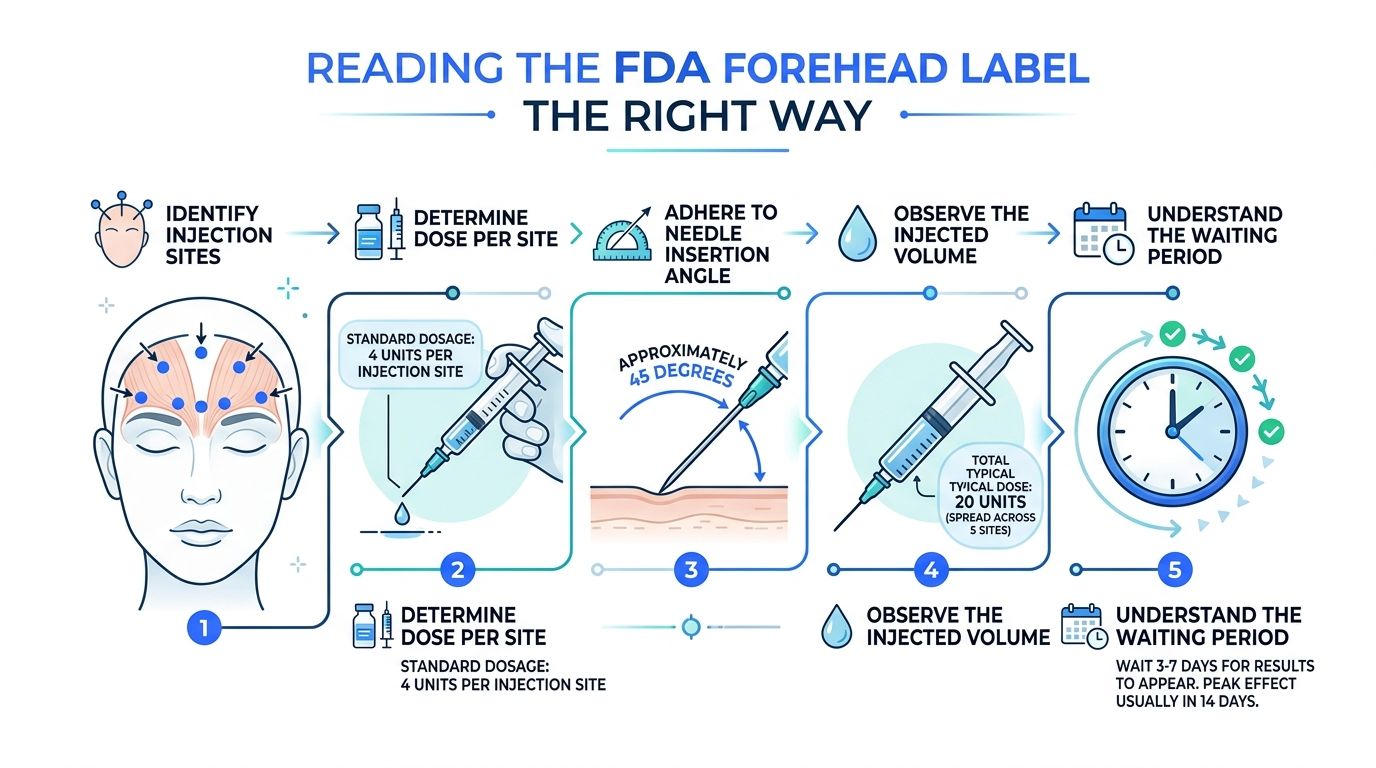
The FDA reference becomes more useful when you look at its structure rather than repeating “20 units” as a standalone answer. For adult forehead lines, the labeled pattern places 4 Units at each of 5 sites, for 20 Units total. Each site uses 0.1 mL, so the protocol distributes the product across the forehead rather than concentrating it in one area.
Five sites are a pattern, not a promise
The five-site structure gives an injector a studied framework for distributing treatment across horizontal forehead activity. It doesn't account for every forehead shape, asymmetry, muscle boundary, or brow position. A clinician may alter placement or dose when the patient's anatomy makes the standard pattern unsuitable.
The combined protocol is also important. The label describes 20 Units for the forehead and 20 Units for the glabella, totaling 40 Units when both areas are treated. This isn't merely two unrelated cosmetic zones placed on the same invoice. It reflects the opposing actions of brow elevators and depressors, which can influence the final brow position.
Practical rule: A labeled dose tells you what was studied for a defined product and pattern. It doesn't replace an examination of your forehead at rest and during expression.
The FDA label is a regulatory reference, not a universal prescription. A provider may recommend less or more in individualized practice depending on muscle strength, forehead dimensions, asymmetry, previous toxin exposure, and whether the goal is gentle softening or stronger movement reduction. The important safety question is whether the injector can explain the departure from the reference clearly.
A good consultation should identify the product, show the planned injection regions, and discuss how brow position will be protected. If someone quotes 20 units without asking you to raise your brows, relax them, and describe your desired movement, the number is missing its clinical context.
Typical Real-World Forehead Dose Ranges
Published clinical references show why online answers don't always match the FDA-labeled pattern. An NIH clinical reference describes forehead or frontalis dosing across 8 to 25 units and 4 to 8 injection points, with typical ranges of 10 to 20 units for women and 20 to 30 units for men. Those figures are ranges, not instructions for self-selection, and they shouldn't be treated as interchangeable with the labeled Botox Cosmetic protocol.
| Reference point | Forehead units | Notes |
|---|---|---|
| FDA-labeled Botox Cosmetic forehead pattern | 20 | 4 Units at each of 5 sites, using 0.1 mL per site |
| NIH-cited forehead or frontalis range | 8 to 25 | Delivered across 4 to 8 injection points |
| Typical range cited for women | 10 to 20 | Individual anatomy and treatment goals still determine dosing |
| Typical range cited for men | 20 to 30 | Stronger muscle activity may affect the plan |
| Individualized dosing comparison | Approximately 12.9 for younger adults, 12.7 for non-younger adults | Separate study using individualized dosing rather than the fixed labeled regimen |
The individualized comparison above came from a review of clinical evidence involving 144 participants, while a separate U.S. randomized study involving 1,178 participants evaluated a combined forehead and glabellar protocol. That study used 40 Units, split into 20 Units for the forehead and 20 Units for the glabella, rather than treating the forehead as an isolated zone. The evidence supports the labeled component while also showing that individualized forehead dosing may be lower in practice. The peer-reviewed review summarizes both dosing contexts.
Why ranges aren't contradictory
A range exists because patients don't have identical frontalis muscles or identical preferences. Someone with a shorter forehead, modest muscle activity, or a desire to keep expressive movement may need a different plan from someone with powerful brow elevation and broad horizontal creasing.
Lower isn't automatically safer, and higher isn't automatically better. Too little may leave untreated activity or create uneven movement, while too much can make the forehead feel heavy or overly restricted. The target is effective, balanced relaxation, not the largest number a provider can justify.
What Actually Changes Your Personal Dose
The same wrinkle pattern can produce different dosing decisions in two otherwise similar patients. One may lift the brows forcefully to keep the upper eyelids open, while another may have low brow position and little need for compensatory movement. Treating them identically would ignore the function of the frontalis.
Muscle and forehead structure
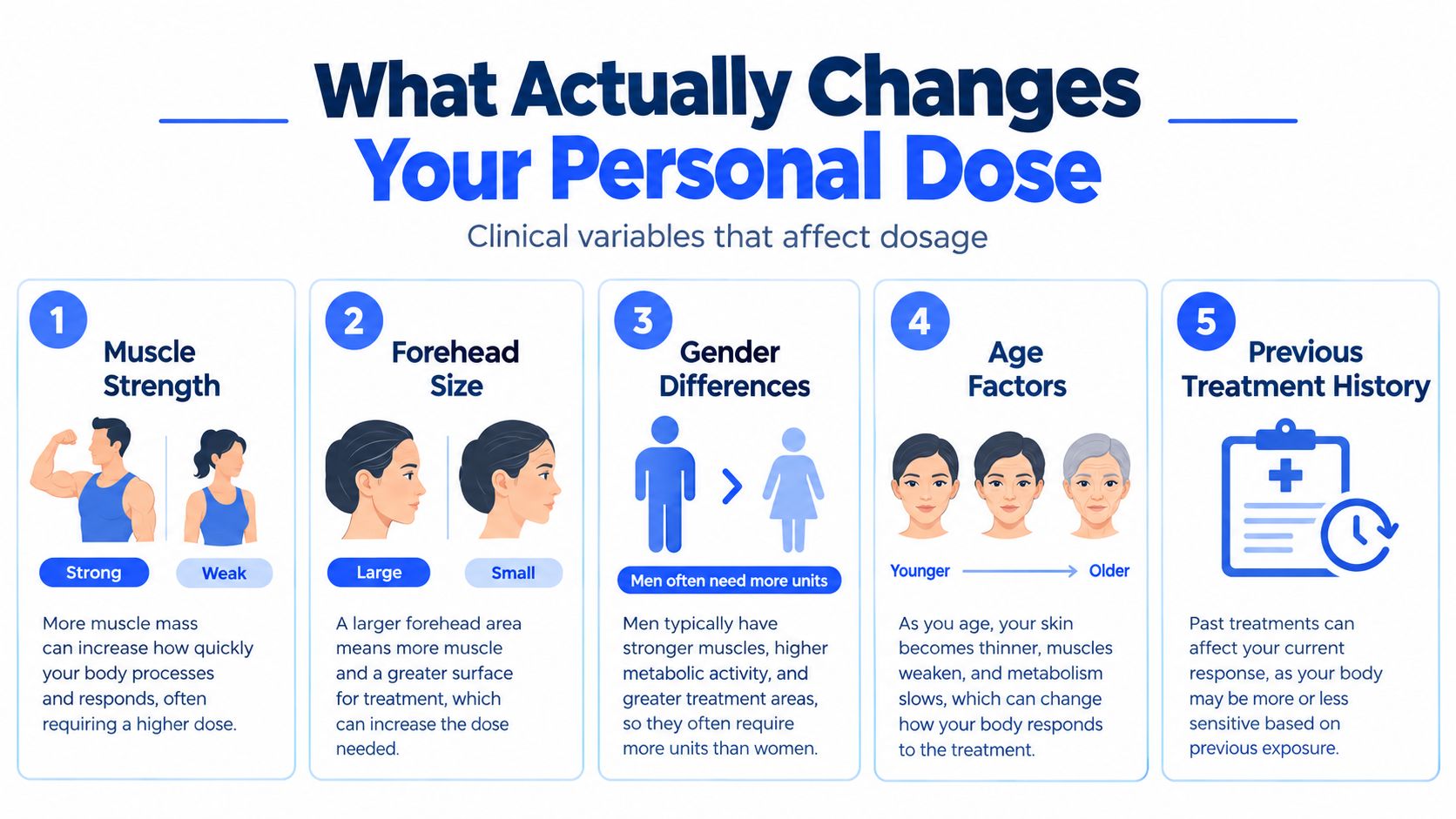
Muscle strength is one of the clearest variables. A strong frontalis can create prominent movement and may require a different distribution from a weaker muscle. Forehead size also matters because the injector must assess how widely the muscle works and where the horizontal lines form.
Sex-related differences in muscle mass can influence typical dosing patterns, which is why clinical references often show different ranges for women and men. That distinction is only a starting point. A smaller, muscular woman and a leaner man with mild frontalis activity shouldn't be assigned a dose from a demographic category alone.
Brow position changes the risk calculation
Look at the brows at rest before deciding how aggressively to relax the forehead. Patients with low brows, hooded lids, or a history of using their forehead to lift the brows may depend on frontalis activity more than they realize. Weakening that support can make the upper face feel heavier.
Asymmetry deserves equal attention. If one side lifts more strongly or one brow naturally sits higher, identical placement and dosing may not create a balanced result. Prior toxin treatment adds another variable because muscles may respond differently after repeated exposure, and the injector needs to know what worked, what felt heavy, and how long the result lasted.
Your desired expression is part of the prescription
A patient seeking gentle softening isn't asking for the same result as someone who wants minimal forehead movement. I might assess two people with equally visible lines and recommend different plans because one wants to keep an expressive brow and the other prefers a smoother, quieter forehead. The dose should serve that preference while respecting brow mechanics.
The 20-unit labeled figure assumes a defined protocol. Your treatment plan must respond to the person in front of the injector, not just the line severity visible in a photograph.
Why Treating the Forehead Without the Glabella Is Risky
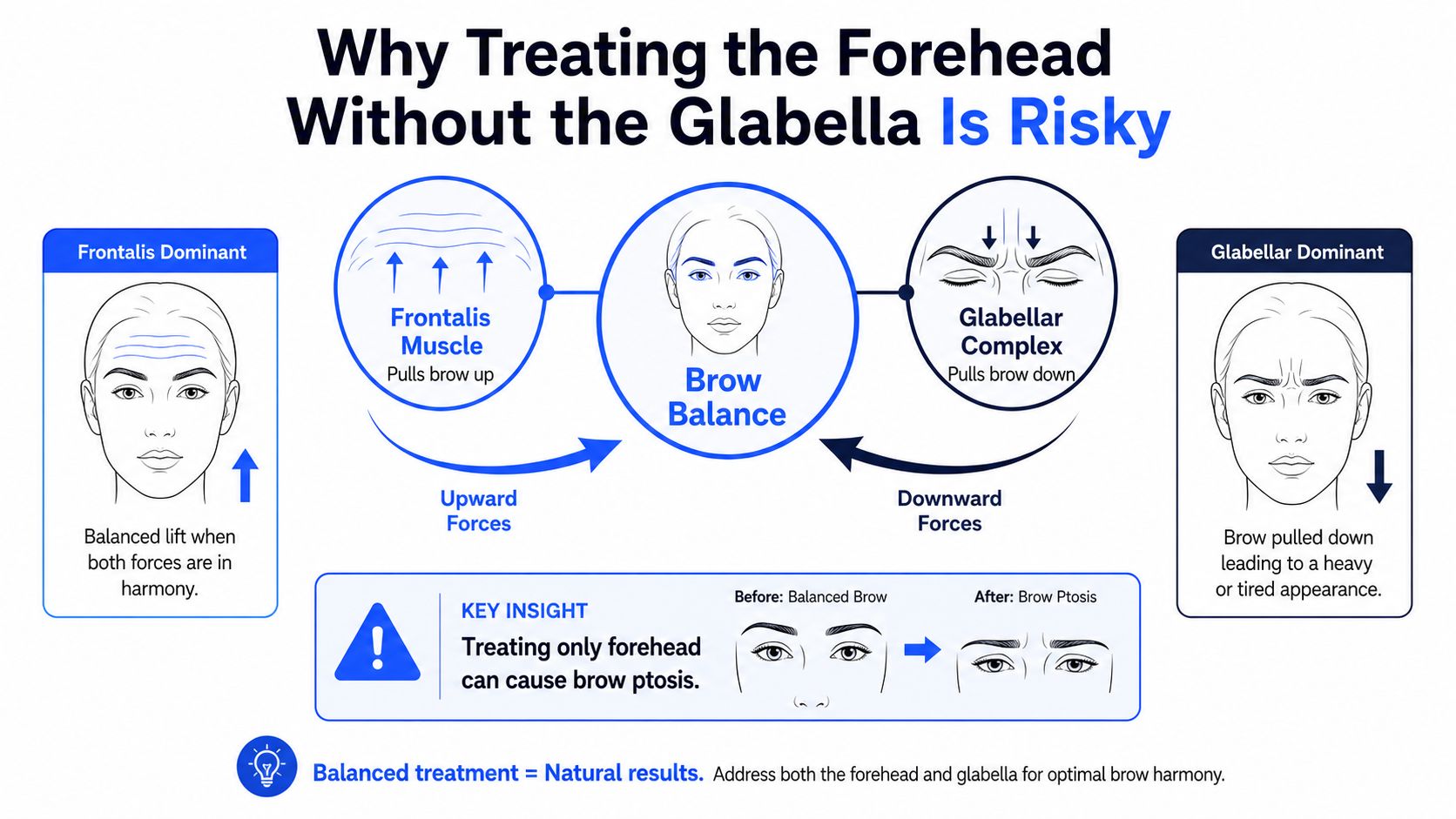
The forehead may look like one treatment zone, but its muscles don't work alone. The frontalis lifts the brows, while the glabellar complex helps pull them downward. When an injector weakens the frontalis without considering the depressor muscles, the brow can lose some of its upward support.
That doesn't mean every patient automatically needs identical treatment in both areas. It means the provider should evaluate the upper face as a connected system. The FDA-labeled protocol recommends treating forehead lines in conjunction with glabellar lines, using 20 forehead units and 20 glabellar units for a 40-unit combined session. The purpose is not just to increase the total. It's to manage the balance that influences brow position. ProMD Health's guidance on eliminating frown lines provides additional context for why the glabellar region belongs in the conversation.
The better question is about upper-face balance
Patients often ask, “Can I just treat the horizontal lines?” Sometimes the answer is yes, but only after the injector assesses brow position, glabellar strength, eyelid heaviness, and compensatory movement. A forehead-only plan may be reasonable for a carefully selected patient, yet it shouldn't be treated as the default without anatomical reasoning.
The practical reframing is this: How much neuromodulator can soften the forehead while keeping the brow where it belongs? Experienced injectors answer that question by observing movement, not by applying a fixed package to every face.
Safety, Placement, and the Side Effects Dose Can Cause
Units matter, but placement can determine whether those units produce a balanced result. NIH guidance generally places forehead injections at least 1.5 cm above the superior orbital rim, with mid-to-upper frontalis placement considered less likely to contribute to brow or eyelid ptosis. The NIH clinical reference explains forehead anatomy, placement, and complications.
Reported complications include bruising, asymmetry, headache, and brow or eyelid ptosis. The cited reference reports ptosis in 0.59% of patients, while bruising is commonly reported. That percentage describes a reported clinical complication rate, not a guarantee for an individual patient. Your risk can change with anatomy, injection placement, prior treatment response, and the skill of the injector.
Patients who deserve a conservative plan
An experienced provider should slow down and assess carefully if you have:
- Low brows: Weakening the frontalis may reduce the support that helps maintain brow height.
- Hooded lids: Existing upper-lid heaviness can become more noticeable after excessive relaxation.
- Compensatory forehead lifting: The forehead may be working to keep the eyes feeling open.
- Marked asymmetry: Identical treatment on both sides may not produce symmetry.
- Prior drooping: A previous episode should influence both placement and dosing.
A smaller dose doesn't eliminate risk, and a larger dose doesn't guarantee a smoother result. Good technique includes mapping the treatment area, respecting the orbital rim, and planning for how the product may affect nearby movement. Providers pursuing education in this area can browse toxin-related CE topics for broader clinical learning.
Static lines need realistic expectations
Botox primarily reduces dynamic wrinkles, the lines created or deepened by muscle movement. It may soften etched lines over time, but it won't necessarily erase a crease that remains visible when the face is completely relaxed. Increasing the dose to chase a static line can create unwanted heaviness without solving the underlying skin change.
For a patient-facing overview of technique, candidacy, and aftercare, ProMD Health's Botox safety information is a useful starting point. An in-person assessment remains essential before treatment.
What to Bring to Your Injector Consultation
A productive consultation starts with information that changes the clinical decision. Bring the name of any previous neuromodulator, the approximate treatment date, the areas treated, and what happened afterward. Tell the injector whether your brows felt heavy, whether one side dropped, and whether you want a relaxed forehead or visible expression.
Your preferences deserve specific language. “Natural” can mean different things to different patients, so explain whether you want movement preserved, lines softened only when your face is at rest, or a stronger reduction in expression. If you raise your brows to keep your eyes open, mention it directly rather than assuming the injector will infer why.
Questions that reveal a thoughtful plan
Ask:
- How did you choose this dose? The answer should refer to your muscle activity, forehead size, brow position, and goals.
- Are you treating the glabella too? If not, ask how the provider plans to preserve brow balance.
- Would you use a 30-unit or 40-unit combined plan, and why? A peer-reviewed randomized study compared 30 Units with 40 Units for combined forehead and glabellar treatment. The 30-unit plan used 10 forehead units plus 20 glabellar units, while the 40-unit plan used 20 units in each area. Responder rates were higher with 40 Units, and the study reported similar adverse-event rates with a trend toward longer-lasting benefit. Review the randomized study details in PubMed.
- Where will you inject? The provider should explain how placement protects brow and eyelid position.
- When will we reassess? A follow-up plan matters because the final effect isn't judged immediately.
Be cautious with a flat-rate unit bundle that ignores your anatomy, a consultation that never examines brow position, or a provider who promises that more units will automatically produce a better outcome. Those shortcuts miss the central issue, which is balance.
Don't compare products by unit count
Units aren't directly interchangeable across neuromodulators. The American Society of Plastic Surgeons notes that 10 units of Botox Cosmetic or Xeomin may require approximately 20 to 30 units of Dysport for a similar clinical effect in a facial region, and it states that full effects typically become apparent after 7 to 10 days, with results commonly lasting about 3 to 4 months. The ASPS statement explains product-specific units and timing.
If you support clinical comfort planning, you can also browse topical analgesics for clinics as a resource on topical options. For ProMD Health, remember that care follows a cash-pay model, so services aren't covered by insurance. Ask the clinic directly about the current treatment plan and payment details rather than assuming that insurance will reimburse cosmetic neurotoxin treatment.
ProMD Health offers Botox, Dysport, and Daxxify consultations for dynamic forehead lines, with treatment plans based on facial movement, brow position, and your desired level of expression. Visit ProMD Health to explore available locations and schedule an assessment with a qualified injector.